October 09, 2011

Cricket Bat in the Jungle, Batting Wild, Batting Free


On finding a ‘Cricket Bat’ in a Goan jungle, more precisely in the wildlife sanctuary at Mollem.

If you plan on having a ball in the jungle it’d help to have a cricket bat to play the ball with, or better still, have a ball with. You might yet get a pitch to parade your skills on even if it’s a wet one and the soil is loose beneath the surface, and if you’re lucky you can count on a wild bison for a wicket keeper.

It doesn’t matter if the bison cannot collect the ball cleanly, trust its girth to stop some from passing it to the boundary as did Dhoni in the recently concluded Test series between India and England, and life goes on.


Just watch your step if you do not want to sprain your ankle running in. Where Indian Bisons (Indian Gaur) have stepped through they’ve left ample evidence of their weight on the pitch, deep holes where water collects temporarily before seeping into the earth.


And to clear the field a flat batted shot will not do, get under the ball and attempt a skier to clear the trees if you aim to get the ball anywhere, else it’s likely the nearest tree will field the ball long before you’ve completed your bat swing.

For spectators if you’re happy with a Grey Hornbill busy in a fig tree, chattering Flycatchers, Emerald Doves in tree tops, Warblers in thickets, Kingfishers hovering over jungle streams, and Langurs leaping among branches then you’re set for the game, a bee buzzing in your bonnet.

While there’re bees around, there’re no colourful bonnets about to buzz in, unless the colours sported by Bonnet Macaques on their behinds suffices.


However, speaking of colour, there’s plenty around. Winged wonders who’re as exotic as their names would suggest, flit about the field all day, zig zagging like commuters on Mumbai thoroughfares.


Common Map, Common Crow, Common Sailor, Grey Pansy, Grass Yellows, and even a Count you can count on, the Grey Count, among the lesser Commoners who’re no less cheerful or enthusiastic to see you take guard.


Just take care not to swing your bat when one of them is passing by the edge, for there’s just the chance the Hot Spot might awaken that very moment and show up the spot where the wing singed your bat, sending you on your way to the pavilion, except here you’d have to clamber up the rickety steps of a machan to cool your heels, or to the straw hut the forest curator uses to keep an eye on the grass plot maintained for the Indian Bisons in the wildlife sanctuary, not unlike the pitch curator who keeps a beady eye on the grassy pitch lest an Indian player, enamoured by the nightlife in town, and having partaken of its spoils the night before staggers onto the grassy pitch before play begins.

Don’t forget to watch the ball as you cream it through. There’s every chance Langurs might decide to swing it right back and there’s no guarantee they’ll be aiming at the stumps, and not you.


If you clear the field, chances are the ball would’ve to lucky to make it through the vegetation, and there’s no knowing who’s lurking in there for, over the years I’ve seen slitherers of ever kind when hiking in these very patches, including Kraits, Cobras, Russell’s Vipers, Saw Scaled Vipers, and Whip Snakes here.

But then fortune favours the brave, so you might as well make a dash for the ball before the vegetation devours it and you’re apprehensive in reaching for it in the thicket harbouring the unknown – a motivation as pressing as any in diving for the ball before it crosses over.

Is there a lesson I see here in including this patch in the fielding drills Duncan Fletcher puts the Indian Cricketers through given how they rolled over and lay supine before the ball ‘died’ on the boundary. I’d assume there is one.

Aha, the thoughts that will flit about a perspiring forehead on spotting a cricket bat in the jungle no sooner had Philip and I spotted it by a freshly made dirt track in the sanctuary.


We found our own cricket bat in the jungle the moment we stepped through a rocky path laced with straggling grass and into the thicket before happening upon a newly laid dirt track along the periphery of the sanctuary that runs by the highway conducting vehicular traffic to Belgaum from Panaji, through Mollem before surmounting the Anmod Ghats and back the same way.


Looking around me I spied ‘seats’ of leaves, likely Teak, arranged neatly in a small clearing set back from the newly minted dirt path, indicating where labourers had settled down for a bit of shade and quiet at lunchtime.

The leaves were yet to lose their colour and elasticity, indicating it wasn’t a long time ago that workers laying the walking path were batting the lose topsoil into place with the stodgy cricket bat that looked like it was hewn from the trunk of a Jackfruit tree or maybe a Mango tree. I couldn’t be sure, just that the weight suggested the possibility.


And the fact that they’d left the bat behind where we found it meant they would return to work on the dirt road some more, it looked like it might need some more of batting the soil layer down before the Sun, assuming it would manage to pierce.

I lifted the solid wooden batter shaped like a cricket bat and swung it in the arcs I used to when I was at school and dreamed of making it big as a batsman. But whacks that life dealt me on the hind quarter with cricket bats of another kind nudged me into batting corporate timelines, with teatime restricted to dip wala chai produced in cheap plastic cups stacked in a corner of a makeshift cafeteria, cups you had to learn to hold lightly between your fingers if you didn’t want to turn them into fountains of steaming tea spouting in your face.


I liked the way the workers had arranged the leaves into a temporary seating. Over time the ‘seats’ would turn to mulch and likely nourish the very tree they came from, not unlike the branches that colourful fungi had made their home on.

In the jungle, the temporary is permanent, and temporariness, enduring.


The number of ‘leaf-seats’ suggested there were no more than four workers involved in laying the jungle path. And if you concede the bisons their right of way, and hence the right to leave their footprints deep in the dirt track there were fewer indentations in the entire stretch of freshly turned over red soil of laterite origin that sloped along to a jungle stream some distance away from where we stood than what you’d find in a foot of city roads in Mumbai.

As Philip and I stepped on the surface, bending to trace the outlines of what appeared to be Bison tracks, I felt the surface needed more of the batting down and baking in the Sun to hold firm if it was to survive more of the monsoons on their way West over the Arabian Sea.

And one Cricket Bat in the jungle, worked by one batter at a time, would not suffice if the surface was to be batted down firmer before the soil dried out. More wooden bats were needed, and more batters to wield them and work the surface.


As Philip and I walked down the incline, binoculars dangling from the neck, I wondered if it wouldn’t help to have the ‘feared’ Indian batting lineup donate their cricket bats for the purpose considering they barely made their effort count on the scoreboard in the recently concluded Test series in England, and given how many were found short on technique in facing the English bowlers would it harm the team to have them assigned to batting down the surface of this jungle trail?

I doubt if it would. If anything it’d give them a better feel of tapping the surface of the pitch with the toe-end of their bats to flatten out unevenness before taking guard at the wicket, that’s assuming they’d be picked up to play for India again.


For Drinks Break they can reach into the crook of a nearby tree for water to quench their thirst. That way they could imbibe some jungle wisdom from the Wisdom Tree.


For a shower, they could make do with the jungle stream that courses by not far from the trail.


And if it turns out the Indian batsmen are no good even at batting down the surface of a jungle trail, then there’s the jungle well to hide them from sight lest they get noticed by the selectors again.

September 27, 2011

The Silent Sentinel


Panaji, Goa. 2011.

In the moment the tide passes
Allowing time a temporary reprieve,
The shoreline reveals its midriff,
As it basks in the rare relief cast its way.

The sentinel’s lights, having fallen silent, pause
As eyes scan the horizon for an anchor.

Finding none to steer their course,
They chart their run along the shore,
Keeping a meandering soul company, and delighting in the colour
His umbrella lends a wistful monsoon sky.

In the moment meandering meets serendipity
Time anchors my wandering feet to the passing moment.


September 14, 2011

Chaltey, Chaltey, Baaton, Baaton Mein


Behind the dwellings and commercial establishments on Nirmal Chandra Street are more dwellings along narrow lanes that convey residents along to their homes. The lanes are wide enough to let two residents pass each other but not if a two-wheeler were to be parked in the way.


From the road there’s little to indicate the layers that wrap neighbourhoods along tight lines, only relieved by brightly painted doors and windows and lanes sectioning them into blocks while cutting through the neighbourhood.


Into one such neighbourhoood we had sallied forth on a winter morning in Kolkata. When we turned left into a lane branching off the Nirmal Chandra Street the Sun had just about managed to rise above the street-facing homes to light up the houses behind, and it was barely an hour shy of noon.


Around a scooter parked in a lane connecting homes, four school going children had gathered, likely discussing their plan for the day off from school. Sundays are unusually quiet in the older parts of Kolkata.


There’re few people about in the morning, and those who’ve stepped out for an errand or accompanying another for public service exams usually conducted on Sundays will meander about or bask in the winter Sun reading newspapers roadside.


In the winter Kolkata embraces the Sun early in the morning. It’s no use turning to the clock to confirm if it’s still night, not when the winter dawn stirs at a time when it’s still night elsewhere. It was the farthest we had traveled east. And it was the earliest we had seen the Sun rising.


Except for men bathing around a water tank on a footpath along the BSNL – Entally Telephone Exchange building, and later around another water tank in Monilal Saha Lane, there were few people about, among them a barber who had set up an impromptu shop at a street corner. Round the corner behind him the street ran empty.


On Sundays the shutters of most shops along the road were still down with a few exceptions like K. C. Mookerjee & Sons. The Iron & Hardware Merchant probably had a tradition dating back from 1836 to keep alive.


Chatterjee Paul & Co. were probably under no such compulsion and it’s likely they dated back just as far back in time as K.C. Mookerjee & Sons did. Alongside Nirmal Chandra Street, Chatterjee Paul & Co. had also listed Wellington Street, the original street name. If anything, mails addressed by the former name would still find its rightful way.


Chatterjee and Mookerjee are Bengali Brahmin names, a formidable community in the Bengali cultural landscape, admired and respected for its contribution to the Arts, as ubiquitous as the famed yellow Ambassador taxis. And like with most non-Bengalis, those from my generation and from the one before were first introduced to the names Chatterjee and Mukherjee courtesy the classics both filmmakers entranced the Indian audience with, their middle of the road cinema tapping into the goodness of India that Indianness is often associated with, or at least used to be.

While Hrishikesh Mukerjee moved the Indian masses with Anand, Chupke Chupke, Gol Maal, Anupama, Abhimaan, Guddi, Khubsoorat, Aashirwad, and Bawarchi, Basu Chatterjee tapped into the everyday India of his time with the timeless films Rajnigandha, Chitchor, Choti Si Baat, Khatta Meetha, Ek Ruka Hua Faisla, and Baaton Baaton Mein among others. Together they defined a culture and froze it for successive generations to tap into while reminding those of their generation of an India of before, of the 1960s, of the 1970s. Their themes move me still, and the songs even more so.

I first imagined Mumbai local trains from Basu Chatterjee’s 1979 hit, Baaton Baaton Mein, and as a kid I actually believed that romances blossom in Bombay local trains after watching the kindly Uncle Tom introduce the Bandra Boy Tony Braganza to Nancy Perreira to the background score of Suniye Kahiye, Kahtey Suntey Baaton Baaton Mein Pyar Ho Jayega as they travel from Bandra to Churchgate on the Western Line. It was not until much later I learnt that the reality of Bombay of my time was very different from that of Basu Chatterji's time when it was still possible to fall in love Kahtey Suntey Baaton Baaton Mein.

It’s a song I never tire of, an imagination I’ve never abandoned, an era I indulge myself in through films of the time, yes, of a time when Nancy’s mother, Rosie Perreira, initially apprehensive of letting Tony marry Nancy since he was earning only Rs. 300/- per month, finally relents to the match upon learning that his pay would increase to Rs. 1,000/- per month after his probation period.

Suniye Kahiye, Kahtey Suntey Baton Baton Mein Mein Pyar Ho Jayega


सुनिए, कहीये
कहते सुनते बातो बातों में, प्यार हो जाएगा

ये पहली नजर का, उफ़ क्या असर है
तुम्हारी कसम डगमगाए से हम है
नहीं जिस पे काबू, ये हैं कैसा जादू
मेरे लिए तो, सच भी भरम है

घटा, चाँद, बिजली, बरखा, पवन में
शामिल हो तुम मेरी हर कल्पना में
तारीफ़ मेरी इतनी करो ना
उड़ने लगू मैं, कही आसमां में

तुम्हारी अदा है, वो सब से जुदा है
चाहा हैं तुम को इसी वास्ते
हम बेखबर है, तुम बेसबर हो
उस पे हैं देखो नए रास्ते


It’s perhaps indicative, and maybe even instructive, of the streets and the city of how signboards will sometimes chaltey, chaltey remind the traveller of an entirely different context and baaton baaton mein hee transport the meanderer back in time, to once familiar signposts.

September 01, 2011

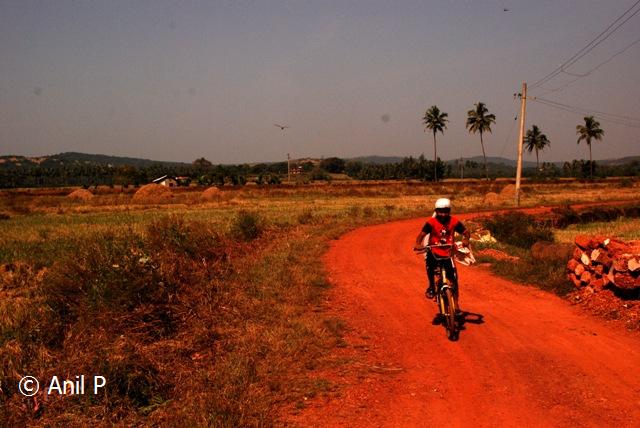
Down The Dirt Road


Boy Riding A Bicycle

Goa, 2008.


From the house in the shade of trees,
A little boy in red cycled down the winding dirt road.
Past harvested fields and coconut trees he rode
Clasping an empty bag against the handle,
As he flew down the stretch.
With the loose end of his bandana bouncing behind him,
He pedaled furiously and was soon upon us.

But before I could ask him
What it was his mother had sent him out on an errand for,
He curved past me before turning into a blur on the road
We had ridden along on our way to the river Zuari.

When you’re young and raring, any road will do.
And freedom is pedals under your feet,
A set of wheels at your command,
And an excuse to hit the road away from home.


August 31, 2011

Jama Masjid On Eid Eve In Mumbai


After an early dinner of Surti Thali for Rs. 80/- each at Hotel Surti located at the intersection of the Bhuleshwar Road and the Kalbadevi Road we crossed the crowded intersection and entered the Sheikh Memon Street in a blaze of lights streaming out of shops on either side of the street, the displays of jewellery in the Zaveri Bazaar enticing shoppers rivaling the bustle of the street on the eve of Eid-ul-Fitr as we made for the Jama Masjid in Bhuleshwar, among the oldest mosques in Mumbai.

The Bhuleshwar Road terminates at Sheikh Memon Street while the Kalbadevi Road continues to Metro Cinema adjoining Dhobitalao and across the road from Jer Mahal near St. Xavier College.


As dusk fell, the lighted minarets of the Jama Masjid towered over assorted shops shining brightly, among them the diamond and gold merchants of Zaveri Bazaar on Sheikh Memon Street. Past Tribhovandas Bhimji Zaveri, among India’s best known and biggest jewelry retailers besides being a trusted name in the jewelry business in India, the minaret grew larger, its features now clearly visible in the lights illuminating it.


Mumbai’s Jama Masjid is contrary to what one might expect. From the street there’s no flight of steps leading to an open courtyard fronting the mosque and reached form three sides like it’s with the Jama Masjid in Delhi. Instead Mumbai’s Jama Masjid is a quadrangular building enclosed by buildings opening into the streets.


Hidden from view of the street, an ancient tank lies behind a gate on the eastern entrance of the mosque and is approached past a courtyard behind the arched entrance opening onto the street.

The Jama Masjid was completed in 1802 after a Konkani Muslim merchant consented to its construction on his land in about 1775 provided the ancient tank located in what was formerly a garden was preserved intact. From this ancient water tank rise arches that support the mosque.

The Jama Masjid is located opposite Mangaldas Market at the intersection of the Sheikh Memon Street with the Princess Street and the Janjikar Street. The Crawford Market.is located to the south-east of where the Sheikh Memon Street terminates.


Looking up from the street, with my back to street vendors jostling for customers thronging the shops on either side of the Sheikh Memon Street, the Jama Masjid arrays in a series of angled terraces and balconies distinguished by decorative features. Strategically placed lights highlighted the features in the glow of the bustling night market. The domes of the mosque merged with the night.


The Jama Masjid extended the luminescence of Mumbai’s night street to the skies above.


In another time and context the towering minarets of the 19th century masjid might’ve been an extension of the sparkling jewelry in shop windows but today the minarets pushed against overcast skies under the watchful eyes of the Mumbai Police manning the barricades to the congested lanes while camped by patrol vehicles off the entrance to the Jama Masjid.

These are no normal times.


As the month-long dawn to dusk fasting in the month of Ramzan (Ramadan) drew to a close, Mumbai’s Muslim community thronged the markets largely around Pydhonie, Bhuleshwar, and along the Mohammed Ali Road and Crawford Market for last minute shopping on the eve of Eid-ul-Fitr before feasts and festivities kick off on Eid tomorrow. Clothes, bangles, and shoes, including false eye-lashes among other things flew off the shelves.


August 26, 2011

On The Road From Bharatpur To Deeg


Deeg was not on the cards originally, not until we found we had time to spare in Bharatpur on a warm summer day in March some years ago.


Approaching noon, Tom and Anne had gone in search of the Indian Courser the bird-watching guide had promised to show them, disappearing from view along a rutted path that led off the narrow road meandering through the bird sanctuary while we waited under a Peepal tree watching a Tree Pie, its distinctive whites on the tail having betrayed its presence in the lush foliage it shared with a noisy Jungle Babbler unhappy at being abandoned by its six sisters, and an inquisitive Red Vented Bulbul that would turn its head at an impossible angle from time to time to ensure we were up to no mischief, straightening up each time I caught its eye accusingly.

The birds of Bharatpur, I would soon learn, left nothing to chance. With water scarce they could be excused their discretion.


Upon returning to the hotel for lunch halfway through the day following a fulfilling bird-watching trail in the Bharatpur Bird Sanctuary it was suggested we try Deeg, the former capital of the Jat kings of the Bharatpur princely state, and under an hour’s drive from Bharatpur along the way to Alwar in Rajasthan.


On learning the palace at Deeg was worth going miles to see, we needed no further convincing and braced for the bumpy ride to Deeg, a little over 35 kms. away.

The road to Alwar cut through open fields, the landscape alternating between the green of standing crop, the driver pointing them out to be Sarson, and the grey of tilled earth awaiting sowing or one recently harvested.

“The Kharif season is a particularly busy time,” the driver explained, his eyes peeled out for tractors laden with sacks of potatoes rumbling past. “Typically Bajra, Jowar, Udad, Til, Moong, Chaura, and Makkai are planted in the Kharif season, though Makkai is not as favoured as the rest.


We passed more tractors ferrying potatoes piled high, often hearing them before they rumbled into view.

Rabi usually sees Sarson planted though some farmers will plant potatoes and wheat while others will plant Masoor Dal.”


The number of tractors, and trucks transporting potatoes, a long line queuing up outside a storage facility in one particular instance, suggested that potatoes vied with Sarson as the preferred Rabi crop. The distinctive yellow flowers of the Sarson Ka crop lent the ubiquitous green a dash of sprite.

“Along with Sarson, farmers will plant green peas, and Chana, crops that need less water, requiring watering a mere 4-5 times. And usually it rains that much in the winter anyway,” he concluded.


The road to Deeg saw little traffic, made up almost entirely of tractors and trucks ferrying potatoes, and camels carting cattle feed along, their bulging loads chaffing under invisible constraints, inflating the bulbous loads further until the cart-load of feed swelled like a humungous water belly.


The camels nevertheless carried on gamely.


The fields were set back from the road but not by much. If farmers were working the fields they were not easily visible from the road.


However, at many places the fields were dotted by dried dung cakes arranged in circular piles raised waist high, sometimes higher.


The dung cakes the women were stacking high were relatively large compared to those one might see stacked up roadside in Maharashtra or Karnataka, and interestingly they were usually accompanied by kraal-like circular straw structures with tapering roofs fashioned like a toupee using what appeared to be bamboo shoots strung together and covered in dried straw.


Not all roofs tapered, some were rounded, resembling split coconut shells upturned on the floor. Likewise, the shoots strung and strengthened using dung plaster were used in raising the circular walls where bricks were not used for the purpose.


On the roads in the north of India, no driving experience is complete without drivers astride the jugaad smiling and waving out to inquisitive travellers fairly half-way out the window at their first unexpected encounter with the jugaad, that signature improvisation of the pumpset engine, or the one sourced from a 350 CC Royal Enfield Bullet, and fashioned with wheels and a carriage hammered together at a local garage to transport villagers between population centers, its exposed entrails adding to its aura.

We passed many jugaads on our way to Deeg, and I cannot remember seeing any sporting a number plate. A sleeker alternative would've stuck out like a sore thumb in the rugged landscape.

Deeg lay ahead as the heritage of the Jats, and a chapter from India’s history, beckoned.

I lay back in the seat and watched the landscape saunter by as the road slipped between the wheels ever so slowly.


Related Links:

1. Bharatpur's Wandering Waterhen.

August 18, 2011

What Elephants Eat, Dogs Don’t


But What Human Beings Eat, Dogs Eat Too.

So, I could understand what these three dogs were hoping for when they lined up in front of this lady at the Dubare Elephant Camp on the river Cauvery in Coorg.

And each time she laid her hand into the food she had bunched up in a piece of paper, the three dogs stiffened up as if preparation to race each other for the morsel the moment she cast it in their direction. They held their ground, unmoving, concentrating on her every moment as she tucked into the goodies, oblivious to the enquiring presence of three hungry dogs.

And each time she brought her hand to her mouth to polish off a mouthful of food, six alert ears straightened up even further as if to make certain she was prepared to eat it and wouldn’t spit some their way.

And when they heard her munch on the food, the six ears relaxed just a wee bit before the trio cocked their faces to one side, eyes alert, as if to say “Really, you didn’t throw us some!”, not that they saw anything differently from an angle but probably in disbelief that nothing came their way.

And so they waited, and waited, and waited, without luck. For all the lady knew, they didn’t exist. That must be some hunger, I thought, to feel nothing about six eyes watching your every move and not acknowledge their presence in any way let alone share some of it for, this was no ordinary place where they could move on and find a shop to wait by where people stepped up to buy food and hopefully share with them some. This was nearly in the middle of nowhere, bounded by the river at one end, and a forest on the other, with life limited to housing quarters for the forest staff.

Nevertheless I understood why the dogs waited out their time at the lady’s feet as she tucked in her food.

Because What Human Beings Eat, Dogs Eat Too. At least most things, that is.


But What Elephants Eat, Dogs Don’t Eat. At least most things, that is. Surely not, Ragi balls.


So it was all the more reason why I was mighty surprised to find this dog below waiting in front of the elephant as it fed at its eating place.

Because What Elephants Eat, Dogs Don’t.


Ekdantha, or The Single Toothed One, was done with his bath in the river, and it was time for his breakfast of jaggery, and Ragi balls at the feeding area.


He stood still as the mahout fed him jaggery, and later allowed visitors to feed him some, including the large Ragi balls.

And in all that time, the dog stood to attention as Ekdantha ate his breakfast, reaching with his trunk for Ragi balls while lifting it to open his mouth for chunks of jaggery.

What was she thinking wanting to share in the elephant’s breakfast! Not surprisingly, nothing came her way.

Maybe Ekdantha knew that dogs don’t eat what he does, and hence didn’t throw any morsel her way.

Now that would be something.

This wise old dog below stood in silence, gazing at the river, or across it. I couldn’t tell for sure. But he neither waited in hope in front of human beings nor in front of elephants. Only hopeful of somehow finding his way across the river someday so he could have more options to try his luck with finding food.


Now that’s something to wait for and be hopeful about. After all, wisdom from age teaches one of the things to choose to wait for, and the things to be hopeful about.


Interviewed on BlogAdda: In the PART I of my interview they published today, I talk of my early influences in the context of travelling, the move to Mumbai from Goa, my reasons for starting blogging, the story behind the name: Windy Skies, and much more. It's a privilege to be featured by them, and has been a pleasure answering their questions.

Click to read PART I of my interview. Any feedback on the interview you might want to share, bouquets or brickbats, I’d be more than happy to see it on the BlogAdda interview page, and hopefully here as well.

PART II of the interview will be featured the next week. Thanks for reading, and for reading this space all these years.