November 16, 2012

Gauri – Ganesh Visarjan, Day 5 Of Ganesh Chaturthi


I position myself roadside, out of the way of crowds streaming toward the lake, the men bearing Ganapati idols, and women, Gauri idols. Men carrying Ganapati outnumber women carrying Gauri. It is day five of Ganesh Chaturthi celebrations.
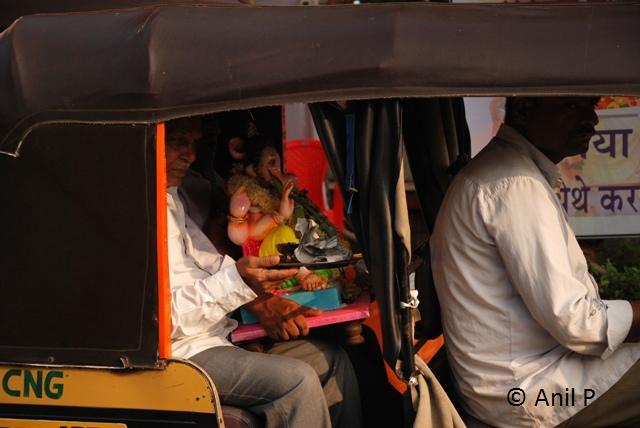


The police have blocked off the approach to the lake for regular traffic, only letting in rickshaws or tempos bearing devotees carrying Ganapati idols that come to a stop at the entrance to the lake.


Families get off. The head of the family, a male, carries the Ganapati idol resting against his chest before placing the colourful idol on a retaining wall surrounding the lake. Chants of Ganapati Bappa Moraya rend the air.


There, they perform puja and offer prayers before carrying them to a makeshift barricade where bare-feet workers wearing saffron t-shirts with the name of patrons prominently displayed on the back carry the Ganapati idols to a waiting boat fitted with an outboard motor.


In no time the makeshift platform is occupied by Ganapati idols placed by their bearers to be taken out to the boat by local youth. An official, possibly from the fire brigade detachment positioned for rescue operations should any mishap occur, warned the boat-bearers in saffron t-shirts against coming drunk on duty, telling them they can do so once they're done with loading the boats, implying it would hurt religious sentiments of devotees to see their beloved deity handled by drunk bearers.

Yet, one of the bearers smelled heavily of alcohol. It takes all kinds to pull off a festival on the scale Mumbai hosts it.


Once the boat is loaded with Ganapati idols and a few devotees who want to do or see the immersion themselves, it motors out to the middle of the lake.


I watch women in sari walk with large Gauri idols balanced on their head, accompanied by more women, among them their neighbours and relatives.


Ganapati idols outnumber Gauri idols 10 to 1. The sight of women bearing Gauri idols during Ganesh Chaturthi is heartening, indicative of responsibility equated in matters divine. All around me are excited voices. They mingle with invocations to Ganapati, and sounds of cymbals.
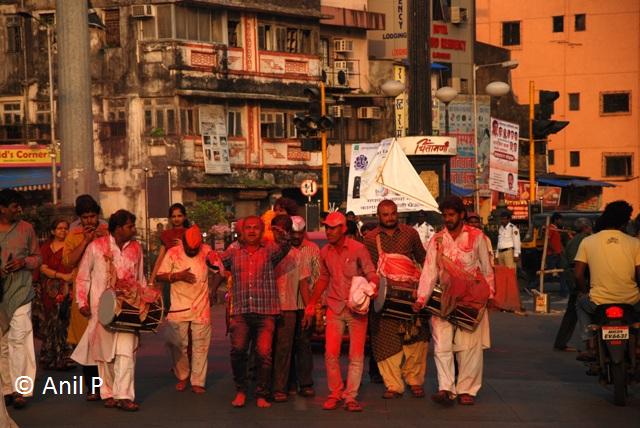

Ganesh Chaturthi can be a noisy affair. Vibrant and noisy. Among them the Sonar family who accompanied the deity with much pomp and colour. All eyes turned to the riotous procession drumming their way along.

~

For eleven days Ganesha reigns supreme except day five when he has to share the spotlight with his mother, Gauri as Parvati is popularly known in Maharashtra, and elsewhere.


At the best of times the Mumbai street is crowded, leaving little latitude whatsoever to manoeuvre your way about. 


Come Ganesh Chaturthi, especially the main Ganesh Visarjan (Immersion) days – Day 2, Day 5, and Day 11, the streets leading to lakes, wells and the sea (Girgaum and Juhu) are impassable as traffic shares roads with the loveable deity being borne to the water in a steady stream of families making their way to the numerous immersion locations around the city.


Newspapers publish in advance the routes rearranged by Traffic Police. And I’ve little doubt that it’s one of the most widely read sections. No one fancies being caught up in temporary dead-ends that seem anything but temporary once stuck in it for hours on end.


Drums and occasionally trumpets accompany the rotund elephant-headed deity to his watery abode, families seeing him off with affection. 


Hundreds of Ganesha idols make their way to the water. In the evening all the roads leading to immersion spots turn into a sea of colour. Soon boats ready to carry their esteemed 'passengers' to their resting place, a time of much emotion and sadness.


Those who cannot muster music along for want of people to accompany them or lack instruments, will hire brass bands to do it for them.


On immersion days, the Brass Band will be rolled out with smartly dressed musicians bringing up the procession.

It repeats year after year.  


It’s only on the fifth day that Lord Ganesh is not on his own instead sharing the spotlight with his mother, Gauri, as she accompanies him to the immersion place to be immersed herself.


However, not every Ganapati is accompanied by Gauri, only those who’ve installed Gauri idols in their homes alongside Ganapati will carry them both else Ganesha makes his journey alone even if he shares the cart with Gauri, both emerging from different homes.


Likewise, families who’ve only installed Gauri idols will carry Gauri to the immersion point all by herself. The absence of Gauri idols in Hindu households does not mean she’s not worshipped, she is, since Gauri Puja is an important and integral aspect of Ganesh Chaturthi celebrations, except they’ll use more traditional forms of representing Gauri – small earthen pots my mum said used to be painted over with fighres of Lakshmi, Shanka (shell), Chakra (wheel), Tulsi Vrindavana, and a Cow with a calf.

Now she says, copper vessels are readily available with these signs engraved on it. Some use silver vessels for the same purpose, all so as to avoid the ‘hassle’ of finding an earthen pot in urban centres and possibly the lack of immersion points within easy access.


Men carry Ganapati, and women, Gauri.

Women bearing Gauri idols for immersion on day five of Ganesh Chaturthi is not as common elsewhere as it’s in Maharashtra. While Gauri Puja is a thread that binds Hindu womenfolk across India, carrying Gauri idols for immersion is not as prevalent elsewhere.

~

She further says, ‘Mysore-side, she’s known as swarna Gauri and is installed a day before Ganapati is installed.’

‘Elsewhere in Karnataka, she’s celebrated as Jyesta Gauri, also revered as Lakshmi, and installed on Anuradha Nakshatra which appears on the second day of the commencement of Ganesh Chaturthi, sometimes on the third day.’ Gauri Puja ritual is interesting.

‘Rice is placed in the copper vessel with the five signs, some will use wheat depending upon what’s staple for the region or the household in question.’


‘Once the Puja is done on the third day following Gauri installation, the rice or wheat as the case may be is removed from the vessel before the Mula Nakshatra goes away and is made into payasam or payasa. Unlike rice that can be boiled and made into payasam, the wheat needs to be ground before it’s mixed with milk and made into payasam.

I grew up seeing Gauri Puja performed at home. Unlike Ganapati where the entire family is involved right from the time decorations commence to his immersion, Gauri Puja is primarily driven by the women of the house.

She tells me the thread is placed in the vessel, and as with rice or wheat offerings, it’s removed from the vessel upon deinstallation and worn on the wrist or around the neck until the day before Dussehra when it’s removed and buried in the earth around the Lakshmi pole.

‘In some regions, women remove the thread on the full moon (Purnima) after Dussehra. An alternative is to cast it in the river to avoid it channelled out along with garbage.’

In older days she remembers seeing Brahmins going house to house, Brahmin homes, selling thread made from cotton. ‘Thread offered up to Gauri during Gauri Puja would be made of 16 strands. A second 16-strand thread, or a third depending upon the number of married women in the family, would be similarly offered during puja to be worn by the women either around the neck or on the wrist once the puja was done and Gauri de-installed.

The thread is made wet, applied with haldi (turmeric) and Kum Kum (vermillion) and placed in the vessel for the duration Gauri remains installed. In instances where married relatives elsewhere are unable to perform Gauri Puja then a 16-strand thread would be dutifully placed for consecration on their behalf and mailed by envelope to their address.’

I distinctly remember this as I would carry the envelope with its distinct haldi strains to the post office and mail it out. Other times the postman would bear an envelope home and opening it Mum would extract the thread.

Seeing haldi now evokes many different memories and times.


October 31, 2012

Meandering Among Ruins And Memories In Bijapur


A snake lay flattened on the road. Using a stick I found in the brush roadside I turned it over to see if I could identify it. I couldn’t. It was flattened to its skin, scattering scales around, making identification ever more difficult more so since I’m no expert on snakes.

Ahead, the Ring Road sloped and ran straight before curving out of sight; later in the day we would ride it on our way to Torvi, past Navraspur. Trucks droned up the incline, shattering the silence in the countryside that’s gradually losing its quiet and open expanse to an expanding population radiating outward of the city centre – Bijapur.


I stepped past the twisted figure, a sign of a last act of desperation as it drew its body close upon suffering the first impact before suffering another, and another. Time came at it like a sledgehammer practicing its blows. In its death it had frozen its attempt at clinging on to life.


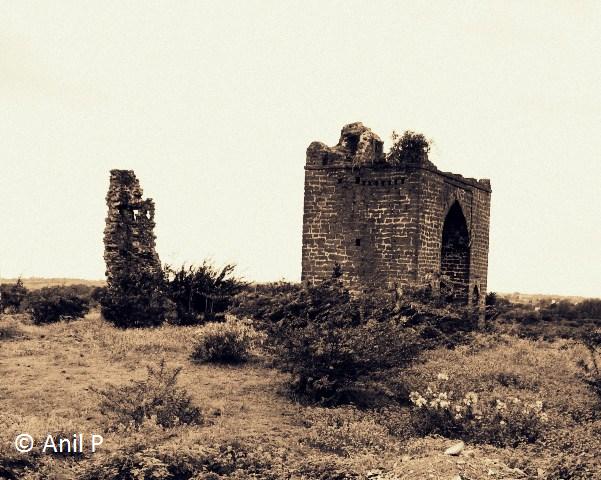
Crunching gravel we walked to remnants of an old stone structure a little distance away, an imposing stone gate that stood all by itself.


To the left of the gate a crumbling edifice stood unsteadily, likely a remnant of a wall that extended from the gate. Very little remains of it to help identify its function positively. The structure of the gate itself has survived well with the exception of battlements surmounting its roof.

I wonder if the rooftop battlements, of which only a hint now remains in the surviving embrasure to one corner of the roof, were merely decorative elements or formed a part of an active defensive line extending along walls from the gate, guarding its approach. Grass spouts through the lone crenel, obscuring it to all but a persistent eye. I notice a crumbling fortification at the same rooftop corner as the surviving battlement. A turret? A resting place? A control room? I cannot tell for sure.

Wildflowers grew among thorny bushes, relieving the stark landscape that stretched flat northward. The great plains of the Deccan stretch a long way. Winds play in the open expanse, winds so strong they'll knock the unwary off their footing.  


Bijapur is a city of monuments, in ruins or otherwise, together stringing a history under Muslim rule that was both bloody and uplifting. The city itself traces its pre-Islamic history to the reign of the Hindu Chalukyas, the Yadavas, and the Sangamas of Vijayanagara before Islamic invaders took the sword to them.


The old, arched stone gate rose high over me. I walked through it not knowing if I was entering the gate or exiting it as I made for a mound past it, but most likely exiting it. From the mound I hoped to get a better view of the Bijapur countryside that lay not far from my cycling route from years ago. A masjid, visible through the gate, stood on rocky ground a little distance away.

Madhav and I were on our way to Navraspur, and beyond, to the temple at Torvi, a permanent fixture on my periodic visits to this part of Karnataka, a ride I hoped would relive memories from long, long ago for, finding myself in Bijapur during vacations from school I would mount VRN’s bicycle and head out on the NH 12, better known as Athani Road, for Torvi over six kms. away.

VRN has since passed on to the great beyond, and the city I first experienced as a toddler clinging on to his cycle’s handlebars, legs crossed under me as I tagged along with him around the city, one that I can no longer imagine without its association with VRN survives to tell its tales in the many monuments in disrepair within its fort walls and outside, the latter in the general direction of Navraspur, structures that were at one time likely a part of a grand design Ibrahim Adil Shah II sought to construct at Torvi after removing his seat of governance in 1604 from the citadel in the old city to new fortifications underway around Navraspur and Torvi. Among others they included palaces, and water tanks that were as much architectural marvels as they were lifelines supplying Bijapur, and the ill fated new city, with water.

Only the new plan never saw fruition, the new seat of governance near Torvi was razed to the ground and plundered by Malik Ambar in 1621 A.D. Abandoned, the seat of governance returned to Bijapur’s old citadel never to leave it again. Ibrahim Adil Shah II died soon after.
~

It is September; the sparse rains that come Bijapur’s way in the north of Karnataka have given way to clouds marching in the sky, turning the light a heavy shade of gray, and the atmosphere, sombre.


Rather than continue to Navraspur and Torvi on Athani Road (NH 12) straight west that goes on to Belgaum via Athani, Madhav and I turned off it, onto Solapur Road after taking a right soon after the road breaches the Adil Shahi era fort near the bastion named Sherza-i-Buruj (Lion Tower) where the medieval monster of a canon, the 55 ton Malik-e-Maidan (Lord of the Plains), sits in splendid isolation, pointing West at the horizon from whence Bijapur’s enemies once threatened it.


The canon, a star attraction with locals and visitors alike, was a war trophy carted back to Bijapur by Ali Adil Shah after vanquishing Nizam Shah in 1562. At over 4 and ½ metres, the Malik-e-Maidan is said to be the largest battlefield bell metal armament ever cast in its time by Muhammad Bin Husain Rumi in 1549 AD in Ahmednagar as noted by an inscription on the canon.


If not for the railing fencing off the viewing enclosure I’ve little doubt that inquisitive visitors would attempt to slide down its barrel, comfortably fitting into the opening 1 and ½ metres wide.

Its sheer bulk weighing in at a staggering 55 tons is said to be the key reason why the British did not steal it out of India as booty given the cost of transporting it to the coast after first considering sending it to the King of England in 1823. It was just too big a loot to carry, else like with other loot gracing British Museums, the Malik-e-Maidan would’ve likely occupied a corner in a far removed from the landscape.


Leaving Athani Road (NH 12) after taking a right turn, we rode along Solapur Road before turning off it, onto Jatt Road, riding past Darga Jail, Khwaja Ameenuddin Chisti’s Dargah, and Phani Parshwanath Jain temple, eventually joining the Ring Road near where the snake lay flattened.

The Ring Road circles back to Athani Road shortly before Navraspur; Torvi lies a short distance further on. Over the years, I’ve ridden both, the Athani Road and Solapur Road out of Bijapur on my way to Belgaum, and occasionally Solapur. In daytime, early morning to be precise, the Deccan landscape makes for a pleasing ride.  

The customary ride to Torvi is as much a homage of sorts to the rite of passage that cycling from the city centre to the then sleepy village six kms away once was as it is a tradition for, the Narasimha temple built underground and to reach which one has to navigate a short dark passage chanting “Hadhey, Hadhey” is of particular significance to my family, and hence to me. My mother would never fail to remind me to chant “Hadhey, Hadhey” (make way, make way) as we negotiated the underground passage that leads to the sanctum sanctorum.    

On my way to Torvi astride VRN’s bicycle, the Atlas type, I would pause on rutted roads that ran past views similar to that in the picture above, wondering about them.

There was little or nothing to identify their origins except they were a permanent fixture in the landscape from as long back as anyone could remember, atleast among those I ventured out with, Jai among others. The mullahs with their thick black beards extending at an angle from large jaws set off by piercing black eyes were a tad intimidating at any rate and as a kid I knew better than to tangle with their lot, helped no doubt by several intimidating experiences in the community they served and lived.


I wondered after the purpose of the gate towering before me. Madhav meandered around it. Two women sat in front of a disused masjid on a mild elevation a little distance away, muslim women tending goats foraging in the brush around. 


On a subsequent visit a year later, again with Madhav, passing cowherds would identify the masjid for me as Dharyali masjid.

“It’s no longer used now,” one of them would say in a sing song Kannada dialect peculiar to Muslims from North Karnataka.


The same man, pointing his stick to the apparently mysterious gate I now beheld would identify it as Pani Darwaza (Water Gate). “In those days water would flow through it from there,” he said, showing me the path the water took before pointing through the gate, past the Dharyali masjid, to the open expanse behind, indicating the direction from which the water flowed. Further exploration in the direction he pointed out reveals what appears to be remnants of a masonry construction, probably belonging to the reservoir. Again, I cannot be sure if the reservoir brought its retaining walls this close to this gate. A large reservoir once existed at Torvi, of that I'm certain. Maybe it still does.

The gate could not possibly have been built as a conduit for water. As an approach to the reservoir, likely, but surely not as a water channel. It had to be a part of fortifications if not an embellishment.  


There was little to indicate with any clarity except possibly to those who’ve lived there and heard stories passed on from generation to generation.

Behind us, in the general direction from where we came, in a similarly ancient patch of the countryside, a massive stone structure lies in disrepair, figuring in some significant way with water works the Adil Shahi kings effected to supply Bijapur city with water drawn from the reservoir located near Torvi over six kms. away.

On another visit many, many years ago, I had made my way to the abandoned structure, marvelling at its scale and architecture, wandering through it while wondering not so much as to its function of which I was aware but about how it must’ve functioned in its day, and the thought behind its architecture. I wonder still. 


In time the Adil Shahi reign came to be known for innovative engineering to put in place secure water pipelines to supply the city, including underground water channels carved in rock and interspersed with chambers and inspection holes, control towers, water cisterns, wells, ponds, and the many water tanks that dot the city, most notably the Taj Bawdi and Chand Bawdi, each an exercise in lending regal splendour to their purpose, a place to bathe and draw water from, a space to seek respite from the sun.

~

Apparently little has changed in the patch of landscape we had stopped by to wander about. The gate’s arch frames a masjid behind.   

No wall led from the gate. There was nothing to indicate where the gate led in the days gone by except for overgrown thickets crowding tombs and a mosque where men in skull caps sat chatting in a corner.


From the mound we ascended for a better view of the countryside, two more structures revealed themselves a little over fifty yards from the arched gate and Dharyali masjid. One appeared to be a mosque with two minarets, the other, most likely a tomb, or maybe both were tombs though I cannot recollect seeing one with minarets.


Zooming in I could see men in skull caps gathered to one corner of the platform that conveyed a passage around the main chamber walled off on the side facing us.


Two Muslim women emerge from the thickets along a dirt path winding between thorny bushes, past the dilapidated monuments I now viewed through my lens.


For a fair distance to the north, nothing moves. Slowly the landscape converges to a canvas, securing the feelings it invokes, into colours turned sombre from the weight of history and ignominy heaped by an uncaring present.

Except for a wooden triangle with notches I find lying centered on the approach to the arched gate that Madhav said was most likely an implement used in performing Black Magic, one that he forbade me from picking up, there was little sign of life about the place except for a black goat grazing in the thorny shrubs.

It might have as likely been an instrument used in accompanying the dead to their burial places. I cannot be sure except, on my subsequent visit to the same place close to a year later, Madhav and I found two sets of stones heaped on the approach to the arched stone gate in the manner of burial mounds, and were more likely than not  graves of fairly recent origin. Graves at the gate? Whose? Why here?

Bijapur has always posed me more questions than answers, retaining its mystique and mystery in unanswered queries.


Walking back from the arched gate, we continue along the Ring Road and circle back to Athani Road (NH 12) before continuing to Torvi, past Navraspur.

I will tell of Torvi another time.


October 30, 2012

Durga Homebound


Kolkata

With Panchami approaching, artisans ferry Durga out of Kumartuli. A truck awaits the goddess in a nearby street off Rabindra Sarani (formerly Chitpur Road). It will ferry the idol to a Durga Puja pandal in the city where the goddess will be the focus of attention of visitors hopping neighbourhood pandals, each pandal decorated and brilliantly lit to set off the goddess in the night.

September 22, 2012

Sunday Brunch at ITC Grand Central, Mumbai


I find communities interesting not merely for characteristics, cultural, linguistic, racial and other traits that define them and set them apart from other communities, but equally fascinating for the reasons that bring them together. And reasons are many in a country as diverse as India, and more so Mumbai, the very microcosm of India if ever there was one.

Even so when they gather they mostly do so around shared traditions, and customs, each unique to their heritage, religious and geographic, and rarely cutting across communities. 

The only exception that cuts across communities, reaches across neighbourhoods and brings people together in an act of faith that has little or no equal is FOOD.


And the Sunday Brunch at the ITC Grand Central, Mumbai, is well on the way to gaining its own faithful, who will make their way to the Hornby’s Pavilion each Sunday as religiously as they would Sunday Mass or so it seems from the corner we occupied one Sunday not too long ago at the invitation of the ITC Grand Central at their expense.


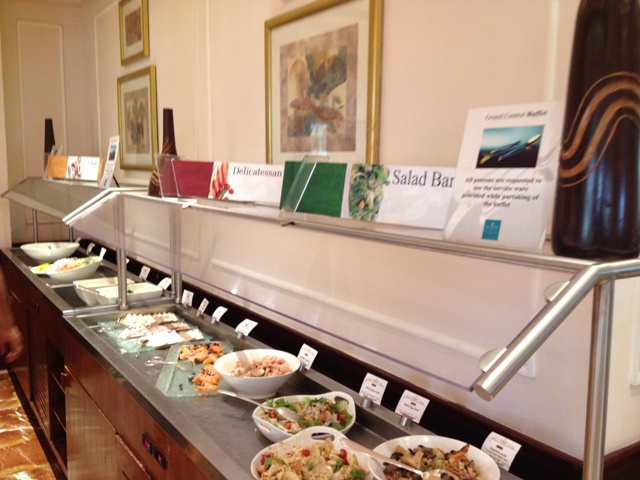
The sheer diversity milling around the hall probably matched the diversity of the spread on offer, ranging from Continental, Italian, Thai, Lebanese, Chinese, and Indian.


As if on cue, the Hornby’s Pavilion began to see footfalls no sooner the clock hand struck noon. The staff  was a blur, moving as if to an unseen conductor; their practised ease indicative of a ritual strengthened over the years. The Sunday Brunch of the ITC Grand Central has been in existence since the time the hotel came up in Parel, formerly the heartland of Mumbai’s Mills.


The regulars, and the not so regular, joined together in a community of common purpose, food. Some smiled at others, acknowledging presence, finding common ground in the spread on offer; others nodded to one another, from familiarity engendered over the years, in time adding to the reasons that bring them dutifully to the hotel. It was a heartening sight, and testimony to what food in expert hands can achieve – a sense of community that answers to a brand.


It is this I thought that probably makes ITC Grand Central’s Sunday Brunch, like I’m sure is the case elsewhere, an event to relish.


It was indeed a lavish spread of live starters namely kebabs and kathis on roll which are accompanied with variety of salads. We equally enjoyed the live counter preparation of Pastas and delicious Risottos. It’s rare to find Risottos being prepared on the spot. It was stirred to perfection giving it a delicious creamy texture. There was shrimp cocktail smoked salmon which everyone is fond off. Buffet had Capers, Grated Egg Yellows and Whites, Diced Tomato and Red Onion, Smoked Fish Spread, Lemon Segments, Dill Scented Cream Cheese and Whipped Butter.


Salads were farm fresh and crispy with variety of dressings. There was an extensive antipaste mazze which was inclusive of a salad bar along with different condiments like olives among others. A little Lebanese spread was included which had  hummus which is not there otherwise on everyday lunches and dinners, it’s a speciality to the  brunch, you should keep an eye for if you make it to the Sunday brunch. There were cold carts smoked salmon and they had an elaborative roast section too with their all time favourite dum-ki-macchi on platter. The Su-chef Dipti told me the guests are very fond of dum-ki-macchi and they specifically ask for it.


The main course had variety of curries with elaborate spread of biryanis namely Subz Dum Biryani and famous Hyderabadi kacche gosht ki biryani accompanied with variety of Indian Breads, Chaats and Raita. Children were having their share of fun too by rolling up sweets on the chocolate fountain. It kept the kids busy while their parents were relishing the eating experience. In addition there were juices, raw fruits, soups and breads to choose from with variety of cheese and dips available to enhance the taste. We stuffed ourselves with freshly baked croissants and to mention there was large variety of multigrain breads and muffins too.


For those with sweet tooth there were tons of hot and cold mouth watering Indian and continental desserts. There was Mango Jelly, Walnut Brownie, Chocolate Mousse, Passion Fruit and the Chef special Kiwi Cheesecake. The cheesecake was delicious, divine, smooth and creamy, a smoothing sweetness went down the throat making it memorable. A very attractive selection of  Indian sweets were available starting with very soft Gulab Jamun stuffed with freshly prepared khoya, and Kaju Katli, Moong-dal Halwa prepared in clarified butter. 


For kids and ice-cream lovers there were variety of ice-creams accompanied by a live counter for waffle cone and crepes. For the health conscious Frozen Yogurt variety was definitely something to suit their palate and they could easily indulge in.

For the south Indian vegetarian food lovers Chef Rajan DOSA DELIGHT counter is set up sometimes with dosas whipped up on the spot. Dipti mentioned that Chef Rajan has been with ITC for very long and is 70 plus now. He has his list of loyal patrons who still ask for him and miss eating his dosas and thoroughly enjoy whenever they are available on the spread.


While  ITC’s Sunday Brunch connects with its patrons in the spread it puts out every Sunday, it is deepening the connect beyond its own offerings by inviting its regular foodies into contributing their own recipes, traditional or otherwise, in an act of community that seeks to join the legacy of its own brunch with the legacy of contributors' kitchens. Dipti said recipes would be shortlisted on basis of their innovativeness, uniqueness and for their quality. The guest whose recipe will be selected and available on the spread will be personally invited and felicitated.


The Sunday brunch priced at Rs. 1,950/- plus taxes per person comes as a wholesome package with delicious variety of food and unlimited amount of alcohol which translates to a perfect gourmet savoir-faire. Its by far well prepared, lavish food spread with a soothing ambience and an eager-to-help staff who keep a check on your wine glass, ensuring it’s never empty, makes for a pampered experience.

Where quality of cuisine and atmosphere to experience it is a constant, the place is no longer a one-off destination on the way to elsewhere; instead, it transforms into a home of sorts, an event on the calendar, a place to take others to, an option to help another share an experience one has come to look forward to; in essence engendering a Sunday community. Ensure value for money and all bases are covered.

Watching visitors bond together, even if in nuclear units bounded by their tables, smiles facilitated the crossings between their tables and the buffet, and it was easy to see that in several instances the nod of the head and acknowledgements could only have resulted from seeing faces that're familiar from having met at ITC's Sunday Brunch in Hornby's Pavilion. That I believe is as important a triumph as the one served up, and one more reason to travel to Parel on a Sunday.

Where food can succeed in turning a destination into a gathering of a community, it'll have made a much greater contribution to people walking into the pavilion than merely with providing a quality food experience. The Hornby's Pavilion, I thought showed the potential for this, making small strides, as Dipti indicated when she spoke of the 'regulars'. It has some way to go yet, but appears to be heading in that direction, making an effort to deepen its connect as with the 'citizen recipe' programme it aims to roll out for its clientele, an attempt to celebrate the individual in the community of foodies.

Note: The invite extended was on the house.