April 22, 2012

Indo-German Urban Mela, Mumbai


It was just as well we ended up at the Indo-German Urban Mela at Cross Maidan past sundown for, as we walked up to Entry Gate 2 on Vithaldas Thakersey road, near the intersection with Veer Nariman road, the night was well and truly upon us and from behind the entry gate rose multi-purpose pavilions glowing in the Mumbai night.


For a moment one could be forgiven for believing one was entering a gigantic jewellery showroom past closing time, with precious jewels the size meant for fingers of a species many times larger than an average human, glowing invitingly to explore them in the dark of the showroom.  

A flier said: The gemstone shapes for the pavilions are a reminder and celebration of the colour and vibrancy of Indian art and design.

The pavilions could as easily be gigantic fireflies in futuristic woods as they could equally be life sized specimens in an open air geometry class, the structures a suffusion of circles, hexagons, squares, decagons and straight lines.


It was perhaps fitting that the Indo-German Urban Mela, a collaborative celebration titled Germany and India 2011-2012: Infinite Opportunities marking the 60th year of diplomatic relations between India and Germany, was themed StadRaume – CitySpaces and opened in Mumbai first, for perhaps no Indian city is as consumed about City Spaces, and subsumed from the lack of it, as Bombay is.


From Mumbai the Indo-German Urban Mela will next move to Bangalore before opening in Chennai, New Delhi, and finally Pune – all major Indian cities rapidly changing from increasing urbanisation, and grappling with its implications ranging from issues concerning mobility, energy, sustainable urban development, architecture, cultural space, and education among others.

The pace of change wrought by the demands rapid urbanisation places at the city’s door is a topic no longer confined to genteel drawing rooms of the Mumbai elite who’ve ‘lived through’ the transformation of Bombay to Mumbai through the 1960s to now.

Instead it’s being played out in gory images of suburban commuters falling off overcrowded Mumbai locals at about the same time the Urban Mela (Mela is Indian for 'a Fair') opened in the rare open space, Cross Maidan, located between Churchgate, and Victoria Terminus (renamed CST), the rail heads for Western and Central Suburban train lines respectively, and symbols in recent days of much that’s gone wrong with the city as it bulges ever more delicately with rapid urbanisation.

Having cleared the security checks I headed for the info desk for sundry information booklets including the layout of various pavilions. The pretty girl at the counter cheerfully apprised visitors of the sights around, patiently answering questions put to her. To retain the enthusiasm she did after a long, hot April day, for unlike the pavilions cooled to bearable temperatures, the information kiosk could only rely on the fickle Mumbai breeze, was probably down to the due diligence the organisers exercised in selecting volunteers to help out in the Urban Mela.


I’d have imagined the 15 pavilions, variously dedicated to Planning and Architecture, Mobility and Transport, Supplies and Infrastructure, and Culture, Society and Public Life, would also draw on issues specific to Indian cities, like Mumbai for example, and enumerate solutions and contrast similar issues mitigated by careful planning and implementation in German cities.

It’d have helped to have visitors relate to issues they face in their personal capacities on account of demands put on city spaces by rapid urbanisation and be introduced to possible solutions Indo-German collaboration could bring to bear. I’d have liked to see solutions offered for immediate local contexts in addition to the Siemens pavilion featuring a range of interactive experiences to enable visitors to see how cities of the future can be built around innovative technological solutions to help “turn grey cities green”.

While Siemens did an excellent job in demonstrating with interactive experiences a plan for future cities, it was largely a learning experience for possibilities that new cities can be made to hold, not immediately apparent to Mumbai residents unsure of what their future holds as Mumbai threatens to unravel at certain levels from rapid urbanisation. The Siemen’s pavilion at the Urban Mela was more of a What might have been if only moment .

Too often, a lack of awareness of long-term solutions available and an inadequate understanding of how other cities elsewhere in the Western world are preparing for the challenges of rapid urbanisation is reason why public mobilisation in India, and Mumbai in particular, rarely ventures beyond protesting against immediate issues faced by residents in Mumbai and elsewhere.

If ordinary Indian citizens are to put pressure on the government and demand a stake in public policy beyond the mandatory once-in-five-years ballot, they’d have to build a citizen consensus on a future they’d like see for themselves and succeeding generations, and that can only come about if they’re aware of the possibilities urban planning and technology hold.

To that end, the presentations put out by Siemens, BASF, Lanxess, Bosch, and SAP in their pavilions were revealing, instructive, and useful to an extent.

While cities like Mumbai, given the direction and the distance they’ve travelled over the decades, might have little potential to gain from solutions presented, I’d like to believe there’s still much that can be done to redeem the seemingly irredeemable in certain aspects, most notably in urban transportation, starting with the suburban rail networks.

Soon a long queue snaked past Lanxess and Cultural pavilions, in the direction of the Beergarden and the Open Air Stage where psychedelic lights played on a screen mounted on a raised stage, the venue for the opening concert by the Schal Sick Brass Band, and subsequent programmes on succeeding days following the opening of the Urban Mela on 14th April, including the Indo-German Hip Hop Week B – Boy Cypher & Hip Hop Chill Out Session, and Pecha Kucha Mumbai #8.


At first I thought the queue, largely youth, and mostly couples, were lining up for beer at the large beer garden near Gate 3 only to realise that they were queuing up for an evening of Silent Concert & Disco at the Open Air Stage. They would be dancing away to music streamed through headphones clamped on their ears while the rest, unless they happened to be by the stage, would be oblivious to the event.

In the mellow of a night aglow, with no music playing except through headphones, the bobbing heads shaking a leg would be lost to those in the distance as traffic on the adjacent road periodically claimed the silence each time the signal turned green.

Apparently Goa has led the way in popularising the Silent Disco, with each partygoer  dancing to their own music via their headphones.


The Beer Garden was slowly filling up. Expatriate Germans among other visitors held forth on tables, their sleeves rolled up. There was a hum in the air, and intermittent silences elsewhere.  

I couldn’t get enough of the pavilions. They were quite unlike any I’d seen before. Apparently their design allows them to be combined and installed in a variety of ways to form larger structures, assisting them to adapt with the local environment.


A booklet further informed that the largest pavilion is 210 square metres and is made up of three self-supporting hexagonal structures, just like a honeycomb. The pavilions take inspiration from traditional mobile structures like pagodas and incorporate this with a combination of Indian techniques, textile technology and high-tech components from Germany.


It further added: Precious gems and stones together with traditional Indian shapes and patterns have provided inspiration for the layout and colour of the pavilions with gold, copper, ruby-red and sapphire-blue all key to the aesthetics of the structures.


Designed by the award winning installation artist Markus Heinsdorff, the pavilions are among the highlights at the Indo-German Urban Mela, and I would surprised if among the well heeled who walked through the gate, an enterprising soul or two didn’t get their next bright ‘idea’ for a winning Shaadi Ka Mandap (Marriage Tent).

There’d no shortage of clients willing to pay for the Pandal (Pavilion) to see their darling daughter or son take wedding wows.


We exited the Mela by the same gate we’d entered, past the Charkha, a 30-ft high steel structure formally dedicated to the nation in 2011 by TATA Steel on the occasion on the birth anniversary of Mahatma Gandhi, October 2.

In the night sky, in the backdrop of glowing pavilions, the skyward spiral of steel perhaps seemed an appropriate and instructive context to a city simultaneously spiralling upward and down, with its populace balanced somewhere in between.


As we stepped out and walked toward Veer Nariman Road, the Eros, that faithful Bombay landmark, beckoned. Cine goers were milling about the entrance. A poster of  Housefull 2, the sequel to Housefull hung above the entrance.

If I needed any reminding so soon after seeing exhibits centred around City Spaces and the challenges rapid urbanisation places on them, the film Housefull did more than an adequate job driving home the point that Mumbai is indeed Housefull.

The Indo-German Urban Mela ends its innings in Mumbai late today, a fine beginning, and a memorable experience. 


Related Link


April 14, 2012

Allahabad, In Search Of Another’s Meaning


The moment I heard the story of a beginning from long ago, the city quickly transformed from a place of tourist interest to one deeply personal, imbuing the visit with poignancy I could only share from memories recounted by a tremulous voice and moist eyes, stories of beginnings that I’m told Allahabad once promised and delivered, of a persona it shaped long ago, of a personality it accepted as its very own, of a couple it introduced mutually, of a father’s force it helped gather strength from its early embrace of a vibrant youth who would later shelter many a dream of another and inspire a zest for life and lend their future a meaning.

Only the promise did not last, not from lack of trying or wanting but to vicissitudes of fate, of destiny, emerged today, many years ago.

I was only as aware of Allahabad’s significance as anyone who hasn’t seen or heard him would be, but in time I was drawn into it as another’s memories intertwined into mine to a point where Allahabad became my own pilgrimage as well, of a shared destiny, of shared loss.

Memories count not from the frequency of their telling but from the strength one draws from them to compensate for the loss of a loved one, more so today than other days though other days are not very different from today in some ways, for some reasons, for somebody, for everybody.

Memories are anchors left behind long after fate disengages the ship’s tenuous hold on the shore and steers it reluctantly away, away from the shore, away from those it anchored, away to the deep sea, to the great beyond from whence there’s no return.

This was my first time. This was the other’s first time. I could sense the silence, the pause, the apprehension of feelings that would inevitably surface as names from the past would finally materialise into tangible realities. Eyes would behold them finally even if as concrete signposts.

Even so as the streets emerged on our journeys through the old city, revealing buildings I had never seen before, it was as if I had always known them for, I had heard of them, of their association with the one whom fate led away, the role they once played in his life, and the potential his presence nurtured and promised.


As the wheels turned, and the rickshawallah pedalled away, the crisp morning air revealed familiar milestones from retellings of those times, his times. Chatham Lines.


As we turned off the road in Chatham Lines and walked through the gate of the Faculty of Law, Allahabad University, adjoining MONIRBA, Motilal Nehru Institute of Research and Business Administration, the shade of a tree beckoned.


On a raised platform that ran around the tree, students of Law had left their belongings behind while they answered their exams inside the brick and mortar building.


Many students milled around, some leaned against the platform. We sat in the shade. The head turned, the eyes took in the surroundings and trailed along the outlines of the building. I could only imagine the emotions building up, of the reality sinking in anew as the past, one the other hadn’t seen, only heard, came up face to face.


He will have walked these very corridors, sat under this very tree, mingled with friends and sipped chai.


I listened. I nodded. I followed the gaze, the face, the emotions, and sensed the reluctance to leave, drawn as the other was to the association the place had with the father.


And then we made our way to the Allahabad University, its majesty derived as much from the presence it commanded with its edifice as with the lives it shaped, the aspirations it nurtured, the ambitions it gave wing to, his among others.


We walked its grounds, lingered in its shade, glanced along its corridors, meandered along paths leading to its various blocks, made way to student agitators chanting slogans as they marched down a pathway, and paused by its gardens.


He cut his teeth here. Acquired the Allahabadi style and speak, and joie de vivre
.

I listened. I nodded. I imagined. I felt. I shared. I lived.

Students walked through the gates, laughing away, sharing banter, carefree. It would’ve been the same back then.

Only faces change.

The afternoon was slipping away. Feet dragged. Pauses abounded. Silence hastened time, past and present.

Allahabad.

A life lived. A time gone. An association renewed. A memory strengthened. A loss fathomed. A feeling plumbed.

He used to say 'Ae Shehar Ae Allahabad, Royega Tu Zaar Zaar Mere Jaane Ke Baad ...'

Allahabad.

April 09, 2012

Pilgrims' Progress


Tirupati, 2009

Brahmin pilgrims on pilgrimage to Tirupati account for their daily expenses in the temple complex.


April 07, 2012

Cashews And ‘Nuts’


As we swept past a turn on the NH66 heading South, a lush green rice field emerged by the roadside.


Sandwiched between the highway and a hill and bounded on the west by a smattering of banana plants along an outer embankment of mud and laterite breached by an opening to channel water into the field, the dollop of green was like fresh lemonade to the eyes in a deciduous landscape and red earth.


Canacona lay 15 kms away.

We had driven through Balli on the NH66 on our way to Cotigao, dodging shadows while they sought to embrace us in the early March morning light filtering through trees, a sight that kept us company all the way through.


Leaves danced on the road, swallowing us up like a blanket moving up and over the head, except this blanket stretched kilometres on end and I was more than happy to let it slide over, and over. To be ‘netted’ without being constrained is to be embraced without being held. It’s a different feeling.


The caress of the road is experienced in myriad ways.

It was a fine morning for the road and I was relieved to be in Goa and about the place. A day of hiking in the Cotigao Wildlife Sanctuary beckoned us both. Philip’s binoculars and camera lay in a bag between the seats while my own was hidden away in a canvas bag drawn around my neck.

While early March is not the best time to go cashew hopping in the hills about Goa, for the cashew season is only just about beginning, I was nevertheless struck by the visible absence of the distinctive cashew fruits in trees along the way, not even in the cashew plantation the Government of Goa has undertaken within or along the limits of the Cotigao Wildlife Sanctuary that we passed by later that morning. (See photo below).


“Late March and April is when you’ll see the trees awash with cashew fruits,” Philip said. While I was aware of it, I’d hoped to be enlivened by colourful cashew fruits hanging from branches roadside.

In some parts, cashew harvesting is over by mid-April, in other parts it marks the beginning when fruits are harvested for Feni, the local alcoholic drink, and cashew nuts for processing at cashew factories.


A Goan summer sojourn is incomplete without cashews, and mine was saved, however fleetingly, by a local villager a few kilometres out of Balli.


She was walking along the road carrying on her head a large plastic tub heaped with cashew fruits. The fruits still retained cashew nuts. Atop the heap of cashews a small plastic bucket lay face-down, likely for use in collecting cashew nuts once separated from the fruits.


In the day to follow we would be buffeted by the overpoweringly deep and heavy smell (fragrance to some) of cashew distillation roadside, on two occasions each, enroute to Cotigao and back.


One was at Shisheval not far from where we stopped for cold drinks at a local shop across the road from a temple to quench our thirst from hiking in the wildlife sanctuary all day.

In another instance a small makeshift distillery in the open space between houses with sloping roofs was being readied to host a rudimentary distillery. The thatched shelter rose from four wooden supports in the open. The floor was levelled out and probably awaited a coat of cow dung. Early for the season I thought back then though maybe not quite.

Approaching May, the Goan countryside is dotted with local cashew distilleries housed in the open in cashew plantations. They’re mostly constructed from no more than four wooden supports driven into the earth and roofed with coconut fronds to shade the earthen or copper pots used to distil cashew juice obtained from crushing cashew fruits in a basin carved out of laterite rock or in cemented enclosures on raised platforms.

Then it’s time for distilling Goa’s best known alcoholic drink, the Feni.

Urrack, an early by-product of the same distillation process, is only marginally lesser known than Feni, atleast in Goa, and equally in demand among locals if not more than its more illustrious sibling. And so it is for Neero.

Villagers will carry their cashew produce to the local distillery, their own or that belonging to another, to sell the produce for a price. If the cashew distiller will buy cashew nuts they’ll likely offload them too, the price for raw cashew nuts ranging between Rs. 70 – 90 per kilo depending upon the demand for processed cashew nuts in the market. Processed cashew nuts produced by cashew factories sell between Rs. 450/- and Rs. 600/- per kilo subject to market demand.

Manohar Parrikar, after taking office as Goa’s Chief Minister last month, has indicated introducing a minimum support price for Goa’s cashew cultivators, a benefit only enjoyed by areca nut and coconut cultivators. The BJP manifesto prior to its election victory was reported to have promised a support price of Rs. 90/- per kilo of raw cashew nuts.


Watching the middle-aged woman walk with the load on her head, probably eking out sustenance from a few cashew trees in a small plot of land, an income that’s as seasonal as it gets, a minimum support price for cashews would go some minimal way in alleviating finances.

Cashew nuts are currency, a reality that escapes no one in Goa, not even children plotting capers to meet their objectives like the bunch of us ‘Nuts’ did growing up.

Back from school one year the lot of us had financed the purchase of our cricket kit from selling raw cashew nuts at a neighbourhood shop for Rs. 10/- per kilo. If any of our parents had learnt how we’d sourced our cashew nuts, from raiding cashew trees in the countryside, there’d be hell to pay, including a tight slap or two administered to each ‘Nut’ complicit in the childhood caper.

The cricket kit barely lasted beyond two seasons, with the bat we’d purchased second-hand for Rs. 37/- from Tufaan Sports Club, a grouping of local Muslim boys from families with a relative or two working in the Gulf, giving away even sooner, barely two matches into the summer. It splintered along the side quickly enough to stir disappointment and anger amongst us.

At the time of its purchase it hadn’t occurred to us, aged no more than 11-13 years each, that the innocuous tape firmly binding the bottom of the bat was less of a protection for the bat from future blows than from the need to hide the deep crack along its length from past blows.

Much recrimination resulted between us and them. But there’s only so much and only so long 11 year-olds will hold a grudge. Four kilos of cashew nuts went down the drain, not to speak of ‘loss of face’ for having being taken for a ride. Maybe it even served us right, for while I agree in principle with ‘Two wrongs do not make a right’, I’d however make an exception in our case back then.


Soon the woman passed us, walking rhythmically and wiping sweat from her brow periodically.

The road stretched long before her, and us.

Soon we passed her.


Related Link

Read my account of meeting A Feni Consultant In The Jungle.

March 31, 2012

Coexisting Without Converging


It’s surprising how India’s political history will sometimes play out in the street as unintended coincidences as I found out in Kolkata.

I had little doubt that the freshly painted announcement by the All India Forward Bloc, a Left-wing Socialist party, calling on people to attend its 16th State Conference in 2009 did not intend to announce it with the blessings of the Indian National Congress, nor in its shadow however faint.

However, the juxtaposition of Forward Bloc’s symbol, Leaping Tiger and Hammer and Sickle, with the Hand, the Congress symbol, inadvertently highlighted their historical association.

And the irony of the Hand (Congress Symbol) in the background looking over the Forward Bloc announcement would not have been lost on the politically conscious Bengali, more so considering the reverence with which they hold Netaji Subhash Chandra Bose.

The All India Forwad Bloc emerged in 1939 after Netaji Subhash Chandra Bose, having resigned from the Presidency of the Indian National Congress after a bitter fallout following differences with the leadership, broke away from the Congress and formed the Forward Bloc.

While the presence of the hand-rickshaw puller in the picture, the working class that Forward Bloc sought to represent using the hammer and sickle in its symbol, indicated Forward Bloc’s continuing relevance, its present-day reach however does not quite reflect it, marginalised further with Trinamool sweeping the Left from power last year.

Surely the juxtaposition had to be an oversight, the kind you’d expect from a painter rushing from one job to another, with barely the time to whitewash the wall of all its previous claimants to public attention before painting his new client’s political announcement. In this case he had left the Congress (Hand) alone even if weathered from gracing the wall.


Except that the announcement painted on the wall was across the street from All India Forward Bloc’s Jorasanko Local Committee office in Mukta Ram Babu Street. From above reading boards with local news, its office window looked out acoss the street at the wall opposite.

At the very least, the Forward Bloc sharing the wall with Congress would remind passers-by of its origins and its turmoil within wrought by Sheelbhadra Yagee and Mohan Singh seeking its re-unification with the Congress in 1955 resulting in a split and their expulsion, and the murder in 1971 of its Chairman, Hemanta Kumar Basu, allegedly at the hands of Congress workers.

Given India’s nature and history, it’s possible for coincidences to be mistaken for wilful acts, and for wilful acts to be passed away as coincidences.


Links

All India Forward Bloc Party Conference

March 23, 2012

Remembering Shigmo On Gudi Padwa


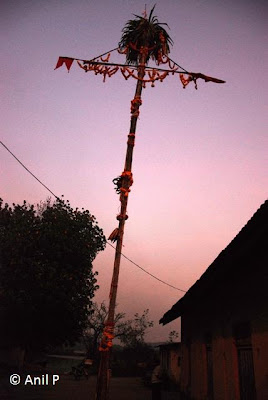
“You should’ve been here at 1:00 O’Clock,” a middle-aged, local man said, probably indicating the time of installation, as I stopped in the temple courtyard to photograph a high ceremonial mast likely constructed from Areca Nut trunk and bamboo and decorated with marigolds, and bananas among other nature offerings, the top surmounted by leaves, similar to the Gudi hoisted on Gudi Padwa.


It rose from a notch in the centre of a raised, square platform where people had made offerings of coconuts to the deity.


Jags and I were returning from a walk along the mudflats and mangroves in Karanjal when I first noticed the high mast erected in the temple courtyard. It was two days after Holi early this month and Shigmotsav celebrations had kicked off across Goa, particularly in the North of the state where traditionally Shigmo (Konkani for the month of Phalguna, the last month in the Hindu calendar) is celebrated from the day of the full moon of Phalgun month to the end of the month that culminates in Gudi Padva, the first day of the Hindu calendar year, that is today.

Only the day before, following Holi celebrations commencing on full moon in the month of Phalgun and lasting a day, I had seen the same sight in the vicinity of a temple in Bhoma as I rode a bus to Panjim. The bus had paused by the temple that sits off the highway, waiting for throngs of people who’d gathered for the installation of a similar ceremonial mast, to make way for the bus. One by one local villagers had come up to the platform from which the mast rose and broke a coconut on the platform as a ritual offering to the deity.

Elsewhere, depending upon the tradition followed at the temples, villagers erect Mango tree trunks or Areca Nut tree trunks though not necessarily restricted to the two. And in the days to follow, given that Shigmo is essentially a festival of music and dance observed largely by Goa’s farming community celebrating the arrival of Spring, villages, and particularly the temples, are transformed by the holding of folk dramas and dances like Khell, Romat, Jagor, Ranmalyem, Talgadi, and Ghodmodni among others.

Villages are not bound by a particular date on which to install the ceremonial mast, each dictated by tradition observed at the temple. Even the commencement of Shigmo celebrations varies across Goa, with South Goa observing it on the beginning of the month of Phalgun and concluding it on Phalgun Punav (Full moon of Phalgun month), while North Goa observes its commencement on Phalgun Punav and concludes it on Padva, today. However, exceptions can be found within each of the two regions. The difference in its observance had to do with the Portuguese banning its observance leading to the colony’s ingenious subjects cleverly disguising its observance along with the Carnival to escape censure and retribution.

“We will keep it until Padwa,” the middle-aged man said when I asked him how long will the ceremonial ‘trunk’ be retained. Today is Gudi Padva, and I believe, with much fondness and piety the ceremonial ‘mast’ will have been lowered. However, the actual Shigmo celebrations involving folk dramas and dances would normally extend only five days from the date of commencement of the Shigmo festival.


The middle-aged man was supervising a few local youth busy putting up a makeshift stage in the corner of the temple courtyard. “Dramas will be staged from tomorrow night,” he said. It’s a scene that repeats across Goa in temples where these celebrations take place. Not all Goan temples celebrate similarly.

“No. Around here you’ll get to see this in Durbhat,” a youth said when I asked him if every temple hosts these celebrations as in dances and dramas and the ceremonial ‘mast’ that he referred to as Shigmyache Holi, a term I felt might not be the original reference. He mentioned two other temples in the vicinity that I cannot remember clearly now.

A sodium vapour lamp cast a gentle glow on the activity below as the men discussed ways to reinforce and shape the makeshift stage where local artistes would stage their plays to villagers crammed in the courtyard. Curious of the atmosphere I made a mental note to ride over to the temple the next day and watch the plays with the villagers. I could not make it to the venue the next day.

However, the rhythmic beating of the drums, that familiar Ghanch-katar-ghanch, ghanch-katar-ghanch had floated on the Spring breeze in the days leading upto Shigmo and in the days since, quivering along quiet roads, stepping across lush green paddy fields, skipping over village ponds, all the while strengthening and waning depending on the breeze carrying the hypnotic beats towards or away as bands of drummers carried their drums from Vaddo to Vaddo, beating the familiar, throbbing beat pulsating with the energy and the promise of Spring, and of life itself.


A day earlier, on our way back through Chorao as we headed for the ferry crossing to Panaji, Philip and I had rounded a turn in the narrow road just before it ran through an open field and happened upon an enthusiastic band of drummers on the roadside hard at their drums.

A few shops and homes with sloping roofs lay on either side of the road, and local men stopped by to talk and offer encouragement. The Sun was descending behind the trees and the evening pulsated to a familiar rhythm from my childhood.


“Will you be participating in the Shigmo parade in Panaji?” I asked one of the drummers as he handed the sticks to a young child before turning to me to answer.

“No, no,” he said, smiling. “For the duration of the Shigmo celebrations, we’ll be moving from waddo to waddo, drumming our way through them.”

In the countryside, Goa resonates to the beat of Spring in Phalgun. Like the season itself, the drums regenerate the landscape, and memories.

And standing on the roadside I imagined children stepping out, as I once did, and dancing to the beats of an ancient people of an ancient land following an age-old tradition.

March 21, 2012

Ek Prem Kahani, Truck Ki Jubaani


It’s rare for a love story to be boring, least of all those that continue to play out in the heat of the Sun and the dust of the road. And irrespective of the ending, each love story is worth telling for, in its telling and retelling it relives its moment in another’s heart, in another’s eye, in another’s mind.


And everyone has at least one story to tell, including trucks like this one who told her own tale of romance on the back.


TATA Se Chali Main Kunwari,
Bhandup Main Shringar Hua,
Dahisar Main Bani Dulhaniya,
Ketakipada Main Pyar Hua.


(My journey from a TATA factory as an eligible beauty paused at Bhandup so I could be decked up to be a bride before I was married off in Dahisar and swept away to Ketkipada where I fell in love.)

Note: Bhandup and Dahisar are names of Mumbai suburbs, and Ketkipada is a locality in Dahisar (East).

March 18, 2012

Photographs Of Lilah Wingfield’s Indian Journey To Delhi Durbar, 1911


The elderly, crusty taxi driver in worn whites knew of Nathalal Parikh Marg in Colaba, and waved me to silence with a gesture that betrayed impatience at my attempt to help him figure out the location using directions the young lady from Sakshi Art Gallery had passed on as we made our way through Colaba to the Centenary Exhibition: A Glimpse Of Empire, an exhibition of photographs Lilah Wingfield took of her journey east to India to attend the Coronation Durbar in Delhi of King George V in 1911. The event also marked the formal transfer of the capital of British India from Calcutta to Delhi.


Jessica Douglas-Home has put together photographs her grandmother, Lilah Wingfield, took of her journey through India including accounts from her diaries she maintained of her journey. Lilah Wingfield’s photographs and her account of her journey to and through undivided India is also available in book form and was released by her granddaughter, Jessica Douglas-Home, to coincide with the centenary of the event.

If it wasn’t for the fact the photo exhibition was advertised as The 1911 Durbar through the eyes of Lilah Wingfield I doubt if I’d have been as inclined to make my way to the tree lined street set in the old world charm of stately stone buildings dating back from the Bombay of old.

I was intrigued by the idea of a young British woman all of 23, born and brought up in Ireland and described in the accompanying pamphlet as desperate to get away from an existence that was unbearably claustrophobic, took the opportunity of the King’s Coronation Durbar in Delhi to escape for a few months to India to breathe freedom, an experience that transformed her life.

Such an account promises varying possibilities including wanderlust, adventure, unrequited love, and romance; of the latter Jessica hinted in her interview with HT thus: “The Begum of Bhopal, the only female ruler of the time, became a good friend of my grandmother and invited her to stay with her. Her son, Prince Obaidullah, developed a crush on her. He was quite keen on her and they had a near romance, despite being married.”

To find out more about this and the rest I’d have to read the book that the lady at the gallery counter informed me was sold out. So I made up for the gaps in the visual narratives exhibited in the gallery with my own imagination though it did not take me far.

While the Raj has been sufficiently documented in photographs with respect to the relationship the British Colonial Rulers shared with their subjects, the Indian Princely States, with images rarely varying in their depiction of lives of Kings, Queens, and Princes beholden to the British Rulers for retaining their way of life, there’s little I’ve seen exhibited of viewpoints travellers shared of their impressions of India on their journeys through the sub-continent, little or none beyond the mandatory serving of fakirs, babas, medicants, and snake charmers.


I’d hoped Lilah Wingfield’s photographs would fill one such gap. It does, only to an extent. Still, it’s an important document if for nothing else than for the fact that while photographs from the time will invariably focus on events and occasions in progress as documented by official photographers, typically framing the key moments, it’s left to a meandering traveller, an invitee to the event, arriving as preparations for it reach their climax, to cast their eye about and record moments peripheral to the actual event.


And Lilah Wingfield does offer up several peripheral moments from 1911, centre stage. Among others, photographs depicting tradesmen displaying their wares in the 10th Hussars encampment where Lilah had her tent, the horse Lilah borrowed in the Tented City that came up in advance of the Delhi Durbar to house over 250,000 visitors, the arrival of Ruling Princes and their entourages by train to pay homage to King George V and swear allegiance to their British Rulers with the possible exception of Gaikwad of Baroda, who, Jessica said as she walked the three of us and another visitor through the photographs on display, “stripped off his jewels before paying homage to the King Emperor George V, even turning his back on the Monarch as he made his way back.” A gesture, Jessica explained, designed to indicate “That I’m your equal.”

It created a furore, a scandal.

A photograph on display catches the plainly clad Gaikwad of Baroda in mid-turn as he prepares to turn his back on the seated King Emperor George V before walking back. It’s a moment of defiance, making the viewer linger on for a fraction more, imagining the very moment in the context of the event, the coronation of King George V as the Emperor of India.


I wondered what he must have thought as he walked up to the Royal Pavilion surmounted by a glittering dome. Did he balk at the very last moment considering the inevitable repercussions that would follow his defiance? Did he wish he hadn’t done it as he walked back?

The power of a photograph is not restricted to the moment it frames, instead it lies in the larger frame of the ‘before’ and the ‘after’ it does not capture.


A similar feeling crept up on me as I paused by the photograph showing Lilah in the middle of a street in Chandni Chowk, captioned: Lilah visiting Chandni Chowk for the last time. In the distance she heard the sound of the 101 gun salute from the ridge as the Royal couple departed.


It's a moment that signals the end of her Delhi visit and preparation for her onward journey that would take her to Peshawar and Rawalpindi in the North West Frontier Province, before pointing her in the direction of Lucknow, Benares, Cawnpore, Agra, Jaipur, Udaipur, Bhopal, Bangalore, and eventually Colombo, spanning close to four months from the time Lilah arrived in Bombay on 28 November, 1911, snapping up the Bombay Harbour from her cabin porthole with her Kodak, to Feburary 1912.

It must’ve been a moment of anticipation, of trepidation, of excitement. Here was a young woman journeying to a country she’d never been to before but only heard about or read in accounts that must’ve included among other things the inhospitable terrain, the man-eaters, the ‘unbearable’ heat, the alien tongues, ‘strange’ customs to name a few, each contributing to the perception of India as a frontier offering challenges not all of which were easily surmountable let alone hospitable.

To that end, while limited in their representation of the scope of imagery her journeys will have afforded her, considering she traversed terrain breathtaking in their diversity, cultural and otherwise, Lilah Wingfield’s photographs nevertheless acquire a certain poignancy in the context of her willingness to strike out of her own comfort for the unknown of India, for making a choice and exercising it.


It’s in this context that the visitor, having navigated the black and white timeline of her impressions of the Delhi Durbar of 1911, pauses that much longer when brought up face to face with the last one in the series showing the Colombo waterfront with a hotel at the far end among coconut trees leaning out to sea and Lilah Wingfield in a hand-pulled carriage, her head turned for the camera, before catching the S. S. Malwa for England.

A journey to qualify for a lifetime, a lifetime possibly transformed in ways probably not imagined before embarking on the journey. It’s the in-betweens that Lilah did not frame that the images on display nudge the viewer into considering, extrapolating, and reflecting upon.


The exhibition is on at Sakshi Gallery, Tanna House, Opposite YMCA, Colaba, between 11 a.m. to 6 p.m.


Sakshi Gallery is reached barely a few minutes walk from the Regal Cinema circle, past Majestic, and is located adjacent to the Holy Name Church on Nathalal Parekh Road (formerly Wodehouse Road).

The photo exhibition, A Glimpse Of Empire, ends tomorrow, Monday, 19th March, 2012.

February 26, 2012

Moments Of Quiet With Our Lady Of Glory


The Sunday morning mass is over. The pews have emptied out. Light streams in through coloured glass windows, echoing a bright and sprightly Bombay morning outside as parishioners file quietly to the front of the church to receive Holy Communion from a priest in white robes before turning back from the altar and making for the exit.

On the way out they stop by the Baptismal font and dip their hands in holy water before taking the steps out to the front where they catch up with neighbours and friends in happy banter, waving out to faces familiar from attending Sunday Mass together over the years, revelling in the comfort of fellowship enabled by shared faith, and humanity.


The Priest has followed them to the front-yard and soon becomes busy returning greetings from his parishioners as they stop by to talk to him. There’re smiles all around. In the shade of the towering Gothic church dedicated to Our Lady Of Glory, in the gaze of Jesus, his arms extended, I can feel the warmth about me, floating on voices rising from the Sunday crowd. Soon the grounds will empty and the caretaker will close the doors behind him.


However, a few stay back for a quiet moment with Mother Mary carrying infant Jesus, closing their eyes to say a prayer, make a petition, offer thanks for favours done, or wish for good health for self and loved ones before reaching out with their hands to the Mother, pausing to let the moment linger in a private communication with the almighty benefactor.


A few prayer books rest on pews where some parishioners left them behind. There’s barely a whisper around me. The caretaker looks at me from across the pews. He is old. Wrinkles have just as surely mellowed his face as soulful hymns. Both hard times and good times mellow people, even if differently, one out of compulsion, and the other out of choice.

He’s waiting for me to finish up so he can close the doors. He is patient.

I pick up a prayer book and turn the pages, pausing at Novena Prayers. And, voices that were ringing out only minutes before as the Mass wound down now rise again, in silence, before joining up with solemn voices from memory, from another place and another time long, long, ago.

The weight of time can make memories seem like they belong to another lifetime, even to another person.

My eyes trail each word as they resonate in my ears, voices that silence shapes into faces from memory.

Gracious Father, we thank you for having given us a tender loving Mother to watch over our Parish, to protect and intercede for us. Your son, Jesus has said, “Whenever two of you on earth agree about anything you pray for, it will be done to you by my Father in heaven.”

And so, now as one family through the intercession of Our Lady of Glory and by her precious son, Jesus, we ask you to build our Parish into units of close fellowship, alive and vibrant in faith, where the needs of everyone are taken care of.

Here, I pause for a non-existent chorus to take over, for words muttered under a thousand breaths. Words that shape into personal petitions hurrying to finish before the voice from the front of the church sounds again:

Our Lady of Glory,

And pauses for a rejoinder from the parishioners.

Pray for us.

Before the chorus sounds off thrice with,

Hail Mary.

I make way back along the wall, skirting the empty pews. The caretaker smiles at me before leaning against the door and walking it across.


Mass Timings at Our Lady Of Glory Church

Weekdays: 7:00 am, and 7:00 pm.
Sundays: 6:00 am, 7:00 am (Konkani), and 9:30 am.