August 16, 2011

Tiranga, The Indian Tricolour


The Indian flag. The Tricolour. The Tiranga. Tiranga Zhanda.


While some will wear it on their hearts, some will wrap it around their wrists, and seem to embrace it, like they would their own. In colours that bind, emotions of a country run.


Yet others will fly it on their rides about town, letting the breeze make its presence felt as it unfurls the flag for all to see so it can wrap the colours about it and dance in the street. The breeze, ever the flirt.


Still others will grace their glass windows with the Tiranga so that no reflection of those passing by is bereft of an identity, not on this day, never.


Then there’re those who will fill the colours with air, so while they sit together, they threaten mischief should they get in their mind to float away with the clouds.


Until then they’ll sit tight in the breeze the fan whips up in the ceiling.
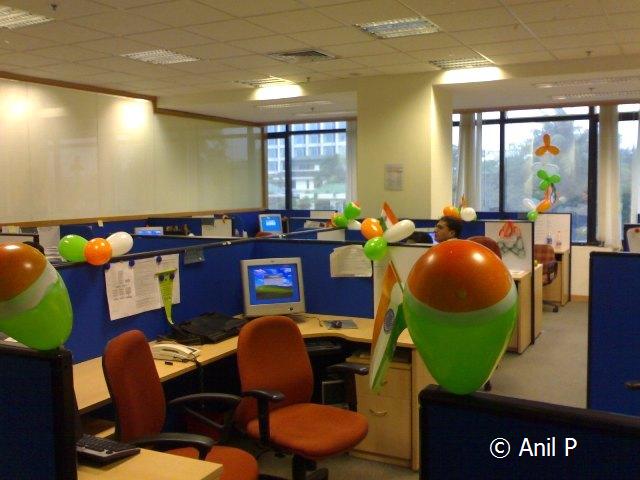


To be reminded of why we work, some will, like at my place of work from before, adorn the cubicles with the colours of India. Take pride in your work, the country will take pride in you. Not that any of us needed the prompting. But then you never know, not for sure at any rate.

On the street I revel in the flashes of the Indian Tricolour. The streets remember because they cannot afford to forget. Others maybe. But not the streets. No, not the streets.


The history of the Indian flag is like the history of India itself, of choices, and compulsions, in equal measure. The Indian flag evolved with the times, reflecting its times, the struggle for independence from British rule.


From its earliest form in 1906, when it was said to be first hoisted in Calcutta’s Parsee Bagan Square, bearing three horizontal strips of red, yellow, and green, with Vande Mataram gracing the centre, followed by the unfurling in Berlin in 1907 of the flag changed to bearing one lotus instead of eight from before, the rest changing into seven stars denoting the Saptarishi, then the one in 1917 hoisted by Bal Gangadhar Tilak and Annie Besant during the Home Rule movement, bearing five red and four horizontal strips alternately, to the one in 1921 during the AICC session in Vijaywada when Gandhiji advised the youth bearing a new flag design to include white to represent all other communities in addition to the red and green the youth had used to denote the two major communities, Hindus and the Muslims, with the spinning wheel or Charkha at the center, the Indian flag has evolved significantly, events shaping it in as much as it went on to shape events once it became a rallying cry for India's independence from British rule.


It was in 1931 that the flag denoting the three colours, saffron, white, and green, with Gandhiji’s spinning wheel at the center, was adopted by the Indian National Congress party by passing a resolution to the effect, eventually becoming the basis of the national flag that we see today, those I saw on the street earlier in the day.


The only change from then being, Mahatma Gandhi’s beloved spinning wheel, the Charkha, was replaced by the Chakra (wheel) from Emperor Ashoka’s Lion Capital dating back to 250 B.C. The Chakra is also known as Ashoka Chakra. Its significance is central to Buddhism as the Dharmachakra or the Wheel of Law.


Sometimes, when I look at the wheel now, the Ashoka Chakra, in the centre of the flag, a mild tremor runs down the length, for it reminds me of the moment I stood beside the enclosed square in Sarnath (Uttar Pradesh) and peered into the enclosure protecting the original pillar that once held aloft Ashoka’s Lion Capital when he installed it in 250 B.C. in ancient Sarnath, where Lord Buddha preached his first sermon following his enlightenment in Bodh Gaya,.

I remember standing there a long time, gazing at the pillar shorn off its magnificent Lion Capital showing four lions in four directions, now housed in the museum across the road from the enclosure. The base of the pillar, shorn of the regal Lion Capital looked forlorn.

I could’ve reached and touched the jagged edges, remnants of the destruction known to have been wrought over Sarnath by Islamic hordes who rode in to grind into dust India’s ethos and supplant their own twisted one once they had destroyed India's culture, and its civilizational basis derived from an ancient religion. India has lost much. India has survived much. And is surviving much. Now.


I had attempted to make sense of the edicts Emperor Ashoka had issued on the pillar, only succeeding in the translation provided on a board nearby. The edicts on the pillar were in a language I did not understand.

It was hallowed ground, no less, where history, antiquity, and the birth of the very essence of Buddhism intersected to form a glorious memory of our travel to Sarnath.

Later, we had trooped to the museum to admire the Lion Capital. It was a stirring sight, its significance as the National Emblem of the Republic of India was not lost on me. I was not allowed to photograph it. I wish I could’ve.

Make time and visit Sarnath someday. It’s a long way off for most of us, but I’m glad I could. I feel you would feel the same as well. That moment was my tryst with history, antiquity, with Buddhism.

I felt the same way when I meandered in Sabarmati Ashram in Ahmedabad, lolling about the cottage where Mahatma Gandhi lived with his wife, Kasturba Gandhi.


It was quiet when we made our way up the steps, across the platform, past the Charkha (spinning wheel) outside the kitchen before stepping into the courtyard flanked by bare rooms, where Kasturba once lived. Sunlight streamed through the window when I stepped into her room, marking the window on the floor, the protective grills slanting across the floor before lengthening as the Sun began to drop anchor behind the horizon.


Make time and visit Sabarmati Ashram someday. Once there, meander, and reflect. Let time wash over you. Many things you know as facts from history today will take on a deeper meaning once you’re there. Take it from me, you will see some things differently.


On our way out I passed the Charkha (spinning wheel) again. The platform was empty. The platform Gandhi would use in his time there to meet with ashram inmates and visitors.


Now when I look back, after Sarnath and Sabarmati, after first adopting the spinning wheel in the Indian flag, then replacing it with Wheel of Law, I cannot help relate the circle of life to the Chakra (wheel). So much of Hindu thought revolves, not only as in a circle, but as a path of return, along the same curve it had set off on. Back to where it had started from. Back to its reason for existence. Yes, back to its reason, even if there’s much that changed along the way.


The centrality of the absolute is so prevalent, absoluteness so desired. And I see it in the initial adoption of the Charkha, the wheel, even if the significance of its role in awakening India lay in self sufficiency it represented and not in any philosophy pertaining to life or the wheel of life. Gandhi believed that self sufficiency co-relates to independence, one reason why he was for including the Charkha in the Indian flag. Charkha, in effect charting your Karma.

The Chakra. Yes. The Chakra that adorns the Indian flag now. Dharma Chakra. The Wheel of Law. Dharma and Law. Potent.

What you see, you understand. What you understand, you do not forget – Sarnath, Ashoka’s Pillar, the Lion Capital, the Wheel of Law, and Sabarmati Ashram, Gandhi’s Spinning Wheel, the Charkha.

You remember because you cannot forget; you remind so it will not be forgotten; you remember because you will not forget; you remind because it should be remembered; you remember because you should not forget.

You. Me. I. They. Him. Her. Them.

All.

Saffron. White. Green. The colours of the Indian flag are a construct of the nation. They’re not colours that run. They’re colours that’re resident. Colours that inspire. Colours that remind. Colours that’re reminded.

The Indian flag. A rallying cry.

I’m reminded of my idealism growing up, of school, of the flag hoisting ceremony, of the goose pimples as desh bhakti songs lifted the atmosphere, blanking out the Sun at times, at other times piercing the monsoon clouds, thundering in the head until the ears rang to the unifying cry, and the heart swelled with pride, a time to remember the sacrifices made, of the sacrifices to be made, a time when I recognized my country in the flag, and the flag in the country, and the people in its colours, and colours in its people. That was the time. Yes. That was the time.

School time, a time when the closest we came to cynicism was if we carried the Oxford Dictionary along, else it was an alien concept.

As a symbol of unity, the Indian flag is singularly important.

A flag is the face of the faceless. Like me. In it, the multitudes rally around an idea. The idea of India. Of an India. Of the India.

It is a living, breathing thing. Today of all days. Today. Yes, today.

August 05, 2011

A Raised Hood And Many Folded Hands


Borivali_Railway_Station_Photo

The over-bridge connecting the railway platforms one, two, three, four, five, and six at Borivali Railway Station is usually crowded, conveying travelers between platforms in the same rushed manner as conducting them toward the exit to the east where they’ll descend the stairs to platform six before exiting the station.

Anxious to board the trains announced on the speaker or hurrying to exit the station to beat the rush heading for scarce rickshaws or buses outside, travelers will rarely break stride or cast a glance elsewhere before making their way about, unless an exception waylays them.


Cobra Statue Nag Panchami Festival

And today it appeared in the form of a firm voice emerging from the corner of the over-bridge, calling out even as the crowd moved and broke ranks in an age old Mumbai tradition –

“Today is Nag Panchami, today is Nag Panchami”.

It’s just as well she called out because the coiled Cobra (Nag) in her basket was barely visible in the flowers and garlands covering it, the raised hood barely noticeable along the curve of the projection.


Worshipping Cobra On Nag Panchami


She sat with the cane basket holding the Cobra, most likely made from copper, at her feet, her hand at the ready by a tin of milk she served up on the metal Cobra’s hood from a metal stirrer wound with cloth to soak up milk, in the same motion a passing traveler made in bringing up a coin as an offering to the serpent on the auspicious day of Nag Panchami, among the first festivals gracing the month of Sravan.

On Nag Panchami day, devotees offer milk, not necessarily in the belief the Cobra will drink it but more from the symbolic value associated with milk as a revered offering to deities on auspicious occasions.


Feeding Milk Cobra Nag Panchmi

“Today is Nag Panchami, today is Nag Panchami,” she called out each time a rush of passengers made their way up or down the stairs. Some folded hands in prayer in front of the Cobra, revered in Hinduism as much for protection from its lethality as for its role as a protector, depending upon the contexts it’s seen in or assigned.


Nag Panchami Photo

Short of time as they go about their daily lives, it suited many travelers to pay up and have milk offered on their behalf to compensate for their inability to make time to visit a Shiva temple and offer milk to the Nag (Cobra) themselves. Meeting half-way is cultural. The middle path is comforting.

She called out again.

“Today is Nag Panchami, today is Nag Panchami.”

Her voice had begun to crack from calling out all day.

As I took the stairs down, it became apparent yet again how a city bursting at its seams will seek to delegate faith for want of time. And in doing so it reveals how, even when pressed hard consistently, it will seek to hang on to tradition in a desperate attempt to retain what remains of an identity derived from the culture of a people, of a past, for an uncertain future.


Note: Shortly, I’ll post on Nag Panchami celebrated at Borivali’s Omkareshwar temple, and Jogeshwari’s Jagdamba & Kalabhairav temple.


August 01, 2011

A Matter Of Chance


Ahmedabad Boy Flying Kite
Ahmedabad. 2011.


Slung over the shoulder
A kite rides his back,
Where, in another time and age,
A quiver of arrows might have.

Where circumstances offer choices
They’re his to make,
But were destiny to shape circumstances,
It’d be his fate to endure them.


July 27, 2011

Prem Utsav 2011 - Munshi Premchand Theatre Festival at Sathaye College

Munshi Premchand's Stories On Stage

Prem Utsav 2011 is currently underway at the Sathaye College Auditorium in Ville Parle (E), Mumbai. Over ten days, Mujeeb Khan’s theatre group, IDEA, is staging 75 plays adapted from Munshi Premchand’s works, ending July 31st, on the legendary Hindi and Urdu litterateur’s birthday. It’s an experience like no other. Go over and watch them.

If I needed any further confirmation that Mujeeb Khan was charting a path of his own and playing by his own rules, I didn’t have to wait beyond the minute after the lights went out at five minutes past eight to realize it myself.

Last weekend, just as the sixth and the last play of the second day at the ongoing Prem Utsav 2011 in Ville Parle (E) got underway at the Sathaye College auditorium, I’d noticed the artistes of his theatre group, IDEA, filter into the rows to the front, free of the costumes of parts they’d essayed through the evening in a series of plays dramatized from Munshi Premchand’s stories.

Mumbai Theatre Performances Of Premchand
I sighed in silence. So, there would be no curtain call, no names of artistes read out to the audience to the sound of applause at the end of each play, nor at the end of the day. Until then I had hoped to learn of the identities of the artistes against the roles they had performed if only to applaud the verve they had brought to each of the six plays staged that day.


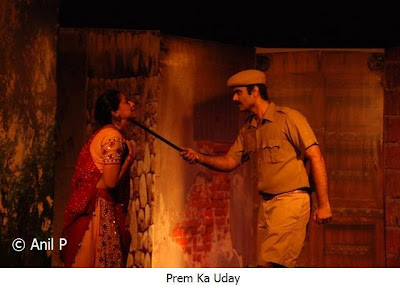
Prem Ka Uday Munshi Premchand Story
They had performed spiritedly even though they had struggled occasionally to come to grips with the language of the legendary Hindi litterateur, a finesse in nuances and tone never easy to master in today’s age of Bambaiyya Hindi of ‘Kya Bey, Kettey Bey and Tu Kaiko, Mee Baiko’ variety, but at no point had they flagged in their enthusiasm or loosened the grasp of their characters, essaying their roles with a passion that must’ve done their mentor and teacher, Mujeeb Khan, proud as he looked out the window of the projector room to the back, his eye as unwavering upon his wards performing on the stage as over the audience engrossed by the unfolding drama.


Mujeeb Khan Theatre Performance
For, when I returned on day four of the ten day theatre festival celebrating Munshi Premchand’s works he remembered me as the ‘person who was photographing scenes from the plays the other day’. Mujeeb Khan apparently misses nothing in his presence. Bearded and clad in a kurta, his fingers were quick and his gestures, expansive as he made his point to the actors on some aspect of his craft.

There was applause aplenty at the end of each of the six plays staged at the auditorium, just that the actors would remain nameless to the end, the audience having to make do with a sheet of paper listing names of all student artistes involved in the 10-day theatre festival, oblivious of the parts they played in each of the plays.

Prem Utsav Mumbai Pictures
Apparently Mujeeb Khan placed greater emphasis on the staging of the play, the characterization of roles, the timing of dialogue delivery, and their precision within the constraints of the Hindi language of the late 19th and early 20th century, possibly of greater significance than the names of artistes. He takes much pride in his wards. And I assume the reverse to be equally true.


Premchand Story Drama Sampadak Moteram Shastri
Moreover there was no curtain for a ‘curtain call’. The end of each play was sounded by an echoing gong that followed a lights out lasting marginally longer than those between a change of scenes within a play. It took the audience some time to distinguish between the two but not after they’d applauded prematurely in the lights out between scenes with the applause they had reserved for the end of play.


Indian Theatre Performance In Mumbai
But no one minded it. The scripts were taut, the actors dedicated, and the performances energetic, making up for the occasional slip; the themes Munshi Premchand wrote about of the India of his time remaining as relevant to the times of the audience as his own even if their prevalence was not as pronounced an urban reality as it was in the milieu Munshi Premchand grew up in in the present day Uttar Pradesh to the north of India.

In my interview with Mujeeb Khan when I returned to Sathaye Auditorium two days later to ask him a few questions about his craft and his mission, Mujeeb Khan would characterize Premchand’s themes as ‘timeless’. He was right.

Poverty, Widowhood, Child Marriage, Feudalism, Worker Exploitation, Alcoholism, Relationships, Greed and the like are enduring in their centrality to society, and equally independent of time, geography, and milieu. Munshi Premchand’s skill lay in the persuasive way he wrote about them, constructing stories that draw readers into the narrative, living the characters in their moments of despair, enlightenment, and deliverance.


Sathaye College Ville Parle Picture
The entry was free. Mujeeb Khan explained it away saying his theatre group wanted to bring Munshi Premchand’s works to the people and had no wish to ‘sell’ Munshi Premchand. Just as Premchand’s works were ennobling for their themes and treatment, so was Mujeeb Khan’s intent, and dedication. Different, surely.


Sathaye College Auditorium In Ville Parle Mumbai
The Sathaye Auditorium is located in the campus of Sathaye College on Dixit Road and seats 150+ Mumbai theatre enthusiasts, small by Mumbai theatre standards but significant for its existence as a part of the college.


Mumbai Theatre Audience At Prem Utsav 2011
Soon after the three of us made our way to Sathaye College, at walking distance from the Ville Parle (E) railway station, theatre goers began to filter through the gates. A security guard sat in a white plastic chair by the board listing the schedule of plays for each of the ten days of the theatre festival, answering queries from visitors as to the starting time.


Munshi Premchand Theatre Schedule
“It’ll start at 5:30 pm,” he said without tiring of repeating it each time someone stepped through the gate.
“Are there tickets for the show?”
“No, the entry is free. There’re passes though,” he would reply.
At which some got flustered at not possessing passes for the shows. It’s easier buying tickets at the counter than chase after passes for entry.
“Where does one get the passes for the shows?”
“There,” the security guard pointed to the door of the auditorium.


Sathaye College Theatre Entrance
Dutifully, people stepped up to the door and pulled at the handle. The door would not budge. A little later, another theatre-goer pulled at the door handle. It still would not budge. The attempts stopped only after someone who knew better informed the others that entry is first come, first serve. And the doors retained their handles.

Eventually I did not see any passes given out and we got in without any. I assumed passes would be of use in the event the auditorium was packed to capacity. It wasn't that day.


Plays Based On Munshi Premchand's Stories
Strung between supports framing the approach to the door opening into the auditorium were motifs from Munshi Premchand’s milieu – kerosene lantern, woven baskets, and a tarazu. The latter was a constant in the undercurrents his narratives wove for, in the end, realization, and repentance had to balance out the straying from the righteous path for the message to go out.

The scales of justice had to tilt the right way. It was in the journey bridging both ends of human character, including the greys in between, that Munshi Premchand’s masterly portrayal of the human condition was essayed. And which Mujeeb Khan had sought to dramatise. He had come a long way, and he had a long way to go.

Theatre Banner At Prem Utsav Mumbai
Blowing in the breeze, a large banner hung from the trees along an open area where students were busy playing football in their colours while cadets stood to attention to one end. A group of student cadets, probably from the NCC, had hop skipped through slush with rifles held over their heads. The rifles were vintage, most likely Lee Enfield .303, at least from where I stood in the distance. I couldn't be certain.

The banner depicted a montage of images ranging from a farmer scouring the skies for signs of rain from his parched fields, a hangman stringing up nationalists from Indian Independence movement, fields under plough, monuments, temples, and Mahatma Gandhi, each a context in Munshi Premchand's writings.

Sathaye College Audi
It had just rained and K and V had disappeared to a roadside tea stall for a glass of chai each before returning just as the bell sounded and the door opened as theatre enthusiasts drawn by Munshi Premchand’s aura trooped into the small auditorium.


Schedule Of Plays At Mumbai Theatre
The next two and half hours skipped time as the six plays staged in succession brought a whole gamut of human condition alive, bringing to life India’s legendary Hindi and Urdu littérateur and his sensibilities while trammeling the composure we had stepped in with, twisting and straightening it at each turn.

It was an evening to remember, and an experience to cherish.

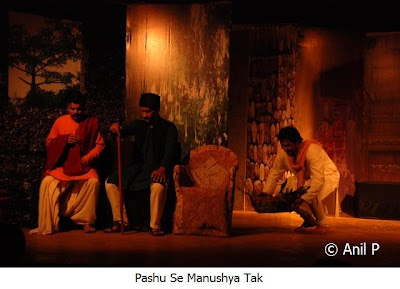
The plays we saw that evening: (1) Pashu Se Manushya Tak, (2) Zindagi Aur Maut, (3) Pachtaava, (4) Boodhi Kaaki, (5) Prem Ka Uday, and (6) Sampadhak Moteram Shastri.


Note: In the next installment I’ll post the pictures from the above plays with brief story outlines.

Plays Scheduled for 28 July: (1) Mandir, (2) Tyagi Ka Prem, (3) Masoom Baccha, (4) Dhithkar, (5) Sava Ser Ghehu, (6) Nimantran, and (7) Jihaad.

The theatre festival opens each day at 5:30 pm, and continues until 31 July, 2011.

IDEA – Ideal Drama and Entertainment Academy.

July 24, 2011

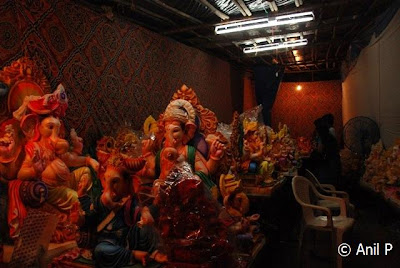
Ganapati Idols Idle Streetside In Mumbai


Ganapati Idols On Sale In Mumbai

If Mumbai needed any further reminding of the approaching Ganesh Chaturthi festival, the makeshift structures made of bamboo supports lashed together and alternately covered by plastic sheets and the occasional tarpaulin now cropping up on roadsides with colourfully done Ganapati idols on sale do an effective job of reminding the city that its most cherished, dutifully celebrated, and much revered deity, Ganapati, pot belly and all, is due a visit to their homes.

I’d have to stretch my memory to recollect any other Hindu deity as creatively rendered as Ganapati or Ganesha as the elephant-headed God is known. If he didn’t occupy the minds as much he wouldn’t find himself skillfully rendered in mediums ranging from plantain leaves, coconut shells, rava ladoos, to wood, Plaster of Paris, and clay among other material. It obviously helps to have a trunk as his most distinguishing feature.

For the sake of Ganapati, the devout will banish fish and other non-vegetarian food from their house until the time he occupies centre stage in the house, preening in decorated luxury while neighbours troop in for his blessings, and the modak of course. It's another matter however, like they say of Goans good-naturedly, that hardly has Ganapati been borne out the front door to much merriment and tears alike, the fish comes in the backdoor!

Ganesha Clay Idols In Mumbai
Across the road in Vile Parle (East), just as we approached the railway station yesterday, headlights from the traffic streaming past lit up the Ganapati idols on sale at a roadside shelter manned by a woman busy on the phone fielding enquiries for the Ganesha idols on sale while her assistant was showing a couple around the place. They had a difficult time choosing from the shapes and sizes on display, each as endearing as the next.

Soon, as the days pass and Ganesh Chaturthi draws near the idols disappear as families take the deity home to continue their love affair with harbinger of good.

And somewhere trackside, only interrupted by the local trains hurtling past, youth from shanties and slums neighbouring the railway tracks will be drumming away in small circles, practicing for the return journeys Ganapati will make, back to the earth from whence he sprang into the Indian consciousness.

Note: On the highway between the western suburbs of Borivali and Jogeshwari, workers in makeshift tents are busy at work on Ganpati idols, adding finishing touches before putting the Ganapati idols on sale.

Note: This year the Ganesh Chaturthi celebrations will kick off on September 1.

Related Posts

1. The Last Journey Of The Elephant-headed God

July 14, 2011

The Burden Of A Hundred Tunes


Street Vendors In Mumbai

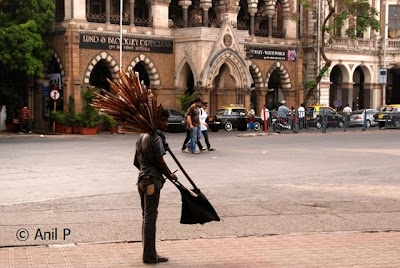
Framed by arches of the David Sassoon Library across the street from where he stood facing the road, the flute player held fort with his tune on the pavement outside the Jehangir Art Gallery, an impromptu stage he chose to lend his burden of carrying a hundred unsung tunes on his shoulder.


Photo Flute Player On Mumbai Street
Circling around Mumbai’s celebrated Art Space, the pavement conducted the moving mass of Mumbai’s humanity along in choreographed chaos not unlike a river in spate breaching its banks to the terrifying scream of its intimidating silence wreaking unsuspected violence from the force of its unrelenting movement forward.

David Sassoon Library Kala Ghoda Mumbai
And like a hapless tree caught in the middle of a strengthening river, the street-side flautist stood alone among his tunes, gathering his melodies around him into embracing his isolation on a busy street.


Jehangir Art Gallery In Kala Ghoda
With the flute pressed to his lips, the flute player had emerged from the Pavement Art Gallery that runs along the length of the K. Dubash Street in the Kala Ghoda precinct, barely breaking his stride past framed paintings of hopeful artists mounted along the open stretch, scarcely interrupting his tune along the way, hoping to interest passersby into lending a home to his many flutes that jabbed the sky indignantly at the indignity of lacking embraces.

But then Yeh Tho Mumbai Hai Meri Jaan.


Street Flute Player In Mumbai
As his tunes flowed outward they wrapped around passing feet without managing to slow them down, lingered by conversations without succeeding in pausing them, floated alluringly past reading eyes with nary a glace gracing them, dodged impatient taxi drivers unmoved to the passing melody, stepped past speeding traffic, and circled around invisible wakes of passing humanity in the hope a tune would find a home in an earnest ear, and a flute, a new shoulder to lean against.

Time fled past. The day grew shorter by the minute. The melodies wound hopelessly by. And a not a single flute left his shoulder.


Selling Flutes On Street In Mumbai
The soulful melodies that issued forth from him thinned out before he let the flute drop, turning his head to scan passing humanity for passing interest. There was none.

Framed by the Bombay of yesterday, with time having chipped city sensibilities to the functional, the promise of possibilities the city once held out to street-side melodies had met their end in the reality of the irrelevance of the individual, and individuality.


Pavement Art Gallery In Kala Ghoda Mumbai
Turning on his heels he returned the way he had come, seeking deliverance for his flutes at another street corner.

The search for acceptance circles around without ever completing the circle.

June 28, 2011

Sunday Lunch


Kolkata. 2009.

The school caretaker holds out two polythene bags to his wife at the doorway of his residence located to one corner of the school courtyard. His cat follows him to the door, out of habit and purpose, equally.

One bag holds tomatoes and greens, and the other, fish. The courtyard is swept clean and quiet. The platforms in the shade are empty of students.


Later he basks in the winter Sun with the cat at his feet. It is Sunday morning and they both have time on their hands, and paws, to pause with the Sun and reflect with the shadows while awaiting lunch.

June 16, 2011

M.F. Husain, Grahak Panchayat, And A Rainy Day


A little under two years ago, on a rainy day similar to those buffeting Mumbai for over a week now, I stepped out of the office with my colleagues for a meeting with office bearers of the Life Insurance Corporation of India (L.I.C) in Worli.

Grey skies had blanketed the city and the rain fell intermittently. While there was respite from the skies between spells of rain, there was no respite from the pall of windswept grey and black umbrellas deftly negotiating other umbrellas passing them by, the black adding to the overall gloom, with the occasional colour floating about in the street failing to break the impasse.

After the pounding through the year, roads clung on to puddles of water, seeking relief from the humidity of a long summer. Commuters exercised caution in choosing the puddles to leap over and the puddles to walk through, often choosing the latter to avoid leaping over a puddle only to land in another with a splash.


The much trumpeted Bandra – Worli Sea Link had opened to traffic a little over a week ago, connecting Bandra to Worli across the Mahim Bay. At over five kilometers the cable-stayed bridge over the Arabian Sea had attracted joy riders soon after it was thrown open to the public, with thousands lining up for a drive in the hope they would experience the roiling sea under them from the safety of the sea bridge.


But Mumbai being Mumbai, priorities soon rearranged themselves, with matters of urgency and compulsion taking over the need for joy rides between Worli and Bandra, with the exception of those with time on hand.

As we huddled into the office transport, matters of work took a backseat in the time leading up to the moment the car lined up with the bridge over a violent sea. Rivulets streamed down the windshield, glazing over the yellows of Traffic Policemen posted on the bridge into images brushed over with effects in image software. With windows rolled up we rolled onto the bridge in a cocoon of silence save the occasional banter, the pattering of raindrops and the whooshing of rearing waves muted to the ear even as the eye sought to recreate it.


Shortly we sped over seemingly innumerable spans supported on piers before approaching the massive central tower rising into the sky, the cables descended at angles, turning the cable-stayed portions on either side of the approach into a pleasing geometry.


A few quick turns negotiating the traffic barricades and we were on the home stretch before exiting the bridge on the Worli side in quick time. I was disappointed over passing it so quickly, and I hadn’t even got a good, long, hard look at the sea as we passed over it. For a moment I doubted if it was over five kilometers long before my colleagues laid my doubts to rest. It was 5.6 kms. long.

Upon entering the main concourse of L.I.C.’s office building I was struck by how high the ceiling was. With Worli home to large corporations, private and public, the L.I.C building was in keeping in the style of buildings fashioned in Worli in the decades before modernity and transparent open spaces sectioned along temporary lines and reflecting facades came to influence architectural space in newer constructions elsewhere in Mumbai. This looked, felt, and even smelt like Babu space except for a large painting nearly rising to the ceiling behind the receptionist. It was a 1963 Husain.


Not that I needed confirmation to the fact. The lines, the colours, the figures, even if a mystery to those not well informed about the Mumbai art scene, like yours truly, pointed to Maqbool Fida Husain, or M.F. Husain as he is better known in India, or rather was known in India before his passing away in exile in faraway London a little over a week ago, just as the monsoons rumbled into Mumbai ahead of time early this month.

The Gods must have conspired in bridging the two events with a common element, the Mumbai monsoon.

The only paintings I’ve admired of M.F. Husain’s are those of the horses he painted, the lines, the strength in the lines, and the mood made for an arresting pause. Of the rest of his paintings, limited to those I’ve seen exhibited in galleries and in print, I rarely found any that distinguished itself to a layman eye, more likely ordinary than not, contrary to what many others might feel. In time I came around to believing that their value lay more in the construction of the M.F. Husain brand than any inherent elevating characteristics.

I turned my gaze at the M.F. Husain on the wall.


Dulled by inclement weather outside, the lighting struggled to reveal the painting from where I sat on the sofa with my colleagues, waiting to be summoned to the meeting.

Curious, I got up from the seat and walked up to the painting. A form rising above the masses before him revealed itself holding up what appeared to be the Sun while looking to his right at musicians playing musical instruments.

In the foreground, probably seeking a face to the faceless masses in a throng, he shows a family. For a moment I stand there, attempting to make sense of M.F. Husain’s painting from the early 1960s. I make no headway except for returning my eye to the hordes or masses populating the scene.

If the musical instrument in the scene, most likely a Tanpura or maybe a Sitar, held in the classic pose of an accompaniment in a Hindustani music recital, is meant to lend a religious significance to the gathering of the masses at the feet of the one holding up the Sun or a ball of light, I wouldn’t know for certain. My guess is as good as yours.

Whether he meant for the imposing figure holding up the ball of flame to be a leader of sorts, I cannot be sure but wouldn’t be surprised if he turned out to be holding light to the masses, showing them the way out or a way forward. I could only imagine the intent.

The only certainty, if I can lay claim to it, is the gathering of the masses, and to an extent the notion of a leader rallying the masses about him, either to lead them on, or give them an audience.

And before the day was out, additional elements I happened upon in the landing by the stairway before we got called to the meeting, soon knotted themselves into a narrative around the masses, and a leader. It was as unlikely a coincidence as it was an unlikely analogy. Ah! The dots one will connect when waiting to be called to work!

Where the concourse opened into the landing leading to the staircase, several writing/display boards were stacked up against a wooden cabin fashioned in the space below the staircase, each writing board belonging to a pressure group organized as an employee union, and serving as notice boards for union demands, appeals, and announcements laid in chalk, with the exception of Grahak Chalval. Grahak is Hindi for customer while Chalval is Marathi for movement. Customer Movement.


The announcement in chalk read:


*Happy News* *Happy News*

For L.I.C. Employees

By Courtsey of Grahak Chalval

Montex Wrist Watch Offer

On Purchase of One Wrist Watch
Get Another Wrist Watch Free*

Leather Belt Rs. 250/-
Metal Belt Rs. 300/-

Offer Date: 13 July – 17 July
Time: Between 12 pm – 3 pm


While I had read about Grahak Chalval before I was surprised to find its presence prominently announced in a Govt. institution. No other Govt. office I had visited before bore Grahak Panchayat’s presence as prominently as at the L.I.C. office that day, in fact there was no visible presence.

Grahak Chalval is a consumer co-operative movement that emerged in the unlikely event of angry residents in Pune burning down a warehouse suspected of hoarding essential household commodities, inconveniencing consumers by creating artificial shortages aimed at hiking prices. The year was 1974, and Bindu Madhav Joshi was witness to the frustrated mob running amok.

Bindu Madhav Joshi, hailing from Pune’s Brahmin community distinguished by its stellar contribution to the Arts, the Academia, Administration, and Social movements, combined with other young social-movement minded Brahmin youth, including Sudhir Phadke and Pu La Deshpande, to raise in consumers an awareness about their rights and help check their exploitation by traders, eventually founding Grahak Panchayat to achieve his objectives.

He mobilized ‘Buying Groups’ comprising members who bought commodities on behalf of consumers before distributing them at their doorsteps on a ‘No Loss – No Profit’ basis, ensuring the benefits of collective buying power while putting a check on trading malpractices formerly visited upon individual consumers. Families benefited from the discounts the ‘Buying Groups’ managed on their behalf, easing financial constraints in the process. It was a rather unique co-operative movement.

Bindu Madhav Joshi’s movement eventually expanded its scope to safeguard consumer interests in a variety of matters affecting consumers, showing them the pitfalls to avoid, the rights to exercise, and the way forward.

As we prepared to take the lift, I couldn’t help notice the parallel between my interpretation of M.F. Husain’s rendition on canvas in the reception and the genesis of Grahak Chalval, the canvas of a painter converging with the reality of a social activist rendered in the consumer movement serving the masses.


In the video below, hear Bindu Madhav Joshi inform and caution consumers of the pitfalls to avoid when buying goods in the marketplace, even advising them to bargain at the counter, reminding them that the Consumer Is King.


Further Reading:

1. Mumbai Grahak Panchayat Website.
2. How The Consumer Movement Started, Outlook Money, 1998.
3. Grahak Chalval, A Unique Co-operative Movement, The Hindu, 1999.
4. Customer’s King Turns 80, Loksatta, 2010.