March 25, 2011

Giving In Memoriam, Panchavati


On the steps that descend to the passage leading past the Ganga Godavari mandir to the Godavari river where pilgrims visiting Panchavati offer their prayers in obeisance to a place made sacred by Lord Ram’s presence during his exile from Ayodhya, and where the bereaved perform the final rites of their departed family members, the elderly and the young lounge in the shade of a raised building overlooking Ram Kund, either awaiting their turn with the priests or reflecting on the loss in their lives while pondering the meaning of life when they're not dwelling on the cards life will sometimes deal them.


Either way it’s a sombre moment, the delighted cries of young boys diving into the waters off the ghats notwithstanding. If anything it only serves to interject thoughtfulness and reflection into the inexorable nature of life, spinning along relentlessly as it circles around to complete the cycle of living.


It’s hot when I leave the shade of the tree by the Shri Ram Maha Stambh (pillar) painted with Sanskrit shlokas and walk down the steps, past the notice painted on a platform announcing the time of Maha Aarti before pausing by a cement bench.


Two elderly men are seated on either end of the bench, the kind more likely found in gardens, partly shielding their faces from the Sun by turning their face into the crook of their elbows resting on the top of the back-rest, a leg crossed at the knee in the manner of rustic comfort.


Etched on a plaque on the back-rest is a heartfelt memoriam to a mother from a grateful son. The ink has all but faded away, but the sentiment has survived time. Returning to the cement bench later, I bend for a closer look at the writing before lingering over the lines below:


Donated in the memory of Smt. Shantadevi Prakashchandraji Joshi by her son,
Shri. Sanjay Kumar Joshi, a resident of Mandwa, and dated December 8, 2004
.

Mandwa is a long way from Nashik. But the river Godavari at Panchavati is among the most sacred of river stretches that dutiful sons will travel to to perform the last rites of their parents, eventually letting go of the one shelter that rooted them to life in a meaningful way.

While there’s little in the memoriam to tell more about Smt. Shantadevi Prakashchandraji Joshi, the sentiment behind the gifting of the bench in her memory says much of what she must have meant to the son, and the family – a warm soul who gave of herself selflessly for her family.

In some ways that sentiment is expressed best in the form of a bench donated in her memory for public use, for the permanence it lends to its continued utility while sheltering, however momentarily, the pilgrims making their way to the river, many of whom are themselves in need of comfort in their moment of loss, their longing for the departed accentuated by the permanence of the loss.

I look at the two men resting on the bench. It’s apparent they do not know each other, likely brought together by similar circumstances, and joined by a bench away from home. Now sheltered momentarily in the invisible presence of an intangible memory, their presence on the bench brings to fruition the intent in the sentiment of a son grieving for the loss of his mother, seeking to retain her presence in his act of giving.

I look around.

There’re more benches, each with a plaque of their own – in the memory of a father, a son, a husband, a mother; the same sentiment, only different names.


In Memory of Jairamdas N. Jumani
Died Aug 1984


Swargiya Putra Krishnakumar
Ke Smarnarth
Srimati Parmeshwari Devi
Jhunjunwala
Shri Pyarelal Jhunjumwala, Thana


In Memory Of
Smt. Radhabai Murlidhar
Borivali. Dt. 1 – 6 – 85


There's no indication of who donated the bench on her behalf. I looked at it wondering why if only so those who read the memoriam are comforted in learning of the people who value the memory of Radhabai Murlidhar.


Swargiya Ganeshilal Baijnath Agrahaari
Inki Yaad Mein Patni Kamladevi
Putra Subash Chandra, Shiv Chandra Ke Taraf Sey
Tarik. 18 – 09 - 2004


I look at the benches. They sit there, awaiting people while people rest on them, waiting out their purpose. Time ticks away, inexorably, like life itself.

Like with the act of giving, the benches make no distinction between those who read the invocations to memories of the departed and those who do not.

I try and imagine another’s grief, and attempt bringing forms to names on the benches. I cannot, at least not commiserate with another’s loss. But I believe that keeping a memory alive mitigates some of the loss, fills it out over time so life goes on even if incomplete in the changed circumstances.


Note: This post, on the theme of 'Giving', is my contribution to the effort Mumbai Twestival 2011 and GiveIndia are putting in to raise funds for the local NGO Welfare of Stray Dogs (WSD) to help with its efforts in sterilising the stray dog population in Mumbai, besides finding homes for the strays, in addition to treating and rescuing those in need of help and assistance in surviving the streets.

Posts that similarly confirm to the guidelines the India Twestival organisers have listed will each raise Rs. 250/- to a charity of the poster’s choice. I chose Mumbai's WSD for the grant in lieu of this post. You've until the end of day tomorrow, 25 March, to make a similar effort.

To make a pledge at the Mumbai Twestival's event in support of Welfare Of Stray Dogs (WSD), click this link to pledge your contribution. You've until March 27 to make your pledge.

If you’re seeking to make a pledge to help NGOs with their efforts, you can choose from the designated cities participating in the India Twestival - Mumbai. Bangalore, Cochin, Hyderabad, and Pune, each city supporting a local NGO.

March 21, 2011

Fire and Sweet in the Heat of Jodhpur Street


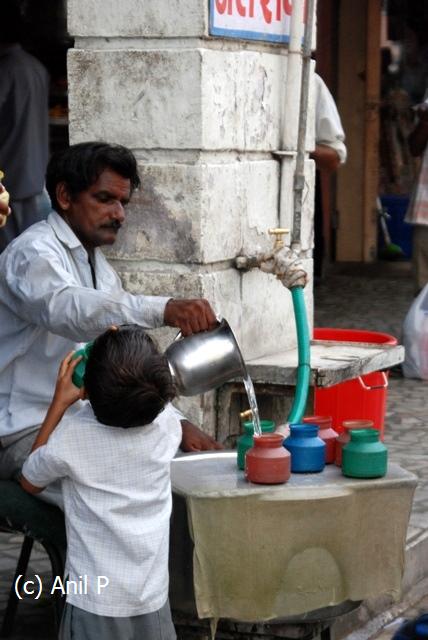
It gets hot at noon in Jodhpur. Very hot. And the middle-aged man manning the makeshift table set up in the street outside Janata Sweet Home, dispensing water out of plastic mugs to the thirsty passers-by served to remind us of the heat after the momentary amnesia from sampling Makhaniya Lassi inside what is easily among Jodhpur's best known shop for sweets and savouries.

We had walked through Saddar Bazaar, home to the clock tower, before time came to a standstill the moment we were beguiled by the Makhaniya Lassi that at once soothed our appetite in as a much as it whetted it.

But it was the Kachori, leaving that lingering taste of Ajwain and Sabuth Dhaniya (whole dry coriander seeds) behind, and the Makhaniya Lassi that were flying off the counter. At first I didn’t think I’d gulp down more than one lassi. I called halt after the third only so I could sample the other savouries on sale - Mawa ki Mithai, Bangla Mithai, and Shudh Desi Ghee ki Mithai among others, priced at Rs. 130/-, Rs. 120/-, and Rs. 140/- a kilo respectively. It’s a pity that unlike the cow, the human stomach is not divided into four parts, each section freeing the others for their functions.

Handed out in a plastic cup, the Makhaniya Lassi at the Janata Sweet Home was quite unlike any I’d had before. A dash of powdered pista on the top rounded off the thick serving of butter prepared to a recipe that instantly dissolved the Jodhpur heat.


Unlike on the coast the heat in Jodhpur will not drain you of fluids or discomfort you to the point where you’d be hard pressed to resist emptying a crate of cold drinks down your throat. The heat in Jodhpur is of a different kind. It can scald your head if you’re out in the mid-day sun in the summer. It can bore a tunnel through the forehead without anyone drawing a bulls eye between your eyes. And it doesn’t help that Jodhpur is the gateway to the Thar desert.


While September is no summer by any stretch in this historic city, it’s nevertheless intense in the street. And this from someone who's no stranger to the heat, having spent much of my vacations from school riding the streets in the Deccan heartland in temperatures reaching and exceeding 44 degree C while most sought the shade of their homes. Even so I’d have expected September to be a mite cooler up north but it wasn’t to be. Blame it on the canvas strap around my neck weighted down by a camera and sundry other things in the bag.


But watching three local men outside the sweet shop nonchalantly digging into Mirchi Bhajia had a salutary effect on me. While the valour of Jodhpur revolves around the martial history of the Rathore dynasty who worshipped the Sun no less and the Mehrangarh Fort rising solidly on a hill top in the distance, I’d nevertheless be surprised if there isn’t one song dedicated to Jodhpur natives' penchant for beating the noon heat with a hot, spicy Mirchi Bhajia.

Talk of fighting fire with fire, surely there must be some truth in it.

It helped that the silent man manning the Jal Sewa counter had water ready. While providing water to the thirsty has a bearing on good karma, I’m not so sure it holds as much value if dispensed to soothe the fire raging from ingesting Mirchi Bhajia. I need to check the Jal Sewa’s Karma Quotient for the latter.


A board bearing Jal Sewa in devanagari script on a pillar announced the water service and imbued the water dispenser’s work with a certain permanence. Not everyone stopped to drink water. Some washed their hands after finishing off savouries sourced from Janata Sweet Home before washing it down with quick gulps of water from the colourful plastic tumblers.


The man tasked with distributing water to thirsty passers-by sourced water for the Jal Sewa from a tap attached to the water pipe supplying drinking water to the building. I thought it likely that the owners of Janata Sweet Home ran it as a public service, helping passers-by beat the heat.

Few shops will tolerate ‘obstructions’ leading up to the entrance unless it’s their own. And moreover Janata (read Public) is as old-school as names of shops go. The water service (Jal Seva) would qualify for public (read Janata) service, its noble intent sharing the name with the shop.

While there’s little reason to pause along the way elsewhere, the water on offer was as good a reason as any to catch a breath while contemplating the lure of the cool Makhaniya Lassi barely a step away.

Or the Mirchi Bhajia depending upon what your ‘beat the heat’ philosophy is.

February 18, 2011

A Cricketing Metaphor


Since the time Cricket broadcasters and Indian advertisers deemed it fit to push L-shaped ads, Pop-up ads, Exploding ads, Crawly ads in the middle of a delivery of all things during the recent India – South Africa cricket series, heralding a new low for even the greedy broadcasters and the even greedier BCCI, reducing the cricket telecast to interspersing cricket between unending intrusive advertising rather than the other way round, I’ve come to dislike brands who intruded into my viewing pleasure so blatantly and put me off all things cricket in print and on TV.

I steer clear of the clutter now, and am apprehensive of switching on the TV for fear of running into yet another segment of Dev’s Devils from 1983. I’d want India to win this year’s World Cup if for nothing than at least so we’d spared of the aging narrative of the 1983 team repeated ad nauseam each time the World Cup swings into view. I’d rather have Dhoni’s Dhulaiwaley given the bar stools four years hence, not that they’d offer any more insight and drama on the studio camera, but at least the faces would be different.

I think it’s a good enough reason for me to cheer the Indian team on. And this coming from someone who, barely out of primary school, sat through the grainy broadcast of the 1983 final on EC TV where the players were indistinguishable from the Lord’s grass, cheering them on on the strength of radio commentary since the fierce hiss on the only TV in the neighbourhood had all but turned the commentary on TV barely audible.

Fortunately, the streets are relatively free of cricket advertising heading into the World Cup unless you’d consider the India Today cover plastered on a Telephone Box at the corner of Nanabhai Lane in Fort a part of it.

Even so I’m delighting in the snatches I overhear on my way about the city. And none more so than the exchange between two youths I overheard recently on my way up the crowded stairs at a suburban railway station.


In rush hour local train traffic I negotiate the stairs connecting the over-bridge servicing railway platforms more from instinct than anything else. The steps are barely visible among assorted feet jamming the stairways.

On reaching out to steady his friend who stumbled on a step behind me, nearly falling in the crush of bodies, the smiling saviour could not resist quipping in jest:


Rough Wicket Hai,
Gir Jaogey.
Simple Delivery Bhi,
Googly Hai.


And the magic was back on. Show me the remote.

February 15, 2011

Home On Uttrayan Eve in Ahmedabad Pol


He saw me much before I noticed him. His window on the first floor overlooked the turn that led into Kuvawalo Khancho, located in Doshivada ni Pol in Ahmedabad’s old neighbourhood of Kalupur, not far from the Shantinathji Mandir in Haja Patel ni Pol we had passed through earlier.


The narrow lanes breathed history, their legacy and antiquity on display as much in the wear of doors splintering from age as in intricately carved woodwork gracing facades and balconies of homes variously dating back through the centuries beginning in 1760 or thereabouts.


Too often in India, where the antiquity of a neighbourhood or a house is in question, the earliest recorded date of construction is likely to be the earliest surviving record, unless the owner happened to engrave the year on the wall.

At the point where the Calico Dome lay crumpled, retained as much for its former architectural significance as for its significance and role in Ahmedabad’s textile legacy, we had crossed the Relief Road apparently built to ‘relieve’ the main thoroughfares of traffic but Amdavadis will joke that while the intention was noble at the time of its construction years ago, the Relief Road is now the most crowded, and it’s likely a smiling Amdavadi will quip, “No relief on Relief Road,” in an accent that is decidedly Gujju, the OOOs arcing through the air in abandon while delightfully reminding of a jest for life.


However we saw little or no traffic on Relief Road that morning. It might’ve to do with our taking to the road early. Even for the enterprising Amdavadi, eight is a tad too early to be plying his trade. Moreover it was the eve of Uttrayan or Makar Sankranti as it is known elsewhere in India when we found ourselves in Kalupur, a time when much of Gujarat, and Ahmedabad in particular, forgoes all worries and responsibilities to take to the roofs to fly kites.


Much of everything comes to a standstill. The Manja makers were busy at work lacing kite thread with powdered glass for use in flying fighter kites on Uttrayan the next day, a Friday.

Resting his face lightly on a wooden length framing the open window, and prone on a bed set at the window his was truly a room on the roof. The blanket was askew at where he had likely stretched his limbs upon stirring to life at the stroke of dawn. If his window were facing the east the clothes hanging from a line outside the window might’ve shielded him from the awakening sun.


I had sensed eyes on me as I approached the turn in the lane and instinctively looked up seeking the gaze before finding it framed in a smiling face pressed to the wooden lengths.

It’s easy to guess in the manner of a school boy if he has any intention of going to school that day, or if it’s a school day to start with. For one it’s unlikely he’d be smiling and lingering in bed if there’s a roll call to answer later. And nothing in his demeanour indicated he had to answer one that morning. Even so I couldn’t resist asking him since it was a Thursday.

“Not going to school?”

“No,” he replied, smile widening. For a moment I thought he might be actually pleased to be reminded he didn’t have to go to school that morning. Reliving it must somehow double the pleasure to a school going lad.

“Isn’t Uttrayan tomorrow?” I persisted.

“It is. But we’ve holidays starting today. Three days.” The smile never quite left him. Apparently, Vasi Uttrayan, the day following Uttrayan, was a holiday as well.

Thursday. Friday, and Saturday.

Then there’s the Sunday.

January is a nice time to be going to school in Gujarat I thought as we parted, skipping along, dodging cows and silence in equal measure.


Glossary: (1) Khancho is Gujarati for ‘Open Space’. (2) Pol is derived from the Sanskrit ‘Pratoli’, meaning ‘Gate’ or ‘Entry’ to an enclosed area, here Pols are micro-neighbourhoods with houses on either side of a street, with access controlled by the gate. (3) Manja is kite thread developed to sharp edge using powdered glass bound by adhesives, including rice paste. (4) Mandir is Indian for temple. (5) Uttrayan or Uttrayana denotes the period (six months) when the Sun travels North on the celestial sphere, the beginning of which is celebrated as Makar Sankranti or Uttrayan.

February 09, 2011

Trucks Roll On, Roll Off Konkan Railway


Before the Konkan Railway came into being, connecting Mumbai with Goa along the Konkan coast, I would travel to Mumbai and back by bus, along roads winding through villages and hamlets hidden among trees and interspersed among rice fields. To watch a villager walk by in the backdrop of mountains would be watch tranquility nudge time along.


Sometimes the bus would pass close enough for me to make out the farmer’s features as he ploughed his rice field in ankle deep slush, goading his oxen on with short guttural commands. In the next square would be another farmer with his bullocks, the scene repeating for many miles along the Konkan stretch.

The sameness never jarred, instead it sought to connect me with a tradition, even if fleetingly, that’s barely changed since the time humans first began to work the land, rooting them to the earth just as surely as wings root birds to the skies, and as irresistibly as a bend in the road draws a wanderer’s feet to it.


If the skies were blue and an occasional cloud were to be making its way across, the water in the rice fields would reflect it just as clearly as if I were craning my neck out the window to sight it in the skies. And in the water I could see the breeze I felt on my face pressed to the window.


The pastoral scenes along the Konkan stretch filled in the hours well. Soon enough the rumble of the bus became a steady hum, receding to the back of my mind like an insistent fly buzzing about in a room stilled by the noon silence. I might’ve been in a theatre watching a slide show of picture postcards play out and not know the difference.


The Goa - Bombay journey was a long one, and the only time I was brought up to a thudding break in the middle of the scenic slide show was when the driver would occasionally swerve wildly to sway out of the path of an oncoming truck joyously muscling his way past a terrified bus-load of staid passengers. I’ve had my share of these untimely thrills over the years to an extent that I began to keep a wary eye out the window for an oncoming truck if only to give me a momentary head-start for a bracing impact, helped no doubt by the occasional wreck left to rust along the Bombay - Goa route, macabre installations that might yet be turned into art someday if only to remind a traveller of the perils that his Karma might’ve in store for him.


I needn’t have worried much, for I’ve lived to tell the proverbial tale. It’s just that having shifted to traveling by the Konkan Railway, and my encounters with trucks on the highway having reduced to seeing them waiting alongside bullock carts at railway crossings, watching my train thunder past, I was nevertheless reminded of my highway journeys when, three years ago, the Mandovi Express I was traveling by pulled up alongside Konkan Railway’s RO RO service for trucks, shortened from Roll On - Roll Off.


The Roll On - Roll Off flatbed rail car was headed the opposite direction with its cargo of thirty trucks transporting goods when we passed it shortly after leaving Khed.

Doors open, the drivers and cleaners were probably twiddling their thumbs, or maybe playing cards awaiting Kolad, their Roll Off point 145 kms. short of Mumbai. In all likelihood they’d Rolled On at Verna in Goa, or maybe at Suratkal, 20 kms. off Mangalore.


The Konkan Railway operates the Roll On – Roll Off (RO RO) service for truck transportation between (1) Verna – Kolad, (2) Suratkal – Kolad, and (3) Verna – Suratkal. The Verna – Kolad stretch is 421 kms., while the Suratkal – Kolad route spans 721 kms.


A little over a year ago reports had suggested that Konkan Railway had made profits to the tune of 120 crores from their RO RO service over ten years, the service having commenced in 1999 before recommencing after a minor suspension of service in between.

The trucks have to obtain height clearance before they’re permitted to Roll On the rail car at the loading point to ensure a safe clearance through the slew of tunnels along the Konkan Railway route.


It must be a welcome change for drivers to sit back and take in the picturesque Konkan stretch from the safety of their cabins as the rail car proceeds to their destination along the coast instead of keeping up through the day, and the night hunched over the wheel.


Needless to say it saves drivers long hours of driving, cuts down on transportation time between the destinations serviced, saves trucks from the wear and tear of the road, and the owners of fuel costs, bypasses check posts and the inevitable greasing of sundry palms along the way, primes the business for quick turnarounds on account of reduced travelling time, and most importantly reduces the probability of accidents resulting from reckless, drunk, or fatigued truck drivers. The opposite is also true, saving truck drivers from accidents resulting from reckless, drunk, or fatigued drivers behind the wheels of sundry motor vehicles.


Watching the trucks idling in silence, I couldn’t help wonder if my own journeys by bus might not have benefited by fewer ‘thrills’ on the highway if this service was up and running back then. It’s another matter really that if Konkan Railway was around ‘back then’ I might never have traveled between Mumbai and Goa by bus to start with, though I’d continued with traveling by bus to elsewhere.

Watch Video: Roll On, Roll Off (RORO) trucks, Konkan Railway


While 30 trucks ‘removed from plying on the highway’ might seem too few a number to make a significant difference to the health of other motorists on the highway, and which might indeed be the case more so now than when I used to travel infrequently to Bombay and back by bus as a school boy, it’ll nevertheless make highways safer considering the service runs each way and is set to be increased with rising demand for the same besides the likelihood of being adopted across the country.

February 06, 2011

A Sabarmati Moment


Later, stepping past the entrance and onto the freshly washed tree lined approach reflecting the morning sun in tiny pools of water each time a light breeze blew in from the river, nudging leaves into letting light course through and momentarily relieve the shade of its cool, moist grip, I paused to watch a young boy trail a kite behind him. He tried in vain to interest his pet dog in his morning endeavour but it had other priorities than follow a paper kite.


Watching the kite rise up behind him the boy ran up to where the path forked at the Upasana Mandir, the ashram prayer ground where inmates of the Sabarmati ashram used to gather with Mahatma Gandhi for morning and evening prayers and his sermons, before turning and running all the way back, scattering squirrels back up the trees. In the shade of trees, the prayer ground overlooks the Sabarmati river.

A lonely figure of a young woman of foreign origin sat hunched over a book in the warmth of the sun, oblivious to the shrieking of parakeets perched on the concrete wall channeling the river onward.

In an opening between raised platforms a wide flight of steps led down to the river. Scattered on the steps were youth in deep contemplation, gazing fixedly at the shimmering waters of the Sabarmati, their whispers if any lost in the breeze. The only sounds floating up were of parakeets squawking urgently, followed by those of crows. Even the steady crush of leaves as sweepers cleared the litter seemed to emerge from the trees, of which a wide variety was represented, among whom the Neem and the Ashoka seemed to be particularly favoured.


Flowers were many, in kind and number, drawing Sunbirds into their midst. It had taken me only a few moments after stepping out the rickshaw to find out that while times had changed, timelessness had not.

February 03, 2011

On The Streets, Stray Dogs Ensure Welfare Of Humans

Sometimes the obvious is not nearly as obvious. It’s entirely possible in this age and time to ‘know’ about ‘everything’ at the click of a link and yet not know a thing about most things that matter in ways beyond the cursory as we happen upon them when going about our daily lives.

I’m inclined to believe that this might be truer of those of us who live in Mumbai or cities like Mumbai where making time a premium commodity, to the exclusion of the timelessness of the laidback, is considered a necessary virtue and held up as a standard to emulate. Any exception to the contrary is likely dismissed as a ‘wasted life’ even if not said so in so many words.

This was brought into sharp focus by Abodh’s post the other day.

On occasional walking forays about the city I'll sometimes pause to meet the eyes of a 'stray' I’ve noticed from my earlier walkabouts, delighting in a secret way the sense of permanence the assortment of wet noses and friendly tails bring to nooks and corners of the city they’ve come to inhabit alongside humans who live and work on the streets. In those occasional moments it never occurred to me to contemplate on the depth of bonding that stray dogs and cats will share with those who begin to care for them from mutual familiarity on the shared street, at least not in the way Abodh experiences in his work with stray dogs in Mumbai.

While I knew of the bonding on the street between 'strays' and humans as a fact, I realized I didn’t know of it from experience.

Reading about Rambo, Tiger, Soorya, and Ronnie whom Rajan, a rag-picker, named after his son who died aged two, and other kindred souls like Karunakaran Pillai in Abodh’s warm reminisces in his First Aid Sundays with Street Dogs and Humans merely reinforces the fact that all that seems obvious at first glance isn’t really that obvious the first time around.

While Abodh’s narrative plucks tentatively at heartstrings, there’s nothing tentative about the warmth the stray dogs bring to lives on the street.

It’s in the light of his poignant reminisces in the post linked above that the annual calendar brought out by The Welfare Of Stray Dogs (WSD) takes on a different meaning.

Extending WSD's assertion that: Stray Dogs Are A Breed Apart, I'd add: For More Reasons Than One.

Here’s where you can still buy The Welfare of Stray Dogs (WSD) Annual calendar featuring strays with stories in their eyes.

A peek into the WSD Annual Calendar:


Below: Isfahan, a ‘Rags to Riches’ story, came from a Mumbai street.


Below: Rocket, now the ‘King of the Couch’, was born in a WSD kennel.


January 03, 2011

Wandering Feet


Kolkata. West Bengal.


Some things changed,
Some things did not.

That which changed did not change everything.
That which did not change stopped nothing from changing.

Things meant to change did not.
Things meant to remain the same, changed.

In the lull between the push and the pull my eyes rested,
Suspended in the momentary equilibrium of my wandering feet.


December 31, 2010

The Sultan


“He is Sultan,” said his caretaker on the street outside a makeshift shaadi ka pandal in Aurangabad. He looked every bit of a Sultan, commanding his Sultanate in the admiring glances of passers-by.

A Marwari wedding was scheduled for later in the day, and Sultan basked in the Sun while he waited out his turn to ferry the groom through the streets of the old city.


While Sultan’s eyes were shielded behind his blinkers, the regal red set off his flowing mane in the late afternoon sun, and I could not help imagine what he must make of his majestic bearing used to embellish those who might’ve little or none of their own.

December 21, 2010

The Open Road


Kankavli, Maharashtra. 2008.


Trust the road you walk on
To lead you along,
So you’re never lonely
When you’ve to walk it alone.

Should you return the same way
Lend your ear to the grass on the margins,
So you may hear it whisper
The song of the open road.


December 14, 2010

Fiat Ducato Campers At Kala Ghoda


I was pleasantly surprised last weekend to see three motorhomes (alternately called camper vans or RVs as in Recreational Vehicles) parked together in the traffic island along K. Dubhash Marg in Kala Ghoda, Mumbai. The number-plates and the profusion of stickers on the back of the vans, more so on one of the two Fiat Ducato Campers, evidently marking countries traveled through, indicated of foreign tourists touring India by road.


It's unlikely that they collected the stickers along the way at each port of call on their overland journey through countries before driving into India, it’d be too much of a hassle to locate one in each country that one is passing through.


It’s more likely they’d purchased the stickers before starting out on their travel, possibly sticking each one on the back as they crossed international borders.


The two Fiat Ducato camper vans were joined by a Mercedes Vito F, or so I think as the logo identifying the Mercedes camper van model was not immediately readable, at least not from the acute angle on the left. The raised V (the larger of the four letters) obscured the rest, particularly the adjacent (smaller) letter, rendering the logo in the kind of flourish that some logo designers will only too happily relish creating as a tribute to one of their inexplicable doodling moments fuelled by cigarette deprivation, or worse for want of spirit fuelled inspiration. Among differently-sized letters raised on a surface, the smaller letter adjacent to the larger one will be obscured when viewed at an angle.


The blue Fiat Ducato was seemingly spared the dust coating the light coloured Fiat Ducato parked adjacent was subjected to on its India travel. When travelling around India by road, it helps to be painted in dark colours if only so the dust will not make itself immediately apparent on the surface, small consolation actually.

A muggy winter day in Mumbai is as good a day as any to be up and about. However the light on the street did not mirror the unusually blue skies overhead, heightened in no small measure by the occasional white cloud sailing free. Post-monsoons, approaching winter, is a good time to travel to India. In the US, the occupants of the three motorhomes would be known as Snowbirders, for escaping the harsh winters of their native countries for the relatively warmer climes nearer the equator, not unlike migratory birds.


While I was interested in having a look inside I contented myself with the exteriors. Considering how difficult it can be to avail of railway reservations to and from major destinations in India (if not booked in advance), in addition to hotel fares on the upswing during the holiday (nee traveling) season in India, the winters, it actually makes eminent sense to get a camper van with amenities that’ll allow a sleep-in on the road every once in a while.

The Mercedes Vito F at Kala Ghoda was smaller in comparison to the two Fiat Ducato motorhomes parked alongside. Contraptions fitted to the back of the van and the roof possibly made space for luggage, or maybe beds. I couldn’t tell for sure. Travellers are known to carry bicycles strapped behind, or even motorcycles.

The lighter coloured Fiat Ducato appeared to be fitted with a retractable roof that motorhomes will sometimes be equipped with to accommodate a roof bed and provide for standing room. Where hydraulic controls are absent, the roof is operated manually, elevated when needed, and covered on the sides by canvas fitted with fly-screen vents.

The Fiat Ducato has a major share of the motorhome market in Europe. The chassis is made available in various lengths, as also height, to suit customer requirements for space to accommodate their travel requirements when converting the caravan base into living quarters. The two Fiat Ducato motorhomes I saw were of similar size and would comfortably fit four in each.

It bears thought why motorhomes cannot similarly succeed in India considering the conveniences it can offer on the road even if we were to discount the fact that such travel will likely mean skipping the India of public travel and related experiences.

If the Indian traveler is prepared to put up with the few inconveniences of the road as opposed to the conveniences of a hotel, namely facilities to wash up in the mornings, he could benefit from being able to sleep out in the open, under the stars as he travels across India. It also bears mentioning that for the concept to take off, towns and cities will need to plan for washroom facilities at the very least for Camper Van/Motorhome travellers without having to book into hotels to avail of them, assuming it's difficult to tank up on water along the way or manage waste disposal.

If that were to happen I’d expect each state in the Indian Union to issue a state logo reflective of the state that the traveler could then stick on the back of the motorhome, collecting stickers along the way at each crossing of state borders. Imagine how much better the mass of stickers would reflect India than if it were to be indicated by only the flag.


Note: Of the two Fiat Ducato motorhomes parked alongside, one prominently advertised Adria Space, the entity that designs motorhomes to suit customer requirements, fitting the design to the Fiat Ducato chassis, like is possible to do with models by Auto manufacturers in the Motorhomes / Campers market.

While I could not see the interiors, the Adria Space page highlights the custom-made interiors they offer to customers. As you’ll see, it’s not made for the backpacker experience. India backpackers will be advised to do it the old and more fulfilling way.


Note: Motorhome / RV Living options in India are limited. If custom-built in India as some Western travellers have, using the Mazda chassis, or bus-frames at local manufacturing facilities, they'll likely offer up their motorhomes / RVs for sale in India before returning, finding it economical to sell it than incur import duties if they were to ferry it back.

Mark, an American, got a motorhome / RV custom-built in Goa, and is now offering it up for sale.


Related Links

1. Explore the Fiat Ducato Camper


December 12, 2010

The Venerable Father, And Grime Riot Disco


It was not just the poster imagery that drew my attention to it on the pavement outside St. Andrew Church, Bandra. That it was overlaid on a flyer announcing Venerable Father Agnel’s Day was one reason, more so since Ven. Fr. Agnel’s Day, Nov. 19, was scheduled for a little over a week after the event that was plastered over it!.

The puff of shy chest hair and the African style suave blue head wrap secured in the front and above the forehead with stylish bobby pins, the millipede styled tuft at the back I’ve no idea of, and proclaiming on a sleeveless tee “I Left My [Love] At Disco”, had enough yellow and maroon, or was it red, to stop church-goers in their tracks barely a stone’s throw away from the horse driven carriage festooned with red and white balloons outside the entrance to St. Andrew's Church.

With Christmas still weeks away, Bandra store-fronts were already beginning to wear a festive look. But what stuck me about the poster, aside from papering over Ven. Fr. Agnel’s Day announcement, was it listed no venue, no announcement of who was performing, nothing. Except for the day, announced prominently. 11.11.10.

To those who knew, the day was enough. To those who didn’t, they didn’t matter for, if they did, they’d know who and where, and most importantly how. So that was that. There was every bit of underground feel to every bit of the announcement - GRIME RIOT DISCO.

It fitted Bombay well. Grime, there’s enough of it if you’d care to look. Riot, there’s been enough of it anyways, of the blood variety that is, unless you’re not prepared to discount local train travel. Disco to forget the grime, and the riot.

The poster on the circuit box screamed – Closed Group. For the moment it still is, if the Facebook page for GRIME RIOT DISCO, only listing Kunal Lodhia, Monica Sharma Dogra, and Anamika Singh, is anything to go by, with only the RSVP for the party put out on Facebook. Partly the lure, I’d assume.


Monica Sharma Dogra of Shaa'ir + Func announced it on Twitter the day before. It turned out that GRIME RIOT DISCO was scheduled at Club Madness in Khar’s Ramee Guestline Hotel, with word getting around via Facebook, and selective promotions at events around the city.

Anamika Singh of FlirtEve, an Event Planning outfit, was tasked with getting the party going, while Kunal Lodhia of WETHEPPL would use it to promote his entity’s artwork, and if his only tweet, “sometimes barbers pretend to snip behind your head so the scissor makes sounds and you feel like you're getting your money's worth.” was anything to go by, the promotional would be side-fare to the music.

With GRIME RIOT DISCO announcing on its Facebook RSVP page: This is the party we’ve been waiting for. Grimey, raw, egoless, ass on the floor, fun. Bombay’s loud. We’re louder. Get into it, it didn’t need a soothsayer to tell you that Ven. Fr. Agnel stood little chance with Bandraites, surely not with the young and the restless, definitely not with a further promise of cheap booze and big sound the organisers threw in for good measure.

However, his faithful, now hopeful of his canonization after the Vatican declared Fr. Agnel, a Catholic priest of Goan origin, Venerable, even if the process of beatification and sainthood is likely to last long with no certainty he’ll ever attain sainthood, have an even bigger battle on their hands than the one with the Vatican – that of ensuring the posters announcing Fr. Agnel’s Day will be read by church goers atleast until the day has passed!

Until then it’s Club Madness ahoy for GRIME RIOT DISCO, or rather was.