July 21, 2007

The Shiva Temple by the Bhima


It took me awhile to locate the black and white pictures. I found the album under a stack of books in my cupboard. As I opened the pages, the residual smell of the Goan monsoon leapt at me from the pages, discoloured over the years by an alternating mix of dry and wet weather. The paper had gone damp, and I resolved yet again to transfer the photographs to a new album before the monsoon came around next year. There is a very real danger of paper falling apart in the humidity unless the white ants get there first, in which case it will be gone even quicker.

I held the pictures to the light in the window that looked out on a teak tree shedding its leaves again, like it has done for five years now since the time it was a sapling in the year we made our home here. Since then Magpie Robins and Rufous Backed Shrikes routinely perch on its branches. I’ve been lucky to hear the Magpie Robin belt out sumptuous melodies perched on the teak’s bare branches. It is a timeless feeling to hear it sing so.

I draw the album closer to my face. A set of three black and white pictures show the family in the raised courtyard of the ancient Shiva temple at Havalgi, a small village in Afzalpur taluka, deep in the Deccan plains of India. In one of the pictures my uncle, the eldest in our family and dad’s first cousin, is holding a silver bust of Lord Shiva, photographed just before it was installed in the temple. Our family was donating the silver bust to propitiate the deity for a wish fulfilled as is largely the custom in the hinterland. Aunty is standing beside him, and so are my parents, Jai, and I. Behind us two trees rise up to the platform, and ascend to the sky, shielding us from the heat of the mid-day sun. I am bare-chested in the photograph, and so is my cousin, Jai. As I see the fading photographs now, a faint memory stirs within me and I narrow my eyes and scan the forms in the photographs.

We’d just come off from bathing in the river Bhima, now shimmering in breaks in the canopy behind us. Walking barefoot from the banks of the river where I had spent the morning floating in waist high waters, and up the incline that stretched over hundred metres to where steps cut in the fort-like walls led to the temple courtyard, it seemed like eternity. Soles burned as I half-ran the distance, shifting from one leg to another to minimize contact with scalding gravel. I was eight years old, and Jai, three and half years older. The entrance to the temple ran along the length of the raised platform that served as a courtyard, facing the Bhima to the north. Four pillars rose from the raised porch fronting the main entrance that led to the mandapa or pillared hall where later we, family members, gathered to watch puja being performed in the garbha griha (literal translation is 'womb house').

In Indian temples the mandapa opens into the garbha griha that houses the deity under the shikhara or the temple pinnacle, in this case the garbha griha housed the Shiva lingam. I always found the mandapa at this Shiva temple dark and gloomy but grew to like the atmosphere for, oil lamps glowed brightly and so did the arti performed during puja, the bell echoing in the confines while we folded hands and watched the priest intone Sanskrit shlokas as his right hand traced flaming arcs in a clockwise direction, the arti glowing bright as beads of sweat trickled down the bare back of the Brahmin priest while he rang the small brass bell by its handle gripped in his left hand. Tradition demands that only males be allowed entry into the garbha griha after a dip in the Bhima. It was young Pratik's turn in the picture while Vasanna looks on. In the foreground Achambhatt is intoning Sanskrit shlokas from a well worn book, yellowing as much from use as from age. To our right lay the silver bust of Lord Shiva that our family had installed years ago.

A Skylight lit up an adjacent room where large cooking utensils were stacked up against blackened walls. During community functions the utensils are lent out to visiting families for use in cooking, usually for a fee. Looking at the blackened walls I suspect some of the cooking takes place in that room. Out in the Deccan Plateau, particularly in the villages, it is not uncommon to find skylights in houses that are built adjacent to one another with no scope for windows except in the ceilings. I distinctly remember lying on the floor beneath a skylight and counting clouds passing that way until it was time to go out and play. Each room had its own skylight. It is possible to trace the 'path' of time by looking at Sunlight streaming down a skylight and tracing its path in the room as the earth revolves in the skies. My granny used to be very good at it. Standing there as if waiting for the walls to speak up I could hear voices floating in from the river behind me.

The Bhima, a tributary of the Krishna, ran low as it meandered past the ancient Shiva temple now displaying cracks along its outer walls in an earthquake years ago. At places in the walls cracks snake down along the length of beams. Originating in Maharashtra the Bhima had come a long way, passing through Karnataka on its way to Andhra Pradesh, covering 725 kilometres on its journey before joining the Krishna on its way to the Bay of Bengal. Behind me rocks rose from the riverbed, too hot to touch. Vegetation was set back from the banks of the river. Women ferried clothes in metal buckets to be washed in the river while young boys carried water ashore in brightly coloured plastic pots balanced on shoulders while women preferred to carry them on their waists, hands curled around the neck to keep the pot from slipping off.


In the years gone by pots used in hauling and storing drinking water used to be made of copper, heavy enough to survive impacts with uneven walls while being hauled up the deep wells using coir ropes that village folk usually made at home. Growing up I learnt to make ropes from raw coir, my hands and thighs turning red from the constant ‘rolling’ required in making ropes. Keshava, our farm-hand, taught me how. I also remember him using flint stone in lighting up his own brand of beedi, whose ingredients I was unaware of but which he diligently concocted, it took the form of a ritual in the afternoons. I used to tag along with him a great deal.

Buffaloes on the banks of the Bhima stood watching people, large brass bells hanging from their necks, their jaws moving rhythmically. Drops of water glistened on their hides as the Sun beat down. Their seemingly vacant gaze fixed on nothing in particular. Womenfolk from the village washed them down in the river, not far from where I lay floating a few minutes earlier, and after they were done bathing the buffaloes they handed over the reins to their children to walk them back to their homes, then the women returned to the rocks and reached for their basket of clothes and made for the flat rocks where they beat the clothes to within an inch of their durability, all the while their arms tracing quick arcs as they brought the unfortunate garment crashing down on the rock in a loud thwack. The current ran steady that afternoon and I had lain in the water watching soap bubbles from all the washing dodge rocks and make their way downstream lazily. In the monsoons the rocks disappear under surging water as the Bhima breaches its banks. Flash floods are not uncommon along its route, something my father used to caution me against.

On my travels to Gulbarga and back, as the red coloured KSRTC bus kicked up dust on rutted roads, bumping uncomfortably along Sunflower fields sandwiched between large swathes of Jowar crops, I always made it a point to peer through the window as the bus passed the bridge over the Bhima near Devangaon in Afzalpur taluka, not far from Havalgi. Unlike Afzalpur where I often stopped over at my Aunt’s on my way back from Gulbarga, I stayed away from Devangaon. To this day I remember Devangaon for the feud that led to 4-5 people being shot dead in the KSRTC bus while shocked passengers watched the carnage from the back of the bus. Later Jai told me that the fifteen-odd people involved in that carnage eventually died one after the other, done in by their colleagues in internecine fighting until none survived. At the time I was camped at my uncle’s place in a nearby village a few kilometers away while on a vacation from school.


That evening as the village came alive with kerosene lanterns or khandils as they were known, village folks talked in hushed tones of the killings in the narrow bylanes that snaked between stone houses by the narrow open gutter that ran the same length where sometimes pigs settled in to escape the summer heat. Bells sounding from buffaloes returning from grazing grounds punctuated their voices as firewood caught on in the open chullahs, blackening further the utensils as the tava warmed up for the bhakri (made from ground jowar) that village folk ate with spicy chutney made from hot chilly powder (khar pudi in Kannada) laced with ample garlic.

I remember this because I waited out on the steps in our large courtyard for our buffaloes to return home from their grazing grounds while folks sat outside on stone platforms fronting their homes. Behind them, in the open doorway khandils flickered in stone shelves (for want of a more appropriate description) carved out in stone walls and adorned with quick decorative patterns in red oxide painted with brushes fashioned from dried stalks of hay sourced from Jowar crops; over the years on my visits to the village during school vacations I helped my uncle decorate the shelves with simple patterns in red oxide paint, usually during Diwali when the house got a fresh coat of paint. On the outside of houses in villages in the Deccan it is not uncommon to find doors colourfully painted, usually in green or sky blue with floral patterns decorating the wall holding the door.


At the time of the Devangaon killings I was still in school and had little idea of death and destruction except maybe from Amitabh Bacchan movies, and it was not until a couple of years later when Jai and I came upon a man lying dead on a narrow mud path while we were on our way to the countryside in Gulbarga outside Brahampur (the locality got its name from being home to a large population of Brahmins or Brahmans who had made it their home over the years) to complete our morning ablutions since Guraj’s one room rental in Brahampur near the Raghuvendra Swami mutt came without a latrine, that I saw firsthand a murder for the first time. But that is another story.

On either side of the bridge over the Bhima the landscape along its route opens up the countryside and since most of my trips were during my school vacations that got over before the monsoons arrived in Karnataka I never really got to see the Bhima at full tilt, except maybe once. But that was a long time ago when the bus we had boarded in Gulbarga stopped ahead of the flooded bridge, waiting for the Bhima to recede while we, Mum and I, looked out the window watching the river in spate, flowing over the bridge in menacing silence. Several hours passed before we could see the bridge again. Behind us a long line of buses, Ambassador cars, tractors, bullock carts, and bicycles queued up. Folks had gotten off their modes of transport and formed circles where they stood chatting, some sipping chai from a roadside vendor. In North Karnataka, bus-stops at villages dotting the route are lined by little shops with tin roofs where wooden benches under sparsely leafed trees serve as seating space for villagers breaking for tea and snacks. It was no different that day by the bridge off Devangaon.


If not for the flooded bridge there was little to suggest in the mood prevailing among passengers who had gotten off their transport that this was no village centre and that folks gathered by their vehicles were strangers until then. Every once in a while they regarded the flooded bridge with easy patience before turning to continue their conversations. They accepted that every once in a while Mother Nature would have her way, and it made sense to let her. It was a part of life. India of the hinterland is different from the India of the cities and towns, and nowhere more so than in North Karnataka, or so I believe.

When I returned to Havalgi recently we missed our way past Afzalpur. A Shepherd pointed out the correct direction. His herd was a mix of sheep and goats. They kicked up a fine dust in trying to make way for us. As we motored past kilometers of black alluvial soil dotted with sparse, short trees and thorny shrubs known as jaali mullu (mullu is Kannada for thorns), I kept my eyes open for crops, particularly Sunflower where years ago as a kid I used to lie amid the blooms looking up at the sky and seeing shapes in the clouds as they floated past while bells tolled from Oxen tilling adjacent fields.


But ever since the Almatti canal found its way to the arid regions of the Deccan Plateau a few years ago, farmers have mostly taken to growing sugarcane, a source of much riches, and great despair if sugar factories face a glut in supply and turn away tractors heaped with sugarcane, leaving the farmer with little choice but to stir massive vessels with sugarcane extracts in making jaggery.


Reaching Havalgi temple that day was a breeze, but looking back now I cannot help remembering with fond memories the thirty kilometers we once did by bullock cart many years ago on our way from Almel to Ghatargi, not far from Havalgi, to watch seedi. There were 126 seedis scheduled for the day and we reached Ghatargi with only four left. To this day I can recollect vividly the throng of devotees at the Ghatargi temple crowding one seedi as they passed an iron hook through his back before hoisting him up by a wooden pole and rolling the cart through the village while hushed whispers sounded around me from necks craning up to watch the seedi suspended in the air from the hook through his back. The religious significance has only strengthened over the years. It had taken us a good part of the day to make the journey that day years ago, descending the rutted road into fields each time the Oxen turned flightly and skittish on seeing Karnataka State Transport buses bearing down on them in a fearsome cloud of dust. That night I slept soundly under the bullock cart like scores of villagers around me. Likewise most of them had traveled from far and wide by their bullock carts, some by buses, on their way to the Ghatargi temple.

Standing in the courtyard now and gazing at the Bhima through the trees it seems like another age now. Later in the day we were scheduled to leave Havalgi for Ghatargi to visit the temple there before hitting the road to Afzalpur, and beyond.

I wandered through the temple complex while four children and a stray dog peered intently down the raised courtyard in the direction of the Bhima, the very spot where several years ago our family posed for the camera with the silver bust of Lord Shiva. The trees were the same. Time and tide wait for none, but most trees do.

I walked down to the river and then back up again and turned in the direction of the pavilion along the perimeter of the temple complex where the blue door lay. A series of stone arches enclosed the raised seating area along the entire length of the outer perimeter wall to the West of the temple with doors built into it that looked out on vegetation on the hill where the temple was built. Sunlight streamed in through the open doorway cutting bright rectangles on the stone floor.


I was returning from talking with the temple priest. Mallappa belongs to the Lingayat community and is of short stature and wears Gandhi topi, and talks non-stop. He has known our family for a long time, and if that gave him the right to query me for details that I would not readily part with someone I’ve hardly met then it only meant I’ve been away from the hinterland for a long time. His brother was administering duties as the temple priest at the time. They shared the responsibility by turns.

While I sat talking with Mallappa on the raised temple porch, Nanasaheb (fondly known as Nanappa) beckoned me to where he sat with the priest, Laxmikant (known as Achambhatt in our family), on the raised platform under the stone arch of the pavilion that enclosed the courtyard to the West, a short way off the temple. I was only too glad to take leave of the garrulous Mallappa. As I neared them both, and like on each occasion when we've met before, Nanappa asked me again.

“So when’re you visiting Hungund? You should come over and stay with us,” he said, smiling. I couldn’t help feeling then that he might possibly have among the warmest smiles going around. It jelled well with his gentle demeanour. He was clad in a white dhoti, as was Achambhatt. Both sat bare chested like brahmins usually do during religious functions.

“Surely I will visit, hopefully sooner than later,” I replied sheepishly. Until recently he ran a bookshop in the Hungund bus stand for thirty long years before losing the contract to another applicant.

“I’m retired now,” he said with a smile and without a twinge of regret. I believe it must come from working at the same job for thirty years. It didn’t look like he would apply for the contract the following year.

“Aihole, Pattadkal, and Badami are only a short distance from Hungund,” he said. “You can visit them from Hungund.”

I nodded, having visited those songs in stone many years ago when I stayed with relatives in Hospet not far from there. Now I can only summon faint memories of that visit.

“I’ll make it before long,” I reply, reflecting on the reasons that willy nilly conspired in keeping me away from the architectural marvels in stone that I so delight in. I draw on my tenuous memories from that trip of long ago and imagine the stillness that passing time sculpted for posterity in my mind, and wonder if it will be the same the next time around. It probably will but I will have moved on in the landscape of my mind.

A warm breeze floats in from across the Bhima to where we sit talking. In time the clock stirs the noon stillness and Nanappa’s eyes grow heavy. He spreads a straw mat on the stone floor of the pavilion and nods off while a local villager sits leaning against a pillar, looking at nothing in particular.


In the distance familiar voices float in to where I sit by a large copper vessel astride two stone horses by the blue door. In those voices, uneven in the breeze, I reel back the years and find that though time has moved on, the timelessness of it has stayed behind, for good.

In it I find little difficulty in relating to a home that never was but that always beckoned me like only a home can.

June 24, 2007

Outside the Taj


I waited long for the balloon seller that day.

Behind me the stone archway of Gateway of India rose amidst the multitude milling about its base among pani puri, salted peanut, and ice-cream vendors, and looked out on the Arabian sea in the direction of Elephanta caves. Streams of visitors, some regular, others occasional, crowded the Apollo Bunder like they do every day of the week, coming from far and wide to lounge against the stone parapet and look out on colourful vessels, sea-worthy and otherwise, bobbing in the waters off Apollo Bunder.

The road runs by the Taj Palace Hotel where horse driven carriages, known as Victoria, await tourists - families and young couples - visiting the Gateway for a ride on Bombay’s old streets. The stiff breeze bends back their carefully set hair and blows it free, taking away with it inhibitions, and shrieks and excited cries swirl in the competing cacophony of revelers amid the noise of Taxis and sundry vehicles, drowning the sound of hooves cantering on the asphalt to the steady rhythm of the city – never rushed in all the rushing.

It is perfectly possible to be hearing all of this and still be deaf to it all, for such is the atmosphere in the evenings at the Gateway that it floods the senses with the joy of the outdoors, so much so that if not for an accidental glance at my watch I wouldn’t have known that it was over an hour now that I had been waiting for the balloon seller, my camera slung from my shoulder and a bhutta (corn head roasted over coals) spiced with a spit of lemon and chilli in my hand. Rains threatened overhead but hadn’t breached the bank of clouds that now rolled into the harbour. I had set out for the Gateway imagining in my mind just such a setting, only the colourful balloons were missing. All along, the monsoon breeze washed over me, invigorating me with the promise of life. It was then that I first realised that the three chauffeurs outside the hotel The Taj Mahal Palace adjoining the relatively newer Taj Towers hadn’t moved far from their cars in over twenty minutes. I had traveled a long distance by train that day hoping to capture on film the bounce of brightly coloured balloons in the stiff monsoon breeze against the grey of clouds rolling in from the west while faint light played out the evening.

I waited for a break in the traffic before crossing the road to where The Taj Mahal Palace rose from the sidewalk to tower over the skyline in a mix of Oriental, Moorish, and Florentine styles. Three chauffeurs waited by their gleaming black cars, talking. From across the road while I waited for the balloon seller, every once in a while I would pull my eyes away and look up at the majestic hotel, tracing my eyes along its contours, occasionally catching some movement in the rooms that together with the adjoining annexe number over 550. The stone shows no visible signs of aging from looking out to sea since 1903, the year Jamsetji Tata, a Parsi Industrialist, completed its construction to counter European prejudice that had kept Indians out of hotels and clubs frequented by Europeans who looked down upon them as royalty would commoners. The adjoining annexe, Taj Towers, was completed in 1972 and now stands where Green’s Hotel once did.

I find stone magical and it delights me no end to look at stone structures. In my travels across India, meandering in towns from long ago, stone houses seemingly belie the passage of time. I have grown to like the feel that such structures bring to the lanes they reside in. They imbue the locality with a permanence of an optimistic, letting time echo in the bends that curve away beneath Gulmohar or Copper Pod canopies in the middle of spring, washing sidewalks with their blooms and filtering sky light to dreamy hues that promise endless possibilities.

But there are no trees tall enough to tower over the Taj Palace, nor spacious gardens with flowering trees fronting its arches and framed windows. Instead the Taj sits in the middle of the street by Apollo Bunder like a petulant child reluctant to leave behind his candy floss blown asunder by strong monsoon winds. If I were new to Bombay, coming upon the Taj at the turn in a busy street would have startled me for I would least expect such majesty to sit so easily or so it seems among ‘commoners’.

June 21, 2007

The Smile


He stopped by the poster announcing the Kala Ghoda Arts Festival, and so did his two friends while on their way past us in the Army and Navy building in Fort. They had the same uniform on. There is little to smile about when you're working as a Security Guard in Mumbai. I wonder what he saw in the poster that made him smile so.

May 29, 2007

Saffron and Stone Down South in Kollur


I’m not sure if Kadavil Appu Kuttan is still alive as I write this. I’m not sure either if I can find out if he is alive, and I doubt if anyone can unless Appu Kuttan has returned home to Kerala to his sister Janaki’s house in Trichur, ‘near Guruvayoor temple’, or maybe to his younger brother Ramkrishna’s place not far from there. Appu Kuttan has no family of his own. He never married. However there’s just a chance that I could get some news of him if I were to return to the Mookambika temple in Kollur and enquire with the other sadhus there who’ve made the place their home and live out their days in the temple complex.

The younger among them go on pilgrimages like Appu Kuttan once did long before he turned 86 in the year I met him. But I’m not sure if I’ll be returning to Kollur anytime soon unless I make an impromptu decision to pack my bags and take off to Murudeshwar like I did that year when I went backpacking down south along India’s West Coast.


But I must tell you his story even if it is over three years old, not that there is much to tell because I was in a hurry to get back to the hotel in Murudeshwar that day since the last bus for Byndoor left Mookambika temple at quarter past seven in the evening. To get to Murudeshwar I had to change the bus at Byndoor for Bhatkal before changing again at Bhatkal for Murudeshwar. So Appu Kuttan and I spoke for barely an hour before I sprinted to the Mookambika bus-stand just in time for the 4.45 PM bus to Byndoor.

Kadavil Appu Kuttan told me nothing earth shaking in that one hour. Actually I had serious difficulty understanding what he was saying for, his native tongue, Malayalam, weighed heavily on his Hindi. Moreover, he was old, all of 86 years, and that added to the problem. But somehow, Appu Kuttan and I managed to talk to each other – an old man and a young backpacker trying to connect in a place that was neither’s home.


Earlier in the day I left for Bhatkal after lunch at the newly opened Kamat's eatery down the street from the Murudeshwar temple the village takes its name from, in the backdrop of the gigantic statue of Lord Shiva rising majestically over a narrow stretch of beach where fishermen set off for deep waters early each morning, and mending fishing nets at other times. Narayan Naik waits tables at the Kamat’s eatery and on learning that I was visiting Murudeshwar he said, “Tourists prefer Surmai and Pomfret fished off the coast around here. They don’t have a taste for Noglaa and Bangda.” Narayan of the ready smile was built thin and came from a nearby village. I finished the vegetarian thali, paid the bill and left the hotel. Outside, fisherwomen sat by the side of a rutted path that led to the temple behind me, selling fish from cane baskets lined with sliced rubber tubes sourced from used truck tyres. Glassy-eyed fish lay still in small pools of water in rubber tubing drawing interested customers.


After changing to a Kundapur bound bus at Bhatkal, passing Gulmohar, Copper pod, Cashew, and Casuarina trees along the route I got off at Byndoor and sat out twenty minutes at a wayside inn before boarding a privately owned bus for Kollur. A short way off Byndoor the bus veered left, off the NH17 that ran on 69 kms. to Udupi, Mangalore lay 60 kms. off Udupi. “Government buses do not ply to Kollur, you’ll get private buses though,” the Inn keeper had told me while we were discussing the Raghavendra Swami Muth, a local landmark. The stretch to Kollur from Byndoor ran 27 kms. through lush green fields, isolated homesteads, and past little or no traffic on the narrow winding road through dense forests in the Mookambika Wildlife Sanctuary, home to the dreaded King Cobra.

Narrow strips of wood ran diagonally across from opposite sides of windows of houses scattered along the route, forming diamond shaped openings encasing deep pools of black of the rooms. I could only imagine what must lie behind those openings, and of how the light might play out once the Sun came in through the windows. A brooding sky hug overhead, overcast and threatening heavy rain. Mist covered the mountains in the distance as a light drizzle fell outside. Vyavashaya Seva Bank disappeared round the bend as we drove through Yedathare in the hills. In a clearing by an Areca Nut plantation a group of village boys were playing Kabaddi. We passed a school, scattered houses, and a few shops before the jungle swallowed us again.

I had a sadhu for company in the bus. He sat to my left and remained silent the entire journey, never once turning to look at me after I slid into the seat beside him. Leaning my head against the backrest of the seat in front I looked past the sadhu through the window at the vegetation flashing past as the bus rumbled on to Kollur. Somewhere deep in the jungle Agnitirtha and Sauparnika flowed, regenerating life far beyond their banks, and steeped in history they carried downstream echoes from centuries ago.

Kollur lies on the banks of the Sauparnika at the foot of the Kodachadri hills where Adi Sankara, the pioneering Hindu philosopher, is believed to have meditated on his travels across India. It was known as Maharanyapura in the Skanda Purana before changing to Kolapura after Kola rishi, the sage advised by Lord Shiva to worship Shakti, the lingam that is believed to have appeared on its own (swayambhu) in Maharanyapura, promising him that in due course Mahalakshmi would manifest from Shakti. After Vagdevi, the Goddess of Speech, struck the demon Kaumasura dumb or mooka, eventually killing him to end the reign of terror he had unleashed on the ascetics of Kolapura, including Kola rishi, the goddess came to reside in the swayambhu lingam in the temple and came to be known as Mookambika. In due course, Kolapura changed to Kollur.


The bus pulled up into the Mookambika bus-stand shortly after and I got off and made for the temple. It was Onam and large numbers of devotees from Kerala and elsewhere had traveled to the temple to offer prayers. Clad in pale white saris with gold borders, flowers adorning their hair, women waited by the side of the road that ran by the temple. On nearing the Mookambika temple I saw the stone structure and the golden gopura through the entrance, rising against the backdrop of Kodachadri hills in the distance. As I walked past a group of workers laying the courtyard floor anew and entered the main temple, a priest hissed at me, “Take off your shirt. Take it off.” I took off my shirt and joined the queue of bare-chested male devotees inching in a single file between ancient stone pillars.


Later I walked across the courtyard to the other temple entrance that led out the perimeter wall enclosing the courtyard. On my way out the high wooden door I passed two stepped platforms flanking the passage to the entrance I had just exited. Elderly sadhus in saffron sat conversing on straw mats spread out on the red oxide coated platform. Some of the sadhus were deep in sleep, their worldly possessions stuffed in bags that doubled up as pillows. It was while he was spreading the cardboard mattress on the platform, possibly preparing for a nap, that I first saw Appu Kuttan, a solitary figure in deep pink lungi that came up to his ankles as he bent over the platform to adjust the cardboard mattress.

Introductions in place, Appu Kuttan allowed himself a gentle smile on seeing me taken aback after he had just told me that he had served in the British India army. On demobilizing in 1948, and without a job he began drifting, not becoming a sadhu until he had turned sixty. “I didn’t get any job after my discharge from the army so I became a sadhu,” he said matter-of-factly as I crossed my legs and sat across from him, warming to the conversation. He lit up a beedi and sat cross-legged on the edge of the nylon mat, the beedi stayed firm between his index and middle finger. Recalling the good times when he earned a ‘good salary’ while working in Aurangabad where the “Quartermaster also worked”, Appu Kuttan soldiered for the British Indian Army for eight long years during World War Two, serving in Singapore for a year where the British Army retreated under the Japanese onslaught, and six months in Rangoon where the Allied Army led by the British fought the Japanese to a standstill in the jungles of Burma before routing them in the same jungles, then in the mountains and across the Burmese plains, possibly handing Japan their biggest land defeat until then, and largely orchestrated by Indian soldiers in their thousands, fighting alongside the Burmese, the Karens, and the Kachins.

“I did not swing guns on the battlefield,” Appu Kuttan recalled. “I served in the 37 Field Ambulance Unit on the frontlines. We took our lunch in the trenches, sheltering from Japanese planes on bombing runs.” At this juncture he raises his hands, imitating the Japanese planes swooping down to drop their loads behind British lines. Allied troops were battling to keep China’s overland supply route through Burma open while Japan sought to cut it off. The Burma campaign began disastrously for the British in the December of 1941, with thousands of Indian soldiers in the British India army losing their lives to the Japanese and disease, malaria being rife in the swamps. By mid 1945 the tide had turned, and the Japanese were in full retreat.

“We took many Japanese prisoners in Rangoon,” Appu Kuttan said, a smile breaking on his lips at the memory as he exhaled after drawing deep on his beedi. “Japanese Officers were made to sweep. They would ask us for Goodbye cigarettes,” he said. “Eighteen of us in the Army company did not smoke, so we gave the prisoners our stock of Goodbye cigarettes.”

On joining the army at the “age of 18”, his first posting was Pune, then Aurangabad, before he was sent to Shillong for a year where he was entrusted with the logistics of distributing ration to Army Companies. “Gaadi leke ration ke liye chalo,” he recollects Karunakaran, a driver from Thiruanantpuram, telling him one day at the army camp. From Shillong he marched with the army to Rangoon serving with the 37 Field Ambulance Unit before leaving for Singapore for a year. I turned my head for a brief moment in the direction of animated voices behind me before quickly turning to Appu Kuttan.

“Capt. Lakshmi Sehgal of the INA was arrested in Singapore and held in our prison camp for a day,” he recollected, his eyes lighting up at the memory which I took to be less for the arrest as for her presence in their midst. As he spoke of her I couldn't help noticing his voice rise up a notch in what was otherwise a phlegmatic undertone that sometimes shook, struggled and faded. His age showed up in his voice, again.

Long before Lakshmi Sehgal, born Lakshmi Swaminathan in a Tamil brahmin family, joined the Indian National Army, she was putting her medical education to good use among the poor of Singapore after leaving India for Singapore in 1940, and after the British army fell to the Japanese in the ill fated Singapore campaign in World War II, she served the Prisoners of War, a significant number of whom were Indians. It was inevitable that she came in contact with the Indian National Army headed by Subhash Chandra Bose, born in an affluent Bengali brahmin family, then actively recruiting Indian POWs from the British Army to staff the Indian Liberation Army. The Japanese were only too happy to see this happen. And when Subhash Chandra Bose arrived in Singapore in July, 1943, and raised the Rani of Jhansi Regiment, a women’s regiment, the mantle of Colonel fell on Lakshmi Sehgal, fighting the British on the side of the Japanese.

Appu Kuttan turns back the years. “Lieutenant Colonel Satchidananda Swami commanded us in Singapore and Major David reported to him at the time. Now Swami Satchidananda lives at Anandashram in Kanhangad in the Kasargod district of Kerala.” Known as Anantasivan in his pre-monastic years, Swami Satchidananda came to the Ashram on being urged by one of his former colleagues (possibly Sam Rose) from the Army in 1948, the year Appu Kuttan returned from Singapore and was demobilized from the British India Army soon after India’s independence.

Pauses punctuate his recollections. Never once in the entire duration did he take his eyes off me. When I ask him if he visits his native state Kerala, he replies, “Aata hai, Jaata hai. Time doesn’t pass there. But here (at the temple), time passes. We (the sadhus) talk, and time passes. We sleep by ten in the night.”

After visiting temples all over India, and barely surviving malaria after the Badrinath yatra, and living at the Krishna temple in Ujjain for six years, and six months in Goa 'in between' where he claimed “some Malabari people know me well there”, Appu Kuttan eventually made Mookambika temple his home the last nineteen of the twenty five years as a sadhu. He sleeps in the temple shelter after he left the pujari’s (a priest) house on being asked to pay a monthly rent of 450 rupees, money he didn’t have. “I get meals twice a day at the temple here, and a paratha (a type of bread) from a shop nearby, and then I sleep here,” he said.

A short distance away to our right, under a makeshift tent that kept out the September sun, twenty-odd artisans chiseled away in a random yet rhythmic melody of chisel striking stone, fashioning largish stone slabs that four youth loaded into their handcart before carrying it through the door and into the courtyard where workers were laying a part of the floor anew. Then they came back for more, laughing and joking as they pushed their handcart to the rhythmic clicks of metal against stone in the time that Appu Kuttan and I sat conversing while the clock ticked to the beat of those soothing metallic clicks at a place that history had seemingly rented out for posterity.

As I prepared to leave, I motioned to the camera indicating that I wanted to photograph him. I barely noticed him smile under the white beard. While I readied the camera he told me that he was filmed along with another sadhu in Trichur when he was visiting his sister sometime ago, “TV ne pakda,” he said. I took a few pictures, cautious not to run through the three film rolls I had carried along for the trip. Then I shook his hand and swung my legs over the platform, onto the floor. After sitting there facing Appu Kuttan and the wall behind him, it took my eyes a few seconds to adjust to the glare of the Sun beyond the shade of the platform.


With a short wave of his hand he saw me off as I got down from the platform. By now we had attracted the attention of other sadhus sitting on the opposite platform, his ‘other family’ far away from a home he never really had, and with no one to wait for him in the night and wonder where he was if he got late, Kadavil Appu Kuttan had made the sky his roof and the earth his home. Freedom would come from fires entrusting him to the winds, scattering him where he had once walked, and in the rivers he once prayed to, before carrying him to the ocean, back to where some people say life began.

May 14, 2007

The Remains of the Day


The rail bridge over the Zuari runs parallel to the road bridge. From the window I watch vehicles speed over the bridge in the direction of Panjim (the capital of Goa), but soon we leave them behind as the Mandovi Express puffs her lungs out and lunges forward on her run north along the West Coast. To my left, a fork in the road splits into two, one ascends the bridge while the other runs on to Vasco, passing Sancoale on the way.

I trail my eyes over the spans to my left, held up by six visible pillars, and then linger for a second where both ends of the bridge disappear into a mass of green trees. For a moment I imagine I’m watching a tree bridge held up at both ends by dark green, leafy pillars. I count fourteen pigeons keep pace with us. Time goes still as the behemoth rattles over the bridge against the placid backdrop of the Zuari, only the metal girders flashing past in quick succession confirm our progress across the waist of the Zuari before she flares out into buxom curves, distancing Marmagoa (also spelled Mormugao) taluka from Tiswadi along the contours of an open mouth; the Marmagoa bay. To the south of the bay lies Marmagoa taluka. The city of Vasco sits on its lower lip. From Velsao where I visited Philip’s place sometime ago one can see planes take off and land at Dabolim airport.


In the late evening as we stood on the beach, facing the Sun go down on a fishing trawler returning ashore with its catch of Mullets (shevto in Konkani), Philip pointed out the darkening silhouette of the landmass to our right, jutting out into the sea and obscuring the Marmagoa harbour on the other side. It reminded me of a giant table rising from the sea where the gods sit down to early dinner, watching the Sun go down as a reluctant twilight prepares to bring the curtain down on the day. Unlike buses, or for that matter, trains, there is nothing to tell where planes are headed. A road or a railway track point in a definite direction, a peg in the Earth, a fixture, a steady, identifiable landscape. Up in the sky there is none.

We pass over the Sancoale creek that abuts Sancoale, a small village before Chicalim on the way to Vasco. From the time I first heard Sancoale pronounced ‘Saanq-Oooaal’ as a kid, I hung on to the notion that the sea must have spoken the name using a conch, rolling its tongue to be heard over the lapping waves – ‘Saanq-Oooal’. This was way before I visited Sancoale. It still evokes the feel of a faraway place; somewhere you will never visit but never stop imagining what it must be like to be there either. Eventually I did visit it three times. On one of the trips, Jaggu and I rode the long afternoon from the hinterland, lugging cameras and heading to wherever our fancy took us, even if it meant free-riding sixty kilometers in the blazing Goan Sun. Any place was good enough if it promised memorable photographs, a rustic wayside inn to stop for a pao-bhaji and empty roads to free-ride with the wind in the teeth. And Sancoale in that one image of the whitewashed façade of the Our Lady of Health church, only its front wall now survives the fire of 1834 and the vagaries of age ever since, standing against a deep blue sky, almost defiant in its centuries-old ruins, and marked by refugee-like barrenness of overhanging branches of a nearby tree, stands fixed in my memory like a rusted spear tip in fluorescent blue jelly.


Facing the façade I looked up and traced my eyes along the uneven laterite contours, wondering what must it be to stand alone in a reminder of an age long past, and for a purpose long replaced. Wisps of clouds broke through the branches, setting off the façade in patches of discontinuous deep blue skies. I knelt to take pictures while Jaggu looked around. Skeletal branches cast weak shadows around my feet. A few metres to our left a narrow strip drew up short into the flanks of the estuary. Here the Zuari flows into the Arabian Sea.

A narrow canoe lay anchored to a wooden peg driven into the ground among the mangroves. Broken footwear, pieces of nylon ropes, runaway fishing-net floaters and sundry little debris lay washed up in small laterite rocks piled up on the sides, fashioned to hold back incoming tides. They had met their ‘reefs’ and reduced to debris they now spoke of fishermen and fishing. I wondered if the footwear belonged to a dead man, and whether he had died of drowning, and whether he had drowned from being pushed out at sea. Somehow I felt that such an end seemed likely in the setting the ruins commanded. There was every likelihood the flotsam might have resulted from a fate as innocuous as someone casting away their worn footwear let alone a sinister end in the middle of the sea, but I was not prepared to concede that possibility; believing instead in the forlornness of the landscape abutting the sea and the dark promise it held for an unsuspecting victim. A black dog regarded us nervously as we took in the silence, and contemplated our strangely disquieting setting. In such places, noises cease to be noises, instead they voice the silence of the departed, and the rage of those whom time left behind.

On our way out we passed a low laterite wall fencing off the property. A jamun tree grew over the other side of the wall, and some of its branches reached over the laterite wall where we had parked the bike. Three kids, not older than nine years, were busy collecting jamuns. Two of them stood beneath the tree, holding awkwardly an oversized fishing net to prevent fleshy jamuns from squashing to the ground as they fell. The third was up in the tree, shaking jamuns loose. I picked up some jamuns where they had fallen to the ground on our side of the wall, and brushing off the soil against the seat of my pants I popped them into the mouth. Then I stuck my tongue out to see if it had changed to the colour of the jamuns – inky violet, like I used to do growing up. It had, to the colour of Camel Ink. Old habits die hard.

The setting sun lit up in a shade of gold the fishing net and the two boys straining to hold up its ends. I paused to take their pictures before kicking the bike to life, and entrusting the ruins to the remains of the day, we rode away into the sunset.

April 30, 2007

Alone at the Top

It was at the turn in the road to Paikul that we saw this lone tree on the hill. On our way up the slope the dense undergrowth tore at my shirt and skin as we crashed the spiny carpet of green. Jaggu followed closely behind. In time we got up there and as I looked up at the leafless tree the Sun stared back hard. There was something about the barren tree I couldn't quite fathom as it reared up to the Sun, matching its fierce glare with the intensity of its own desolation. They stood toe to toe as I wiped away thin trails of blood welling up on my forearms where the thorns had caught them.

Sometimes I pull out this picture and look at it and wonder if I missed anything I shouldn't have.


The tree on the hill
Is bereft of leaves,
In a frenzy of joy
They had once danced themselves loose.

April 24, 2007

Where Scarecrows Walk

I do not remember how long it took me to get these pictures that summer day in Carambolim. However, what I do remember is waiting by the side of the road under the shade of coconut palms and mango trees while a light breeze blew across the paddy fields carrying with it excited chatter of Purple Moorhens flocking in the lake behind me. I had walked across the road after the Bronze Winged Jacana that I was watching while it glided on ungainly legs, deftly stepping on Salvinia weeds in the lake as it went about looking for fishes, had moved further back until it became a dot in the far distance, in the direction of the church at Old Goa. I found it rather surprising because on my bird watching trips to the lake over the years I was used to seeing the Bronze Winged Jacana fishing in the waters by the side of the road that split the lake into a 'water catchment' at one end, and paddy fields on the other.

Letting the breeze run over me, I sat on dry grass facing the rice fields on the shoulder of the road that led up to the railway tracks to my right before bifurcating into two; one road ran east in the direction of Neura where Joseph once drove Ajay and me to the church that sits on the hill overlooking a vast stretch of open land cut by narrow slivers of water that I believe draw sustenance from the Zuari, and the other ran on to Old Goa in the opposite direction.

From the parapet of the wall that fenced off the church from the sloping hill I gazed at the scene opening out in the distance. It is rare to see large open spaces in Goa amid what is essentially Western Ghats territory; mountains and hills largely shaping the terrain even as the topography levels out as it descends to the West Coast by the Arabian sea.

Portions of wetlands around Goa were converted into farm lands years ago, drawing water from wetlands. At Carambolim sluice gates control the flow of water from the lake to the paddy fields across the road, and while it sustains the farmers it drains the lake of water, turning the wetland at Carambolim (also spelled Karmali) into soggy landmass by winter when the first of the migratory birds begin to land in the lake. Their numbers have reduced over the years from the thousands in the 1980s to a straggling few at the turn of the century. By February it runs dry.

An occasional vehicle passed by on the narrow road behind me. The paddy fields were empty of farmers who had recessed for lunch in the shade at the base of the bund where I sat watching Cattle Egrets poised attentively over water channels irrigating the rice crops, their eyes peeled out for fishes floating in the water sourced from the lake behind me.

A scarecrow stood in the middle, set off by the green of the paddy crop. For a scarecrow I thought he was dressed well. Peering through the lens I waited for the Cattle Egret to move into the frame before letting the shutter land. I believe the scarecrow did not take too kindly to someone picking off from under his nose even if it was only fishes that the Egret was after and not grain because no sooner had I snapped the lever back to load the next frame the Egret took off.

In paddy fields around Goa you can hear stories of scarecrows that take their jobs seriously even if it means that they have to come to life to hustle out winged folks who challenge their authority.

If you've heard it before, you've probably heard right. Scarecrows can walk, and in Goa they do.

April 05, 2007

The Night and Us


In 1997 the comet Hale-Bopp took hold of our imagination like no other celestial event had in my lifetime except maybe the Solar Eclipse of 1995. We decided it was not enough that we merely see the comet, we had to photograph it. Ten years ago a camera was still a big thing, and digital cameras were unheard of. So when Magan got hold of an SLR, we decided it was time we went looking for the Big Guy. This is a recollection of that trip and of the picture above that Magan took that day.

It took a long time coming before Magan and I actually hit the road in pursuit of the Hale-Bopp. Until then several early morning chases had turned up a blank, most notably the one with Naguesh. After no amount of knocking Jaggu's door in the dark of night had elicited a squeak, Naguesh and I struck out for the plateau before dawn broke over the Engineering College and sat out the dark hours on the plateau garotted by laterite that had changed color to black from being exposed to the elements for hundreds and thousands of years. There we sat, shivering in the cold, and eyes peeled out for the comet in the skies overhead, a Star Dial in my hands but no Hale-Bopp. To this day I cannot understand how Hale-Bopp eluded us that day. And when a herd of buffaloes paused to look at us on their way to their grazing grounds we knew it was time to pack up and try another day. So when Magan suggested that rather than look for it in the early morning hours we should try late evening hours, I readily agreed. We took a different route from the earlier ones.

With my back weighed down by a rucksack packed with camera equipment; a SLR, a tripod, binoculars and a refractor telescope, Magan and I wound our way past the Ajanta Cashew factory, along Cashewnut plantations that swarmed up the hill, broken only in pockets by towering Betel nut palms and a smattering of Jackfruit trees whose fruits hung from the stem like bags under weary eyes. Flat terrain broke into view as the bike laboured up the hill through Priol and into Kerim, a sleepy village nestled in the heart of Goa. Then, a rebellious gravel path veered off the road in Kerim. The road runs on to Savoiverem before drawing up short at the ferry point connecting Volvoi to Maina Surla across the river Mandovi where large barges load Iron Ore from the mines across the river before transporting them to far shores while leaving behind barren land that has turned red in angst.

We took the gravel path in Kerim at the turn guarded by a small semi circular temple called Bhooth Khamba, where cane baskets and small change are offered by worshippers and travelers to appease the resident ghost, believed to menace lonely travelers. Saffron flags fly from staffs affixed to the top of the temple. Across the road from the Bhooth Khamba, bang opposite the gravel road running past the hill we were now making for lay the memorial to Nilesh Naik, a local youth killed in the police firing during the anti-Nylon 6,6 agitation. Thapar-DuPont eventually pulled out of Kerim in face of implacable opposition to the project by local villagers who feared pollution from the plant. It was possibly among the few successful ‘environmental’ agitations in independent India. The gravel path ran on to the now abandoned offices of Thapar-DuPont. Amid broken bottles littering the place, grafitti covered walls stand testimony to plans gone horribly wrong. Occasionally village youth sit among its ruins, drawn to it as much by an association that defined Kerim as by its desolateness in the middle of seemingly nowhere. I had sensed a strange disquiet among the ruins on an earlier trip there.

It was late evening when we took the turn and bumped along the path, pulling up by the side of the hill a short run later, the bike groaning and slipping in the loose gravel. The hill stood dark and large. In the dark even the gentlest of hills take on an ominous character that belies their very raison d'etre. Even in that little light, for, light drops even quicker in the hills, I could see that this hill was different. The massive block of laterite, turned black by unrelenting exposure to the elements, showed in its uneven edges that could quickly cut skin if you were careless. Stony hills rarely have the gentle curves that other hills do. Somehow, I believe this gives them an implacable, unforgiving character not unlike the reputation the village acquired in the middle of its stand-off with the administration over the Nylon 6,6 plant.

In fast fading light, guided by a feeble pen-torch that Magan had carried along to help him set up the telescope and camera attachments, we made our way to the hill more by remembered instinct than by any visible signs to guide us. A previous memory from an outing to another hill where we had seen a Cobra among jagged laterite mounds, rushed to the fore as I negotiated the dark, sharp edges on the way to the base of the hill. I determinedly pushed the thought of another unscheduled encounter from my mind as Magan made his way ahead.

It was the first of April and Hale-Bopp was on its last perihelion before pulling away from the Sun on its way out into deep space, not returning until 4380 unless Jupiter exerts sufficient pull to further skew up the date. With skies conducive for photographing the comet, we ascended the rocky summit that had flattened out into jagged edges of laterite. It was past seven in the evening and a calm breeze soothed our wait for the celestial visitor.

We had the whole hill to ourselves. In the distance to the west, rolling hills beaded the horizon, allowing a faint view of the massive radio towers on Taleigao plateau, a good part of thirty kilometres away, maybe less as the crow flies. To our left a small vale opened out, trees crowding it's rim, and between them reflected slivers of the Kerim water body. Along it outline, lined by brooding trees, snaked a thread of a road, an occasional vehicle droning past.

All fell silent. I sat facing the Western skies. The last vestiges of barely visible twilight hung tenaciously over the undulating necklace of hills. Lapwings flew across my face, twittering home. The sky was shedding it's blue gown for a more appropriate black for the approaching night.

Gradually, emerging from the silent darkness in the North-Western skies, was the comet, a celestial tattoo on the body of the mysterious universe. The only sounds were of vegetation swishing in the breeze and the whirr of the camera shutter release in the background as Magan shot frame after frame of the comet. The atmosphere was unreal. Before me, beneath Perseus, despite hurtling at over 16 kms per second, millions of kilometres away, the comet appeared to rest content in the skies, pampered by the warm brightness of the Milky Way stretching across the skies overhead. The setting seemed complete.

Then it got pitch dark. The Big Dipper in the north was keeping the Pole star company like it had for millions of years. Behind us to the east Mars glared down with blood-shot eyes, and below it lay the inverted L of Virgo. Leo stretched across lazily. Corvus and Orion as striking as ever, beckoning our gaze upwards to partake of the show put up by the skies, a royal welcome for Hale-Bopp. We might as well have been sitting in a planetarium and not realized it, intruding into celestial matters.

Sitting there I thought of the things people think of when overwhelmed by nature. A human lifetime, human distances, mobility and the like pale into insignificance when juxtaposed with celestial magnitudes. The unknown excites imagination. What was I in the larger scheme of things evident in the little that was on display that night?

I wondered if someone like me sat on this very hill when the comet last visited Earth over 4,000 years ago and as I looked up at the stars twinkling away mischievously I was certain there were many among them so far away that I was seeing them now as they existed at the birth of mankind. What then had they been witness to which they cannot communicate to me just as the streaking wonder before me cannot regale me of the world it passed by on it's last visit, four millennia ago. As we retraced our path I looked up at the comet and bade goodbye 'like me you'll go away but when you return someone else will wonder about you and his place in the world.'

And we left the night behind in the silence of its interminable pauses. The kick caught on and the bike roared, shattering the silence of the heavens.

March 28, 2007

Paan Melodies

HT first ran this account of my weekend trip, meandering on Mumbai streets.

Yeh jo paan khayenge na aap ab, yeh ghul jayaga,” he said as he handed us two meetha paans, shaking his head when I asked him for a piece of paper in which to wrap the paan that I did not intend to eat just then.

Seeing him shake his head I decided otherwise. I was not about to treat the meetha paan in a manner that the connoisseur did not seem fit. After ‘forty years and three months’ of running a paan shop in Fort, I doubted if there was anything that Mishraji did not know about paans. A paan rested in a corner of his mouth as he turned to me and spoke in the same manner in which he made us the two paans, soft, and deliberate, taking his time, and in tune with the deserted Sunday afternoon in Fort. “Do not chew it. Just hold it in your mouth,” he said. I stopped chewing it and pushed the paan into the corner of the mouth where it bulged slightly on the outside.

We had happened upon Mishraji’s paan shop on the sidewalk opposite HMV (His Master’s Voice) in the Cowasji Patel Street as we exited Mahesh Lunch Home after lunch, where a waiter found it amusing to alarm a kid with a live crab that he paraded until pretty much everyone saw it claw the air in vain. The street was deserted as we stepped out and took to the Sun.

Two varieties of paan were stacked neatly on a wooden rest covered in red cloth that was wet from water that Mishraji sprinkled from time to time to keep them fresh. Mishraji had picked up the smaller of the two varieties, explaining as he went about opening tins of ingredients that went into the making of the meetha paan. “The smaller paan leaf is called the Magadi patta. It is sourced from Magajpur, near Gaya in Bihar. The bigger one, Banarsi paan, is from Orissa. Dekhte chalo kya kya dalenge paan mein,” he said as he opened a colourful tin of Snowpeas Paan Rasna – Paan flavouring material made of a mixture of Amla – Bel, the latter a creeper. Amla powder is mixed with Bel Pulp powder and added with Saccharine – Sodium and natural flavouring substances. It was free of Betelnut, Tobacco, Catechu, and Lime. Then he added grated dry coconut that was coloured light yellow, pink, and green before dipping a miniature brass pestle into a brass jar of gulkand that he held up for me to smell. “Smell the gulkand,” he said turning to me. “Since the time I found a cockroach in gulkand that I bought from the market twenty years ago, I began preparing it at home along with Katthah, and Chuna (Lime). I make the Katthah from Babul that’s also used in cleaning teeth. I get the Babul from Kanpur.”

Then he pointed out the HMV studios in the building opposite, and said, “Hridaynath Mangeshkar, Lata Mangeshkar, Ashaji, and Mohammed Rafiji used to walk down here after their recordings in the first floor studios up there.” Then pointing across the street, Mishraji said, “Woh samne wala shutter dekh rahe ho na . . . Das Prakash Hotel tha. It used to be a good hotel, no longer exists now. We used to get Masala Dosa from there, made in desi ghee. Those Dosas used to be large. Mukeshji used to like them very much and used to order for them when he came to the studios to record his songs.”

I look at the old radio on the shelf behind him and imagine it playing the immortal hits from the 1960s and 1970s soon after being recorded across the street.

“Narulaji used to be the manager then. Amitabh Bacchan used to visit the HMV studios regularly. He is very good natured. I used to go to the studios and have chai-coffee with them; Lataji, Ushaji, Hridaynathji, S D Burman.” Time rolls back as Mishraji recollects moments long gone, now kept alive by their significance. He adds, “The HMV Studios was like home to them. Sometimes they would call out to me from the First Floor asking me to walk across the street to the Studios upstairs before the traffic lights turned green: ‘Uncle ajao ji, green light ho jayegi, ajao, jaldi aao.’” His voice softens at the memory, quivering ever so slightly as his eyes moisten.

We stand in silence as Mishraji gathers himself, each lost in their thoughts. Shadows on the sidewalk shift as a car drives past. I look up at the building across the street, at the fading HMV logo and imagine S D Burman hurrying Mishraji into crossing the street before the traffic light turned green.

Then it is time to leave. We bid the man from Benares bye, and turn left into Pitha Street while remembered images from newspapers and magazines over the years turn into a slideshow in my mind.

February 15, 2007

Indibloggies Nomination

Windyskies has been nominated in the Best Travel Blog category in Indibloggies - Indian Weblog Awards.

December 25, 2006

Shub Labh


After a long time I returned to Havalgi early this year, back to the blue door and the quiet sky. The Bhima shimmered in the distance like before, and I watched the river with another's eyes this time around, renewing my memories of the old, and looking forward to the new.

When everything comes to an end, everything has to start anew. It is the way of the world.

December 21, 2006

To Annamalai in the Nilgiris - Part II

In the Nineties, I traveled to Tamilnadu to trek five days in the Nilgiris. The Annamalai Wildlife sanctuary sounded a mystical place to be in, and I was majorly into trekking India’s Wilds. It was a long journey this one, and traveling alone gave me time to reflect, but mostly to anticipate, and contemplate. I wrote a diary of my stay there, and of the time I spent trekking the Nilgiris, mostly short notes, nothing comprehensive. In these disconnected notes, I seek to relive my memories again. Needless to say, I don’t have many pictures from those days, a point-and-shoot camera loaded, and no extra rolls to spare, thirty-five frames to last seven days. I was in my teens then. How I wish now I had been meticulous in writing down everything I saw and heard. I didn’t, and I’m left with a scribbling here and there that I intend to publish as parts, and leave out some.

There were two more days to go before we packed our bags and turned our back on the Nilgiris, carrying her in our hearts to where we came from, home.

I was sitting on the low platform that ran square, extending outward from the two dormitory rooms that made up our base camp. It was approaching midnight. The skies were clear except for few stray clouds, and if you looked hard enough at the stars you could see the deep blue of the skies cushioning the starry promise of a joyous landscape, untouched by vaporous city lights and the determined pauses that separate uncertain city realities. There is always a strange silence in the dark. It is as if in attempting to see through the blackness I was searching for contours of shapes I could recognize, turning oblivious to the sounds that would otherwise disturb and jar in another setting, lending further depth to the silence in place now. I could have drawn it over me like a blanket and there would not be a bulge that could identify me. There is nowhere a human being can merge so easily and completely as when he is amidst nature at her freest.

The sounds of the jungle are different in that they are mysterious and evocative of an imagination rife with possibilities, turning the expectant mind into a mirror of its own hopes and desires, thrilling in its imagined fears and half expecting them to materialize. Turning my face in the general direction of the dense undergrowth, a short way off the edge of the platform I now sat on with my feet over the edge, drawn close by encircling arms, and chin on knees, I was almost willing a leopard or a tiger to emerge from the dark, featureless swathe I was trying hard to distinguish from the rest of the invisible landscape that swept over me without appearing to do so. I could neither see it nor touch it. I could only feel it in the invisible features of my knees and hands I felt with my chin, for reassurance that I was where I was, and that I was I. It was strange really to realize that were it not for my senses, there was no way for me to feel my own presence. I could go on living without being conscious of being alive.

To my left, round a small turn skirting the undergrowth lay the gentle rise of Topslip. Any moment, once the clouds inched past the moon, the now invisible swell would be bathed in the uniform silver of a silent night, pregnant with possibilities of the bush. Where I sat, tall trees threw their shadows together in invisible fingers, and my imagination skipped about merrily in the Corbettesque encounters I had readily transplanted into my widening circle of wild expectations. We had come across several instances of tiger pugmarks on our treks earlier in the day, even those of the leopard, but not the big cats themselves. It was the second last day of the five-day wildlife camp. Time had whirred quicker than my camera could capture it.

The Annamalai hills made for a permanent bearing on our treks. No amount of trekking seemed to bring them any closer, and it was in an open grassland, heavy with slush and where a herd of elephants had foraged not too long ago, leaving enough evidence behind, that the hills rising in the distance, glinting a deep brown in the mid-day sun, made me truly understand what it must mean to stand still and provide a permanent bearing to a passing fragrance of life, even if it smelled of elephant dung. Elsewhere, the grave marking the site where Hugo Wood, a British planter born in 1870, and largely credited with saving the Annamalai forests in his capacity as an officer in the Indian Forest Service in early 1900s, lay buried in solitude, and acquired the same permanence of the hills that ringed it, not far from where he lived, and died, becoming one with the land he cherished, protected, and nurtured.

His home lay empty on a rise up the short incline from his resting place, fronted by a gentle drop covered by a dense tangle of trees. It was surprisingly well painted for a house that lay abandoned in the jungle. I walked from room to room, gently turning doors that creaked as they swung free on infrequently used hinges, as if protesting our intrusion into their world. I had no face to go with the form of Hugo Wood as I imagined him doing the same. We were told that the house was used recently in a local film; that explained its relative freshness in the December of that year. It is a unique experience to come across an empty dwelling in a jungle, even if not as elaborate as Hugo Wood’s. But stepping through the outer threshold of this neat, almost majestic dwelling (the wild lends majesty to all that it embraces), with doors swinging freely on creaking hinges, made the experience mysterious in as much as it provoked thought.

I felt that if I put my ears to the walls and listened long and hard enough they might whisper of days long gone by, maybe I might even hear voices that lived and died here. Looking up, I wondered what shadows must have played on the walls and the ceilings in the nights the tigers roared their presence in the vicinity, maybe stepping in the veranda for a sniff and a stroll. What sort of a life might its inhabitants have lived in in so isolated a place? Did it make of them quiet folks, given to prolonged silences that echoed the melodies of their hearts? And what melodies might these have been? I wondered what might Hugo Wood have been like? He was a teak planter alright, and a forest officer dedicated to preserving the Nilgiris, but living in the wondrous setting of the Annamalai hills, what changes must nature at her bountiful best wrought in his soul, and who were the people whose lives he touched? Did those who served him love him as a master? Did he read books and gaze at the faraway hills in the distance? Did he love the land he had made his home, far away from the shores his ancestors had left to seek their fortunes in India? Or was he a lone ranger coming ashore to a land none of his ancestors had ever set foot on? If so what must have drawn him to this patch of Southern India? Was he fleeing his demons, finding succor in the heart of the Nilgiris? I could only look around and wonder, and imagine. In its silence the jungle hides many noises, and in its noises it hides its silences.

We were told that sightings of a mother bear with cubs had been made in the house a few days ago. To the back of the house lay low squares with missing ceilings, in an unbroken stillness of the moment when the last of Hugo Wood’s servants had ceased to live there. Silence has its abode in myriad settings; not necessarily in the permanence of a visible landmark or in the remembered memory of a moment lost to time.

December 10, 2006

To Annamalai in the Nilgiris - Part I

In the Nineties, I traveled to Tamilnadu to trek five days in the Nilgiris. The Annamalai Wildlife sanctuary sounded a mystical place to be in, and I was majorly into trekking India’s Wilds. It was a long journey this one, and traveling alone gave me time to reflect, but mostly to anticipate, and contemplate. I wrote a diary of my stay there, and of the time I spent trekking the Nilgiris, mostly short notes, nothing comprehensive. In these disconnected notes, I seek to relive my memories again. Needless to say, I don’t have many pictures from those days, a point-and-shoot camera loaded, and no extra rolls to spare, thirty-five frames to last seven days. I was in my teens then. How I wish now I had been meticulous in writing down everything I saw and heard. I didn’t, and I’m left with a scribbling here and there that I intend to publish as parts, and leave out some.

It was the sort of hill you would fancy rolling down its length for the sheer thrill of it. A bloated belly of a hungry land, bereft of the edges, notches, valleys and ridges characterizing the Nilgiris elsewhere in the Annamalai wildlife sanctuary. If it were flat, minus the gradient, kids might have loved to have it for a park. I almost half expected it to burp the first time I saw it after getting off the bus that had groaned all the way up the Annamalai hills from Pollachi, on its way to Parambikulam in Kerela. They called the hill Topslip.

To get to Topslip, I took a bus to Mangalore from Goa, then a train to Coimbatore. From Coimbatore I rode the forty kilometers to Pollachi by bus, before changing over at Pollachi for a bus to get to Topslip in the Annamalai hills. The bus took over an hour to cover the 12 kilometres from Pollachi to Topslip. It was the second of the four buses that plied passengers from Pollachi to Parambikulam via Topslip. On reaching Pollachi, I learned that the first bus for the day had broken down. It left me with an unenviable task of spending what was a bright cheery morning in the bus-stand asking, “Does this one go via Topslip,” to anyone who looked remotely like a Tamilian each time a bus pulled up into the bus-stand.

All the signboards were in Tamil. Each time a bus pulled up into the slot reserved for the Pollachi-Parambikulam bus, I turned to a different passenger each time for help in reading the signboard, lest I irritate the same person all the time; it was a busy bus-stand. Fresh steaming idlis served on Plantain leaves at a small, busy hotel a short way off the bus-stand rested easy as I kept my eyes peeled out for any bus that seemed to suggest from its demeanor that “I’m the one you are waiting for. Come on in now.” I hardly moved from where I waited, for, each time I needed to go anywhere, I had to lug my entire luggage with me, and I was fearful that were I to miss the bus, it might mean more waiting to do.

In the restaurant where I had my breakfast, fairly late in the day for one, there was hardly any space in the narrow passageways separating columns of small tables minus the trademark Sanmica tops. Plantain leaves and Sanmica make for strange bedfellows. It didn’t seem to bother anyone particularly as they stepped over my luggage to get to empty tables on their way in. It was no different on their way out. It must have been a happy morning for some reason since most people in the restaurant seemed cheerful; maybe it was the steaming idlis and dosas that did the trick. Their good humour rubbed off me, and I had settled in nicely, tucking in the featherweight idlis and searching for a mental toehold in a vibrant mesh of voices speaking an alien tongue. Eventually, the bus arrived, and I very nearly would have missed it if I had given in to my temptation for an extra plate of idlis. Fatigued from asking umpteen people to read the Tamil signboard on each arriving bus, I had looked on silently as this one came in, thinking “this cannot possibly be the one,” as if the bus to Parambikulam would be any different from the lot I had seen all morning. Seeing me make no move to get in, a fellow passenger who had heard me ask others for assistance with Tamil signboards caught my attention with a wave of his hand.

“It is this one. It goes to Parambikulam via Topslip,” he said in ‘broken’ English. And I almost hugged him in relief.

The Annamalai Wildlife Sanctuary, famous for the Nilgiris mountain ranges, is one of Tamilnadu’s prime ‘sanity’ spots, a hot favourite for campers and trekkers alike. It was Christmas time when I made the trip. I traveled alone from Goa in the Christmas vacation to attend the five-day wildlife camp in the sanctuary, organised by WWF-Tamilnadu and open to Higher Secondary schools and colleges with active Nature Clubs. I had finished with Secondary School the year before.

After getting off the bus the first memorable sight that has stuck in my memory was of this quaint little hill. It could be that after passing through dense vegetation all the way up, tense moments and all when the bus had threatened to roll backward in face of some sharp gradients at irregular intervals, the very sight of this ‘clean cut’ gentle hill was almost like chancing upon a matronly pensioner in a Last Chance school for juveniles who didn’t fit anywhere else but here, and the pensioner, who fitted everywhere else but here. It is not easy to forget the hill then, nor the pencil-thin whine of the bus-engine as it squeezed out the last imagined whiff of power in inching up the incline past tricky bends. I cannot forget them both.

The grassy area that sloped down made up only a part of the hill; the rest of the hill was consumed by cottages that ran along its upper reaches, and along its periphery. If anything lay beyond these white match boxes, I didn’t know of it.

Topslip is a small hamlet in the sanctuary, located at a height of 800 metres above sea level. A narrow path led up its gentle curve; on either side of this intruding ribbon stretched lush green grass, exuding an almost Zen-like calm, belying the true character of the Nilgiris. The steamy vibrancy of wildlife lay tucked away in a mesh of shifting shadows hiding ways of life unchanged from the time they first appeared on the planet. Hide and seek was more than just a game out there; it was the essence of the play nature had initiated – hide to seek, seek to hide.

From the top of the hill the view carried only a short distance away after passing the lone squat structure, our base camp, before coming up against a phalanx of green, made up on the outside by an uneven row of tall trees, and setting off a stark contrast with the grassy, treeless foreground marked by a touch of ‘civilization’ that encircled Topslip with cottages at the top, and a road at the bottom that ran on to Parambikulum. Looping up from our base camp, past the road that ran its length along the base of Topslip on its way to Parambikulam, it almost seemed that the hill which rose in a gentle curve, given its manicured feel, was left unfenced and cleared of mysteries, so that man could feel safer where he could not hide; it was so out of character in the midst of the undercurrent of a roiling ‘civilization’ of the ‘other side’.

After getting off the bus we, by then I had learnt that some of my co-passengers were participating campers, were met by the organizers. We heard the news that a man had been ‘taken’ by a Tiger a few days ago, and that another man had his face opened up by a Sloth Bear recently. Then, we were introduced to a tribal who was to be one of our guides on our treks deep inside the jungles. He was dark, small, and wiry, and wasted no time in hitching up his lungi to show deep gash marks that had healed to a messy looking memory. We crowded around the exposed inside of his thigh, the Sun hard on our backs.

“A leopard got him there, but he managed to get away. He was one of the lucky ones,” said one of our wildlife instructors as the tribal rolled down his lungi, having made his point and taken in the appreciative nods and murmurs. And he stood by silently, looking at us looking at him. He’d earned our curiosity and possibly awe, more surely our respect.

And, though I thrilled in the unconventional introduction we got, and couldn’t wait to get into the thick of it, I had looked up the placid Topslip and wondered if all this could be true as my eyes swept the grassy knoll of calm demeanor and an inviting embrace of the openhearted. Harpreet and I succumbed to the invitation that evening, before the trekking schedule unfolded to its occasionally excruciating character and length.

It was only after a forest guard shouted at us both to get off the green, grassy belly of Annamalai that evening as we lay on our backs in the middle of the gentle roll, watching the skies and the general activity below on the road a short distance from where we lay, near the Base camp, did we realize that this was where the bisons came to graze. At least this was one of the places frequented by a herd.

“You are not allowed to step on the grass around here,” he called out to us at the top of his voice, both hands describing rapid quarter arcs, taking in the contented green bulge that had seen erstwhile British loggers roll logs down from the top of the hill, to be picked up below for loading; hence the name Topslip.

“Human scent gets left behind in the grass,” he explained as Harpreet and I prepared to get up, dusting our backsides as he came up in our direction at a brisk pace. He was built wiry, a trait not uncommon among the older forest guards. "And it can make the bisons wary. GET OFF. GET OFF."

November 04, 2006

To Qurban Ali's in Masjid

Masjid (also known as Masjid Bunder) is the last stop for trains on the Central line of the Mumbai Suburban Railway before they roll into Victoria Terminus (renamed Mumbai CST), built by the British in 1888. Masjid takes its name from Juni Masjid or the Gate of Mercy Synagogue built in 1796 near the once thriving Jewish community in Bombay.

On a sultry Sunday last year, I returned to Masjid, stepping off the train at Masjid station and taking the bridge that led me out west before walking up a gentle incline crowded by paan-bidi shops. Turning right I walked in the direction of the Bhat bazaar (rice market) whose history is almost as old as the history of Bombay itself. The narrow road led me past small shops that appeared to function as efficiently above the level of the road as below it. To conduct business with a shopkeeper of a basement shop, I had to bend and transact business through the narrow opening that opened out at the level of the road. I was none the worse for the effort. Above the shop sat another whose shopkeeper was oblivious to what was happening in the shop below his.

Walking through Bhat bazar in Masjid near the Bombay Docks from where Indian Muslims set sail to the Annual Haj, I passed teams of local youth playing cricket in narrow lanes lined by old buildings on either side. Walking past them, and occasionally ‘sprinting’ up the wooden stairs of a building or two and speaking with curious residents emerging from darkened staircases or corridors that ran past their doors while dodging faint shadows, I soon realized that not all old buildings in Masjid now sport old names.

I meandered past Ananth Niwas; opposite it an older building was simply named Juna Ananth Niwas. Juna in the local language, Marathi, and Gujrati, means old. It is possible that the older building was named Ananth Niwas before the new one was built. Then, it was time for it to pass on its name to the new kid on the block, and acquire the prefix ‘Juna’. I would have thought that it might have been simpler for whoever it was that built the new building to have let the old building retain its name, and called the new building by a different name.

As I stood there and looked around at other old buildings in the Bhat bazaar area, I turned my gaze once again in the direction of Juna Ananth Niwas. I wondered if it was not the case that its residents on shifting to a new building did not want to let go of the identity the old one gave them, and the moments spent growing up in its embrace. There is no other reason I could think of. But this is not always the case with other old buildings there. On changing hands, some buildings in Masjid simply changed their names. Most old buildings change names more than once in their lifetime. The new name all but erases the old one even if the identity and the character of the building remains the same. In time when the older generation shifts to new residences or simply dies out, the old name goes out with them.

For the second time in two days, I took the stairs of the old building in the vicinity that sits unsteadily in the street in Bhat bazaar. Across the building the fountain and the clock tower shone in the mid day sun. It took me a while to adjust to the lack of light in the short corridor that led to a flight of wooden steps. I looked up the staircase as it faded out in the darkness. Behind me the staircase appeared to descend tunnel-like to the street outside where a car sat on the kerb. There was no one around. The wooden steps were bunched up closely, overlapping one another. I’m accustomed to staircases whose steps do not overlap. It is easier to ascend staircases where each step ascends to the next at a right angle, leaving ample foot space with which to negotiate the steps. But here, in climbing up the stairs, I had to withdraw my foot from under the step protruding above before I could place it on the next step. Descending the steps became trickier still. On the way down, the steps do not begin from where steps above them end; instead each step begins from well under the step above it. After almost stumbling once, I took care to place my heel after accounting for the disconcerting overlap between the steps. This construct accounts for their steep descent.

Of the wooden staircases in old buildings that I’ve seen around Mumbai, their construction does not differ greatly. As I came up to the landing on the first floor, I was taken aback by rows of red lights from electricity meters glowing in the dark against a large board fixed to the wall. To its right, a window opened out on the street below. Behind me the staircase appeared to descend tunnel-like to the street outside where a car sat on the kerb. Strangely, for all the noise in the street outside, an eerie silence enveloped the building. It was as if I had stepped back in time, passing a corridor that connected different worlds, removing me from my surroundings. For a moment I hesitated, wondering if it would be wise to explore any further. However, it was difficult to resist the urge to explore the building, so I continued past the swarm of red eyes that seemed to circle maddeningly around themselves, vibrating to a silent melody in the darkened corridor, wriggling like fluorescent earthworms in a continuing nightmare.

I was yet to see any life in the building though the rooms that opened in the corridor ahead seemed occupied even if disconcertingly quiet as if weighed down by its long history. Later I learned from one of its residents that the building was over hundred years old. A window in the side of the corridor looked out on a square shaped opening covered on four sides by walls of other buildings, or maybe by living quarters of the same building. It was difficult to tell from where I stood. It was the reverse of a courtyard; here the back portions of living quarters enclosed the space while their front portions opened along corridors on each floor. Pigeons walked about on sheets shading the windows. Someone had strung hemp rope across the vertical bars which I suspect was to keep the pigeons out. It was cool where I stood. Standing there I could smell the years gone by.

I recollected the conversation I had the previous day with Shantilal Patel when visiting the building with a friend while we were looking for Sookaina Manzil in Masjid. I was curious to find out if the 3, Sakina Manzil from the play of the same name by Jamini Pathak actually existed. It did, though by a slight variation in its name as we found out later that day when we came face to face with Sookaina Manzil near the post office where the postman, Salve, was tolerant enough of me while I climbed up on their sorting table to look up buildings on a map on the wall while he waited down as I read him names off the map. The sorting table had swayed alarmingly under my weight. The next day I returned to Masjid, alone, to meet Qurban Ali. Shantilal had asked me and my friend in the course of a conversation about the 1944 SS Ford Stikine explosion that had rent the dockyard area asunder, if we remembered EC TV. His former work-place was near the EC TV manufacturing unit in Bombay he said. We were conversing by the staircase near the balcony that went from being four feet wide before the explosion of the ship to two feet after the smoke had settled. “Silver bricks thrown clear in the dockyard explosion crashed into the balcony,” he told us. Two women sat by the open door listening to Shantilal tell us both of those days or what little he remembered of it sixty years later. He was born in May, 1946, two years after the explosion that sunk other ships and killed over 800 people, injuring scores with flying debris. Then he told us about the building. “This building was built by Budda Dosha,” he continued, “a rich Gujrati businessman. He owned many more buildings, over a hundred of them. They were five brothers. After they died, their children finished everything.”

On my way out, I passed the landing where we had met Shantilal the day before. I walked across the Narsi Natha Street in Bhat bazaar to where the fountain stood, a monument in stone where, the previous day, a man in green vest was filling water in shiny brass pots from a drum shaped water carrier fixed to a haath gaadi (hand cart).

Later he joined some acquaintances on the platform where they shared a joke while Nandi sat silently facing the street. On a marble plaque fixed near the bottom of the fountain structure was written in clear letters:

The Kessawjee Naik Fountain and Clock Tower.

Erected by Kessowjee Naik & Son Nursey Kessowjee at a cost of rupees 23000 and presented to the city of Bombay for the use and benefit of the public was opened by His Excellency The Honorable Sir Philip Edmond Wodehouse, K. C. B Governor of Bombay on the 8th day of January 1876.

Designed by R.G. Walton, Municipal Engineer.


Sir Philip Edmond Wodehouse was the Governor of Bombay between 1872 and 1877. He died on 25th October, 1887 when he was 76.

Later in the day, on our way to Carnac bunder, before visiting Pydhonie, Bhendi Bazar, Mohammed Ali Road, and Dongri, passing Sandhurst Road station before returning to Masjid, Kurban Ali stopped the taxi as we neared the fountain. We got off. There he told me of how Kessawjee Naik used to sell water from a leather water-carrier in his early days after arriving in Bombay. Later, Qurban Ali told me, Kessawjee Naik built a fortune, and in obvious acknowledgement to the city that helped him find his feet he dedicated the water fountain to the public, and it is over 128 years now of quenching thirst.

I walked past the fountain to what was essentially a chai shop but was named Mahavir Hindu Hotel. Pausing in front of the chai menu on a large board outside the shop, I mulled the choices of chai listed on the board.

Disco chai - 4 = 00
Rajwadi chai - 5 = 00
A1 chai - 6 = 00
Ukala - 5 = 00
Kesri Ukala - 7 = 00


I asked for Disco chai. The owner welcomed me in where I took a picture before drinking Disco chai. It tasted different though I couldn’t place my finger on what made it different. He smiled at me. I smiled back. Outside his shop, people sat nonchalantly on a wooden bench, watching the world go by while a truck emptied its load.
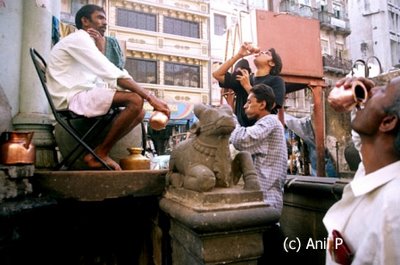
The fountain demarcated the narrow playing areas I now picked my way through, dodging children screaming ‘dead ball’ ‘dead ball’. The green plastic ball they were playing with could not have been more alive in the grey surroundings and the heavy silences characteristic of places weighed down with history or age; mostly both. A red plastic stool substituted for wickets.

The previous day these lanes were choc bloc with people, some of whom had stopped by the fountain where a man in a loose fitting shirt with sleeves rolled up to the elbows sat on a folding chair on the fountain’s raised platform, a brass vessel in hand, and filling brass tumblers with water for thirsty passers-by. The man in green vest would pass the man on the chair brass pots filled with water from the water carrier which he placed by the side of the chair to fill the brass vessel that he used in pouring water into tumblers. Behind the fountain was the office of the Haath gaadi association. Several empty haath-gaadis were parked in front, and some of the haath gaadiwallahs operating in the area sat on a low platform, talking. There was a relaxed feel to the place.

To the other side of the fountain, barely five metres from the first team, another cricket match was on. This lot was older, but the passion was indistinguishable from the previous lot. Taking a left turn ahead on my way to Kurban Ali’s house across the street, I passed yet another cricket team, the third in less than two hundred metres from the entrance to the bhaat bazaar. Excited cries rent the air as the batsman scored a hit. I smiled to no one in particular as I looked up at the sky and marveled at the vastness of it all.

As I walked past Patel Restaurant, a radio rung out an old hindi tune mere sawalon ka, jawab do. Do naa. I looked in the direction from which the song was floating out and saw a youth in the hotel eating batata wada while another man reclined on his haath gaadi on the pavement outside the hotel, his hands crossed beneath his head, eyes open and facing the sky.

Mere sawalon ka, jawab do. Do naa.