

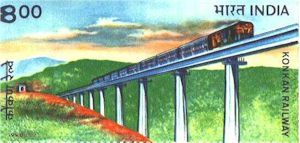
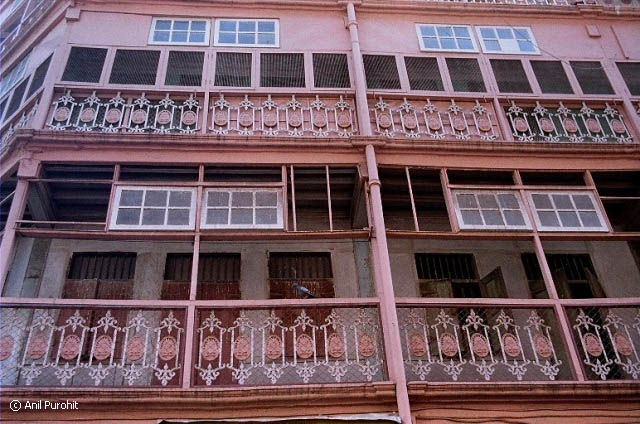
 A short run later we pass a large mound of hay fenced waist high with fishing net and held down by slender sticks driven into the ground at intervals of 3-4 feet each. A cow tethered to a coconut tree nearby grazes in the grass. There is scarcely a soul outside. The balcaos flanking the entrance to verandas fronting individual homes are empty; their red oxide coats lend familiar brush strokes of memories of Goan villages.
Balcaos are porches with seats built into the sides. Alternately, a balcao is a wide veranda running along the front of the house and occasionally along its sides and at the back; seats are built into the sides where the front entrance opens out on the street outside, typically the undulating parapets shepherd the steps down the stairway to the bottom where they meet the road or open into a garden. Where included, the undulating parapets show the influence of the Baroque.
Balcaos are commonly found in Goan houses and generally understood to be dating from the time Goa came under Portuguese rule, and in the years after. The newer constructions are no longer partial to balcaos, and I find them less attractive as a result. In Goa ‘less inviting’ can easily translate to unattractive for, such is the association of susegado with its culture that a balcao might as well have come into being to still time rather than help it pass. Only someone who knows Goa well enough can distinguish between the two and yet be none the wiser for it!
At twenty past ten Majorda junction draws up. The railway track cuts through the village, at places it passes within few metres of houses, shops, buildings and courtyards. Villages and town centers in Goa did not 'grow' around railway tracks and stations on the Konkan Railway run through the state, instead land had to be ‘taken out’ in the manner of separating a trunk from the tree, continuously reminded of the tree each time the trunk is used. The train roars ahead. I listen to the furious clack-clack as the Mandovi Express ploughs through the countryside. Listening to the steady rhythm soothes me no end; music of movement, strengthened as much by the economy of movement as by its periodicity.
In an open patch in front of a house, over 200 plastic chairs, white and red, are piled up in unsteady columns, and over fifty more lie about, waiting to be stacked up. The party of the night before is over and the place awaits a cleaning up. From the looks of it it was no small party, a wedding perhaps, or maybe a wedding anniversary or a birthday.
A clothesline is strung between two coconut trees. Two trousers held by plastic clips hang from it, swaying in the breeze. I wonder if their master has their gentle rhythm.

Off Majorda, paddy fields line the stretch on either side of the tracks. Birds flock to the fields and so do cattle. I catch sight of Cattle Egrets dodging grazing cows, sometimes it is the other way round. The upright Egrets float like tentative white peace flags. In the distance they all look the same, comparable in size to the white church nestled in the folds of hills to the West, some distance away. For the umpteenth time I wonder if the hills are indeed as near as they appear to be from a passing train.
I like Majorda for its paddy fields. My earliest recollection of the village was during a regional conference hosted by Majorda Jaycees. I was marking my days in college at the time. The conference was scheduled for the entire day, bringing together Junior Chamber chapters from the region. At lunch time I had gone off exploring the place with a friend from our group. We had walked a narrow, raised tar road that ran between two fields. There was hardly a soul about and we had walked its length, feeling the breeze caressing our cheeks before playfully pushing back heads of paddy shoots in the fields to our left. And when they bent, exposing their bare midriffs to the stare of the mid-day Sun, it was like a shimmering gold carpet rolled out, inviting us to walk on it. I looked at my friend. And as if on que, quite unknown to her, her hands acquired the extra swing that moments like these induce. She asked me if we could stretch the lunch hour some more. I nodded, only too glad to prolong the sunshine feel. We traipsed to the beat of an invisible rhythm. All along the way bare midriffs shimmered and traveled with us like a Mexican wave. There was just us and the wind, and the wave. Some moments refuse to set with the Sun. Now looking out the window I strain hard to catch sight of that road in the bright sunshine. There is none that I can recognize, not even if I were to see it. The train surges ahead.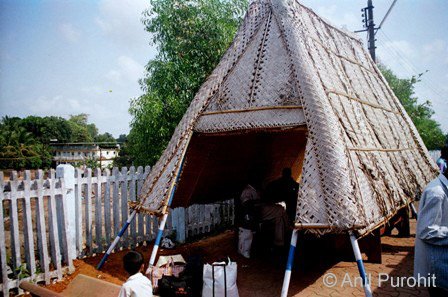 The Sun has traced its path higher, and the sky is slowly changing colour from the deep blue of the morning to a pale white. To shield waiting passengers from the mid-day Sun, Konkan Railway has constructed tent-shaped thatched waiting areas on platforms using coconut fronds readily available all along the West Coast. It is nearing half past ten when we pass the deep blue coaches of the Deccan Odyssey parked on an adjacent track. Ahead, a hill with its entrails gouged out stands silently, its red wound looks out like a bloodied eye contemplating a dilemma. At half past ten we hit the first tunnel at Verna on our way out of Goa, and blinded by the short run of 800 metres in pitch darkness we burst out into blazing sunshine; my eyes hurt for a moment before becoming a part of it. Then we pass a bright white church before coming upon the first major bridge over the river Zuari at Cortalim.
The church straddles the left road skirting just before the road passes under the small overhead railway bridge. To the back of the church, open fields lie as if in perpetual welcome. School children in groups of twos and threes walk past the church at a miserly pace, with none of the skip you might expect to see on their way back from school. The girls’ plaits are held with white ribbons, the loops jut out like Chital’s ears alerted to a sudden noise in the jungle. Even from a distance their neatly braided hair shine from vigorous application of oil. A cyclist pedals past them before drawing up to the side of the road to let a motorcyclist pass. Behind them a lone buffalo stands in the middle of a narrow, open path, regarding the road passing by the church in what I imagine must be mild amusement at finding things still the same from yesterday and the day before, and the day before.
The rail bridge over the Zuari runs parallel to the road bridge to its left. From the window I watch vehicles speed over the bridge in the direction of Panjim, but soon we leave them behind as the Mandovi (named after a Goan river) puffs her lungs out and lunges forward on her run north along the West Coast. Ahead of the bridge, to the left, a road veers off and goes past Sancoale on its way to Vasco. Sancoale, where only a façade of the Our Lady of Health church now stands in an eerie testimony to a time long gone.

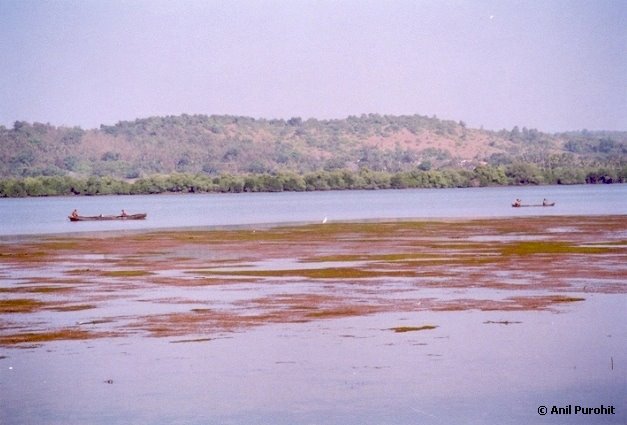
I trail my eyes over the spans opposite, held up by six visible pillars, and then linger for a moment where both ends of the bridge disappear in a mass of green trees. For a moment I imagine I’m watching a tree bridge held up at both ends by dark green, leafy pillars. I count fourteen pigeons keep pace with us. Time goes still as the behemoth rattles over the bridge against the placid backdrop of the Zuari, only the metal girders flashing past in quick succession confirm our progress across the waist of the Zuari before she flares out into buxom curves, distancing Marmagoa taluka from Tiswadi along the contours of an open mouth; the Marmagoa bay. To the south of the bay lies Marmagoa taluka. The city of Vasco sits on its lower lip. From Velsao where I visited Philip’s construction site two weeks ago one can see planes take off and land at Dabolim airport. In the late evening as we stood on the beach facing the Sun go down, Philip pointed out the darkening silhouette of a landmass to our right, jutting out into the sea and obscuring the Marmagoa harbour on the other side. It reminded me of a giant table rising from the sea where the Gods sit down to early dinner while watching the Sun go down. Unlike buses, or for that matter, trains, there is nothing to tell where planes are headed. A road or a railway track point in a definite direction, a peg in the Earth, a fixture, a steady, identifiable landscape. Up in the sky there is none.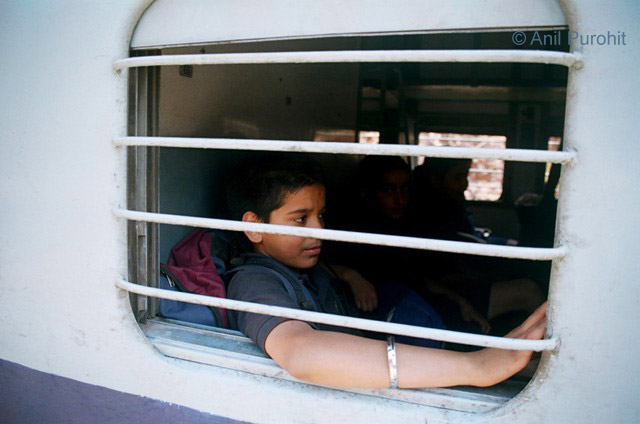 As we near Tivim, vegetable patches adjacent to paddy fields come into view. A rainwater-harvesting construction is underway in a narrow strip of land up the embankment along the tracks. Several squares have been dug up in a row, and narrow channels connect them, leading to a larger square about 25 sq.ft. area. A short run down the slope, it drains off into a similar construction that is lined by laterite blocks at the bottom. As the train speeds past, iron-ore mining dumps draw up by the tracks before we touch Tivim at twelve minutes past eleven. It’s a little over an hour since we left Margao.
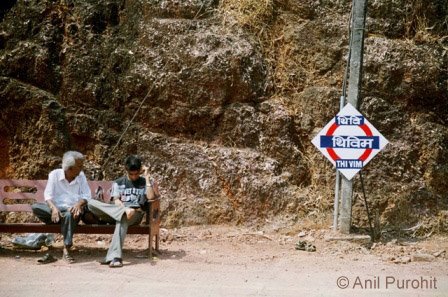 Tourists arriving in Goa get off at Tivim to visit the beaches of Anjuna, Calungute, Candolim, Arpora, and Baga, the cities Panjim, and Mapusa, and the Mayem lake among other destinations. The station has a highway feel to it. Only the entrance is shaded by a roof. Much of the platform is under open sky. I quite like railway stations that way.
Outside, the Sun is shining bright. The train crosses the bridge over the river Chapora on its way to Pernem, the last stop before it leaves Goa and crosses over into Maharashtra.

At twenty-five minutes past eleven we touch Pernem in the north of Goa, known among local government circles as a ‘punishment-posting’ for government employees reluctant to toe a line among other things. It is fairly ‘remote’ and considered under-developed relative to other Goan towns. Shortly afterward the Mandovi plunges into the first major tunnel after leaving Margao, two kilometers out of the Pernem railway station. The tunnel is over a kilometer and half long and is credited with being a tough nut to crack when the engineers were laying tracks for the Konkan Railway. Then we burst out into clear sunshine and cross the bridge over the river Terekhol, a river so green that I wonder if there isn’t a paddy field or maybe a golf course on the river bed. Wire netting covers sides of hills as the tracks cut through them on their journey up the West Coast. The netting employed is a measure to prevent landslides during monsoons, already responsible for some of the worst railway accidents seen in India in recent times. The monsoons can be particularly dangerous times to travel on the Konkan Railway though stoppages on account of accidents and landslides have reduced over time. At several locations on the journey up north, bogies and engines lie splayed along the tracks in a gory reminder of the violence lurking on the tracks at unguarded moments.
I shut my eyes to the strong wind breezing through the window. As the Mandovi leaves Goa behind I wonder again at how quickly the terrain seems to change its contours in the blink of the eye. Moreover the Mandovi has picked up speed as she hurtles ahead, past hills, rivers, and past time!






 Bambar, near Nanus, a short way off Valpoi, is among the few places in Sattari taluka where one can see the Western ghats in all its grandeur. In the late nineteen-eighties, a group of us used Nanus as our base camp over five days to trek in the mountain ranges along three routes: Satregad, Krishnapur, and Bambar. I barely survived the first day after Samir and I were caught in the middle of a rising river on our return from a very difficult climb up the Satregad. The rescue lasted one and half hours using wild bamboo fetched from the forest nearby and ropes taken from our tents to tie the bamboo together. The route to Bambar was infested with leeches, turning my shoes red from the bleeding as I tried to pluck them off. We had carried tobacco and salt to use on exposed skin to deter the leeches, but there were far too many streams along the route, washing off the salt and tobacco we'd applied. After crossing each stream we reapplied the preparation only to see it washed off after a few metres when crossing the next stream. Eventually we gave up though I found it difficult to ignore the leeches latching onto my skin as we brushed past vegetation on our way. Bambar is also home to rubber plantations. It was there that I first saw how rubber is processed into raw products for dispatch to processing plants. It was November, a time when most of India has emerged from the monsoons but out here, mountains and hills were damp from incessant rains.







 The train is late by two minutes. The platform is packed to capacity now. There is nowhere empty she can 'hide' her face, nowhere she can look and not find eyes looking back at her, so she puts her head down, crosses her hands across her bosom, and looks at her feet. Her feet don’t have eyes, so it’s ok. Over time she’s learned the moods of her feet better than her own.


