I learned of David Rocco’s Mumbai visit to film his new series in India centred
on food only recently. Scheduled to be broadcast on FOX Traveller, his India episodes are said to be along the lines of
his charming Dolce Vita episodes in Italy, exploring kitchens and
restaurants, and people and places. A quick swing by ITC Grand Central and I’d
have gotten a glimpse of his team at work only that I couldn’t get time off
from office, so couldn't attend.
But I knew of someone who did and the account that follows is in K’s
own words of the wine evening David Rocco hosted on ITC’s rooftop lounge
recently.
~
Until the kindly gentleman with a
beatific smile said his name softly I had taken to addressing him as Mr. Bean
after hearing his colleagues do the same.
“I’m Jay Bajaj,” the kindly man corrected
me, his smile rarely leaving his face in the minutes we made acquaintance. He was settled on a sofa in ITC Grand Central’s split-level rooftop lounge - Point Of View on the 30th
floor.
The lounge connected the open air
gazebo on both wings, each home to a pavilion raised on a platform.
Behind him a row of high stools
stood against the counter where smartly dressed bar tenders catered to guests.
Gleaming bottles of spirits shone on racks in the warm light that suffused the cozy
lounge equipped with a library and a boardroom. Large windows opened to the
city outside.
Visitors were seated at tables conversing in low tones, their
bags on the floor resting against their chairs.
Jay Bajaj crossed his legs and
stretched his arm along the back of the sofa, a sign he was relieved to be back
somewhere warm, hospitable and retiring.
David Rocco’s production team was
in Mumbai wrapping up filming in the metropolis for their show Dolce India scheduled to air on Fox
Traveller starting September later this year.
Jay Bajaj was taking a well
deserved pause while his colleagues were setting up cameras and other equipment
while scouting the ITC Grand Central for footage and vantage points as the
evening gradually wound upstairs to the rooftop lounge where David Rocco was
scheduled to host a wine tasting event for select invitees.
I reached the ITC Grand Central
located on a busy road in Parel, early, and it was just as well for, while the evening
was to culminate in a wine tasting event with David Rocco, I was equally
interested if not more in seeing his production team plan a shoot for his new television
series David Rocco’s Dolce India exploring India on the lines
of David Rocco’s Dolce Vita that’s
made Season Four, a sign of its appeal and success.
India however is alien to David
Rocco, an experiment, a challenge. I’ll only know if he’s made the cut once the
cameras stop rolling and the promos hit the airwaves ahead of its broadcast.
For now I was curious to see what
transpires in the making of a TV series episode given the success the celebrity
TV host has had with his charming escapades in Italy
stringing viewers along on his jaunts through Italy’s cultural and culinary
landscapes. It didn’t really matter that the evening atop ITC Grand Central’s
rooftop lounge might probably find only a passing reference and look-in when David’s
team sits down to see the rushes with digital scissors at hand.
I was there for the experience of
seeing and meeting with the show’s host and carry back memories of his production
team working to make the India series happen.
The setting at ITC Grand Central’s
rooftop lounge the perfect antidote to the rush of the Mumbai street outside, contributing
just the right setting to the evening even if the gathering was smaller than I
expected.
The ITC Grand Central where part of
the footage was planned on the Mumbai leg of his four-city dash around India
was an apt setting for a wine tasting evening given the views its split-level
rooftop lounge Point Of View affords
its guests gathered under the Mumbai sky to meet with David holding his fort
with Indian wines.
In the open air gazebo, workers
were busy preparing the pavilion for the evening, beautifying it with flowers.
The late afternoon Sun cast its
glow around. David’s production team was up and about testing their equipment
and looking for spots to best film the event.
A cameraman stood by the parapet
and took in the view of Mumbai, high rises interspersing with low rise
residential apartment blocks, together forming waves that rode for a long way
out.
The wind was beginning to pick
up. It would grow stronger as the evening progressed.
He would later tell me that it
was only a couple of days ago that he’d learned India makes its own wines; the
surprise was equally evident on his twitter feed drawing a wry comment from a
quip gently chiding David not to “undermine India” before smiley-ingly
asserting “we can make quite a few things”. He probably meant “underestimate”,
not “undermine”. To which David responded he didn’t ‘undermine India’ before implying he was in India
‘to find out just what things we make here,’ starting with Chennai down south.
The stops – Chennai, Mumbai,
Jaipur, and New Delhi.
~
The team had just flown into
Mumbai from Chennai to shoot on locations around the city in the days ahead. A
quick trip to Nashik for a tour of Fratelli Winery was to culminate in an
evening with wine, Indian wine in particular; Fratelli to be specific.
Leave alone the rest of the
world, Nashik is not as well known around India either with the exception of Maharashtrians
and those who know their Ramayana well. And knowledge of vineyards operating
out of Nashik is an even longer shot outside of wine aficionados, some of whom
wear Italian hats.
It was in Nashik that Sita was
abducted by Ravana while Lord Ram was on exile from Ayodhya.
If you’re visiting Nashik in the
winter, few sights on Nashik’s streets overwhelm the visitor as much as basket
loads of grapes being sold off the street.
Nashik grapes inveigle the
visitor the moment they step out the railway station.
Take a bus out of Nashik proper
for Trimbakeshwar and the countryside is host to sights of farmers selling
their produce roadside in the backdrop of their vineyards.
But I suspect David’s experiences
with India
as a wine making destination is going to come up against those from his Dolce Vita episodes with Italian wine
making traditions. No guesses to who’d win that.
If anything, more people than
before will begin to associate India
with wines once his India
series goes on air. Not a bad beginning.
Speaking with him later that evening
he said he was initially under the impression that Indians drink beer and that
if Indians made wine it probably wasn’t that good.
Then there were the regulars from
down South - “I liked the dosas, the chutneys, and the people. The people are
amazing,” he said sharing his general impression, adding that he didn’t have a
good experience at the fish market. The inedible smells grounded him.
Indians can find it difficult to
beat the stench of open toilets in the summer, let alone someone whose TV series
Dolce Vita promos paint vividly how
to live the good life in Italy.
It’d be too much to expect David
to wind through local Indian markets and not try his hand at bargaining with
the vendors.
“They asked for a cauliflower, 40
rupees. I brought it down to 25. Then he brought me up to 30, and then I threw
in a couple of chillies. That was a good deal.”
Who wouldn't smile through the
day after bargaining a good deal? I would. And I do it as well with the local
vendors.
~
His TV series
David Rocco’s Dolce Vita has made four
seasons and has aired in over 150 countries and counting, taking viewers on a vicarious
tour of Italy exploring its cities and countryside for social, cultural and
culinary encounters where, as David says on his website, “As always, the
starting point is food,” before elaborating with “The show is also about how
food brings friends and family together.”
Even if I hadn’t seen the section
“My Italy” on David’s website that he begins with “Hey! This is my guide to my favourite country in the world,” it
took me only a few minutes of conversation with him to realise that while he’s
left Italy to visit India, he’s never really left Italy. This was
notwithstanding the impression the man in maroon down south in Chennai made on
him as he raised him arm holding a vessel with coffee as high as it could go
while the other arm holding a second vessel descended low before letting the
coffee cascade like a waterfall from the height he’d mustered with his right
hand.
One impression does not make an
entire experience. And India
is no Italy.
It was not meant to be.
To know what I mean you only have
to watch Dolce Vita’s Season Three trailer set in Italy.
The Legwork Behind Making Dolce Vita - India
Where diversity, of the kind
India is home to, entices, it equally challenges, more so given David has
little to no experience with India personally, probably does not speak any
Indian language, relying entirely on India hands to scout locales to capture
India’s essence in the show’s format – food, markets, people, places, and
cuisine, daring failure in attempting a fusion of Indian and Italian dishes.
While his site announced his Dolce Vita road show as “our guide to
all things Italian,” before adding, “This
is a great resource if you're planning a trip to Italy. I've recommended some of my
favourite places to eat and sleep, in some of my favourite cities and areas in Italy. Some are
fancy, some are simple, some just family run establishments, and all are worth
visiting!”
To pull this off with his Indian
series would need local knowledge.
It’s here that Jay Bajaj stepped
in to smooth over hassles common to locating people and locales to shoot
street-side episodes for travel shows. Speaking with Jay as we waited for David
to kick start the evening gave a peek behind the ‘finished work’ eventually broadcast
on TV.
Jay elaborated on the challenge
he faced with the team in exploring India for locations to shoot,
people to feature. Four Indian cities, each different from the other, can
present different challenges even if the show format driving the content is the
same.
Jay spoke of how he wasn’t
entirely sure of which story would eventually work even though he had nine
stories to work with.
“We had to change one of the
stories yesterday because one of the people wasn’t there,” Jay offered as
example of how scripts even when bound can come unglued. “We were thinking of
doing a story,” he continued, referring to another story planned, “But now
we’re in a hurry, so it’s constantly changing. Tomorrow, David’ll be doing PR
while I’ll be out looking for people and places.”
Apparently, the idea for the India series
was first broached to Jay by David last April after David phoned Jay to sound
him out for the series. Initially Jay wasn’t too enamoured by the thought of
getting involved in “all that food series” but David prevailed over Jay.
To know why Jay wasn’t exactly
thrilled at first of a series involving food one doesn’t have to go further
than Jay’s own 72-minute documentary feature
Qawwali – A Musical Journey that
he wrote, directed and produced in 2003 for his own banner – Bajaj Films.
The documentary film was a
musical journey through his own childhood memories, Jay accompanied Hayat Nizami - whose family has been
performing Qawaali for five generations - and his group of Qawaals through
Delhi, the capital of India, as they go in for a recording session, talk about
their music and share its importance in their lives, and sing at different
historical locations around the city. The film paints a vivid picture in sound
and sight of the music, its history, and its home.
Later, I
listened to a Qawaali
from Jay’s film
Qawwali – A Musical Journey. The haunting invocation stayed with me long after the voice had
gone silent.
After speaking with David, Jay
realised it’d be fun doing the India TV series Dolce India though he admitted that he wasn’t entirely sure at
first if David could pull it off, likely for the obvious reasons of land and
language and the baggage that comes with it.
Once the ball got rolling and Jay
found himself in the thick of things, the logistical legwork well and truly
began, starting with identifying sponsors, ITC among them, scouting for
locations and locales, story ideas, people, permissions and the whole works.
“I’ve been here (India) since
September 18,” Jay said. The fact that he remembers the date is an indication
that it’s been anything but a smooth sailing. “A good 5-6 months.”
David’s team is scheduled to be filming
its episodes until April before leaving India and beginning work on
post-production that’s expected to carry on until September, just shy of the
dates they expect the series to go on air.
“13 episodes in all,” Jay lets
on.
Talking of the editing process
and the time it takes, he makes mention of Kunal Vijaykar’s show and of how
they shoot for four hours in a day but take close to five days editing the
footage.
Switching back to the work ahead
of his team, he tells of how they shoot their episodes, each involving extensive
shoots across locations over a minimum of three days before beginning
post-production, all in all a lengthy process.
“We submit all 13 episodes to the
broadcaster and they set up a date to begin broadcasting the episodes. In the
West, National Geographic will broadcast our show, while elsewhere, Fox
Traveller will carry it,” Jay concluded just as David finished meeting his team
gathered in the lounge, exchanging courtesies with a few invites, posing for
pictures, before everyone followed him to the open terrace of the Point Of View rooftop lounge to commence
the evening event everyone had come together for.
By then the equipment was in
place, boom mikes at the ready, and racks of wine bottles and glasses held
centre stage.
The sun had slipped down the
horizon save the last flames licking the skies over the Grand Central in gentle
colours.
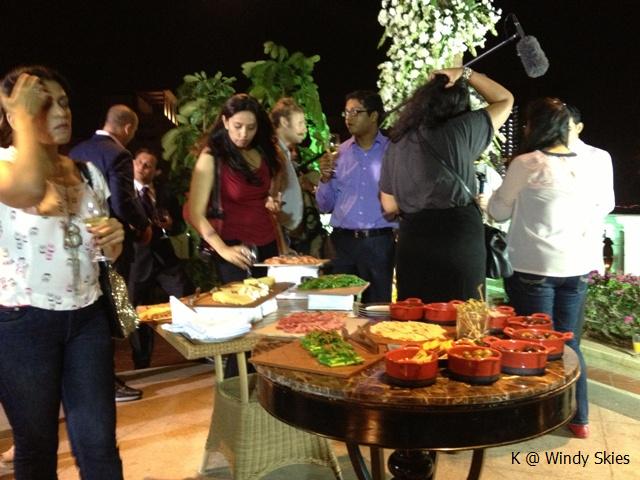
Starters had made their
appearance: a variety of cheeses, and hummus shared space with cold cuts.
After rolling with the production
team preparing for the shoot earlier that evening, I cast my lot with the crowd
for the last act of the evening – David weaving his way about, sips of wine
punctuating the banter, navigating looping smiles under the city sky, not
unlike the style he’s adopted for his Dolce
Vita series.
Raageshwari Loomba, formerly a
singer and actress made an appearance with Farzana Contractor, the Editor of Uppercrust,
India’s Food,
Wine & the Good Life magazine.
The gathering gravitated toward
the spread for the evening, asparagus, pita bread, artichokes, olives, salmon,
cheeses and wines.
~
The Point Of View lounge as the name suggests offers a tantalising view
of the Mumbai skyline for many a mile around in Parel, the Central Mumbai
suburb once the hub of Mumbai’s textile mills that had propelled the city to
the very forefront of India’s textile industry besides transforming Mumbai from
a predominantly port city into an industrial hub.
From Point Of View, the ruins of United India Mills rise in the distance
across the Lalbaug flyover. Chawls with their distinctive projecting balconies,
once home to mill workers and their families, and now their descendants, are
set back from the road. Together they offer the viewer a peep into the past of
a city that rose on the strength of its industry, the textile mills.
The textile mills and the culture
and traditions they engendered are long gone, only surviving in the large
dilapidated structures that remind the viewer of a past that was as
transforming as the present is changing their once thriving and throbbing industrial
space into commercial and residential high rises. The remnants of mills and
chawls in Parel remind of the transition now underway, and the sight from the
Point Of View lounge affording these views and realisation is as sobering as it
is elevating, more so as the old order giveth to the new.
Bathed in the lights that lit up
the Point Of View lounge later that
evening, conversations around wine and David Rocco’s upcoming series on India
floating on the stiff breeze, I lifted my face to the stiff breeze and was
quickly counselled by the warmth of the gathering even as I took in the city lights
beyond the parapet, the glowing lights wrapping the cityscape were laid out
like a mass of glittering necklaces spread outward like a giant ripple that refuses
to peter out with time.
Note: Look out for David Rocco’s India Series on FOX Traveller
sometime in September later this year for his on the good life in India.