February 18, 2010

Bhola Shocker


The next time you are out in Delhi or any other Indian city, step out on the road and walk. There’s every chance you’ll return refreshed, roadside shockers notwithstanding or maybe because of them.

No one in India claims English is their first language excepting maybe a few but that will not stop the enterprising street-side entrepreneurs from advertising their services in English, like Bhola’s open air enterprise under a large tree in Delhi does.

If it were not for the two shock absorbers hanging from nails driven into the tree I might have spent a wee bit longer making sense of the board. Sure there were illustrations on the board but the letters were so prominent as to momentarily shock one into staring at them, the incredulity of it all.


Pegged to a pole in front of the tree the board read: BHOLA SHOCKER & KAMANI REPAIR.

No. The owner does not go by the name BHOLA SHOCKER. He probably goes by Bhola. Whoever painted the board had more than an extra lick of red paint to bandy around.

Shocker is local lingo for two-wheeler shock absorbers while Kamani is its equivalent for the four-wheeler shock absorbers, particularly trucks.

Kaman is Hindi for ‘arc’, or a ‘bow’, the shape of four-wheeler shock absorbers, so I would imagine Kamani would have derived from Kaman.

Bhola is local for simpleton or simple. It’s likely Bhola started young, assisting his mentor while gaining more than a nodding familiarity with friendly truckers stopping at the garage for repairs and before long the name will have stuck like with the proverbial child-helper at the neighbourhood chai ka dukan who will continue to be called Chotu long after he has outgrown his shorts and now runs his own streetside tea shop. I'll leave the story of how the happy as 'ell Sikh kid came to be called Happy Singh for another day.

India’s truckers cannot imagine a life without these roadside repair shops on their long distance hauls. Once an apprentice or assistant learns the ropes Indian roads benefit by an added service point. Their enterprise depends upon their ability to innovate with resources at their disposal, often limited, and their trust in the usually sorry state of roads on long distance runs to send business their way.

Soon enough a tea shop, and a dhaba will materialize to cater to truckers stopping by the roadside garage.

While the other shops in the vicinity had pegged their boards to the roof above the entrance like the Sai Dhaba adjacent to Bhola’s, his own functioned in the shade of the tree with implements stored in makeshift wooden cupboards behind the tree. A white car, its bonnet open, stood in the repair dock. Evidently, Bhola serviced more than just faulty shock absorbers.

On a wooden bench outside a tea shop, adjacent to Sai Dhaba, several men sat sipping tea.

And life carried on as usual, shockers et al.

Sometimes, to be oblivious is to be set free of constraints even when it is an occasionally obvious intangible like say, an alien language!


Note: If you’ve any visuals of shockers to share from your travels around India and would like to share them here I’ll be glad to run them in a post with due credit. Mail me at my contact listed in the side-bar.

February 11, 2010

The Kite Flyer


A Kite Flyer On The Banks of the Ganga.

Benares. 2009.


I shall will the wind
To lift my kite to the sky,
Until it is no more than a dot in the heavens,
And even as I seek to control its destiny
I hope it will escape to the stars.

While I wish to touch the stars someday
I’m happier imagining the stardust at night,
And when it is my time to float away
I’d much rather be by the Ganga
Than floating free someplace else!

February 04, 2010

The Notorious Cannon by the Hazarduari Palace, Murshidabad


The Bagirathi flows barely fifty metres away, hidden from view behind the Yellow Masjid along the embankment to the west of the Hazarduari Palace in Murshidabad, the erstwhile capital of undivided Bengal in the 1700s.

Hazarduari is native for Thousand Doors. Of the thousand doors built into the palace, only nine hundred are said to be real, the rest, false doors.


I’m drawn to the lone white horse grazing in the lawns near the Imambara to the north of the Hazarduari Palace. Tethered to a rope it meanders in the short grass in what is otherwise a well maintained lawn separating the Hazarduari Palace from the freshly whitewashed Imambara, a massive structure leant relief by windows painted green. Workers are busy on the Imambara façade when I walk through the gate of the historic complex one early winter morning last year. The Sun is yet to break through the clouds even though it is well past the time even for a winter morning.

In the distance, the Imambara streaks the green of the vast lawn to the melancholy melody of Bengal history, at once glorious and bloody. The white horse has wandered further. A black goat now grazes along the façade of the Imambara that runs along close to 700 feet, parallel to the Hazarduari Palace to the south.


I walk in the direction of the horse and the Imambara, passing the Madina Mosque along the way, the only remnant of Siraj-Ud-Daulah’s original Imambara that accidentally burned down during a fireworks display before the new one was built in 1847 under the supervision of Sadeq Ali Khan in the reign of the Nawab Nazim Mansoor Ali Khan Feradun Jah, the son of Nawab Nazim Humayun Jah.

It was in the reign of Humayun Jah, a descendent of Mir Jaffer, the betrayer of Siraj-Ud-Daulah at the Battle of Plassey in 1757, that Duncan McLeod designed and executed the construction of the Hazarduari Palace in 1837.

By then the British were firmly in the saddle, the Nawab Nazim subject to the pleasure of his British overlords.


Families, college students, school children in uniform, rural youth, and couples among others crowd the approach to the Hazarduari Palace, its magnificent edifice reached by a sweeping staircase said to be among the largest in India, dwarfing the gathering crowd of visitors queuing up to tour it. Eight years in the making it is now the most visible landmark in all of Murshidabad, and probably the best maintained and secured.


Past the stately clock tower (Gharighar) designed by Sagor Mistri, part of Duncan McLeod’s team that built the Palace, I leave the four masonry lions in mid-leap adorning the four corners of the roof supporting the column bearing the clock behind as I turn off the cemented approach to the Palace and onto the grounds where the old Madina Mosque and a cannon stand. The Madina Mosque is home to a replica of Hazrat Muhammed’s tomb at Madina, hence the name.

I’m curious of the cannon. Cannons displayed prominently usually have a history to them. A local youth selling Murshidabad picture post-cards and poorly printed guidebooks illustrating locations of tourist interest within Murshidabad had enthusiastically pointed me to the cannon facing the Imambara when I asked him for directions to Bacchawali Tope.


Woh dekho, wahan hai,” he had replied, pointing to the cannon resting on a masonry platform by the old Madina. The white horse grazed in the vicinity of the ancient cannon pointing at the Imambara.

A group of four, two adults and two children not older than twelve years, lounged in the shade of the Madina, leaning against the iron enclosure while lighting up cigarettes. The two kids showed much enthusiasm lighting up while the accompanying adults condoned and indulged their enthusiasm in passing what they must believe is a necessary rite of passage into adulthood. When I looked their way the two adults moved away, smiling sheepishly.

The Bachchawali Tope got its name from the havoc it caused with pregnant women in Murshidabad on being fired, resulting in premature deliveries of babies, the blast was so great, reverberating across the settlement. It was never fired again. I wonder if its notoriety was one reason why it fell silent. Tope is native for cannon while Bachcha is native for child.

I find old cannons fascinating, and having seen a few on my travels I was nevertheless surprised to see the Bacchawali cannon fashioned from two distinct parts, the shorter portion the chamber, the larger one the barrel. The design is a departure from the cannons I had seen before, made of one single unit with the chamber and the barrel indistinguishable on the outside, with the Cascable ending prominently in a knob.


The Bachchawali cannon’s cascable does not have the distinctive knob common to most cannons. Other distinctive features are the rings on the barrel, indicating cross sections bound together to make the barrel. The chamber portion is however devoid of these rings. From the outside it appears the chamber could be separated from the barrel. The size of the chamber indicates capacity for a large charge of gunpowder, estimated to be 18 kilos for a single charge. I can well imagine the blast waves resulting from its firing.

The cannon is about sixteen feet long, possibly more, both parts included, its origins approximated to 12th - 14th century A.D.

I walk over to the muzzle face and peer into the large bore, easily over a foot wide. The opening is half filled with mud and torn entry tickets issued at the counter at the gate.

I step away from the cannon, easily among the favoured sights in the Hazarduari Palace complex. Visitors having toured the Palace now stream steadily to the cannon, fascinated as much by its size as by its import, a great piece of artillery that evokes imagery of battlefields centuries ago. There’s much to imagine when peering into the muzzle of a cannon that last fired centuries ago.

The romance of history secures cannons their immortality on the first page itself.

Meanwhile a caretaker rushes the black goat to chase it outside the gate. It had not occurred to me that the goat might have crashed the party without a ticket. The ease with which it negotiated the lawns, munching away on the grass, indicated it was no first time visitor. The caretaker was smiling away as he rushed it with little more than sharp cries.

Apparently the black goat had not walked in alone. Its partner in crime, a ginger streaked rebel and the more daring of the two was wreaking havoc among unsuspecting souls, for while the black goat grazed peacefully on grass its partner sought the easier albeit daring route, stealth-charging a family bunched together in a group near the Madina Mosque.


While they were distracted by my pointing the camera in their direction the ginger streaked rebel made its way among them before chomping away at the food they had carried along on their outing that morning. If you look closely in the picture above you will see its tail sticking out from amidst the visiting group in the vicinity of footwear on the ground.

Soon enough, surprised and startled, screams rent the air even as the black goat came rushing past, chased by the caretaker bellowing loudly. The ginger streaked goat followed suit in the commotion of women and screaming children startled at discovering its presence in their midst and the caretaker hot on the heels of the scampering black goat.


Later I found the ginger streaked rebel meandering in the lane outside the gate to the north-west of the Palace. The black goat was nowhere to be seen. Puris stacked high in a glass case in the pani puri cart in front of the Yellow Masjid on the embankment of the Bagirathi was a challenge too many for the enterprising goat as it went about seeking the next gullible victim to raid unawares. I almost felt sorry for its predicament.

I could almost sense its disappointment at being chased out the gate in so unceremonious a manner. The very indignity of it!

The Yellow Mosque was fenced off with a board on the gate announcing in English and Bangla – Non Namazies Are Not Allowed.

I would assume it to include the marauding goat as well.


January 28, 2010

Robowars at IIT Mumbai Techfest, 2010


Imagine for a moment that you’ve to pick your way through menacing looking metal contraptions with spikes, circular saws, maces, flamethrowers, cutters, flippers, drills, and hammers jutting out their sides.


Next imagine having to dodge them on your way past groups of intense young men huddled in groups by used car batteries, plotting their next move while long lines of electrical wire snake out from their midst, and it’s likely you’ll attempt to hurry past them, unsure and even apprehensive unless of course, you’re the curious type.


Then it’s likely you’ll linger by these menacing machines whose sole purpose in life is to maim and destroy the opposition.


Like the gladiatorial arenas in ancient Rome when man was pitted against man in a fight to the finish, a spectacle watched with bated breath by citizens seated in the amphitheatre in their thousands, so is the spectacle at the SOM Well in the sprawling IIT Bombay campus in Powai year on year when for three days, through successive eliminations of the weak and the ungainly, robots progress through several rounds to vie for the honour of the last robot standing at the conclusion of the Robowars.

The IIT - Bombay, Science and Technology Festival, concluded last Sunday, with thousands of visitors and participants from across India queuing up at the entrance to the IIT Mumbai campus in Powai over three days. Event and visitor registrations ran full through the morning hours.

The first IIT - Mumbai Techfest kicked off in 1998, drawing only a few thousands. This year the annual event marked its thirteenth straight edition. Over 60,000 participants and visitors were estimated to have walked through the gates last year. I expect the numbers to have swollen by a fair bit last week. The organizers, students of the Indian Institute of Technology (IIT) Bombay, claim the three day event to be the largest of its kind in Asia, and if the numbers of visitors and participants streaming in was any indication then it might well be the case.

The Techfest, much as it is about ideas, learning, problem solving, innovation, technology, entrepreneurial spirit, and even camaraderie, is first and foremost about competition. It is about pride, and as much about winning as it is about defeating the opponent. There're points at stake and prestige on the line.


And Robowars sets the competitive benchmark for the rest. It is where the innovative pit their minds to building fighting machines that can fight.


The organizers of the IIT Techfest set out the rules for the robots you could build, defining the box size, the weight not to exceed 40 kilos. The robots' offensive capability is usually powered by a pneumatic source, and controlled by wires or by remote. The wires are held slack when combating the opponent, and are often the source of downfall as well.


From the steps of the SOM Well I watched from the crowd as one of the robots inexplicably ground to a halt mid-battle. While the flustered team rushed to the transparent enclosure that encloses the fighting square it soon became apparent that the wires they were using to maneuver their robot had come undone on being entangled in their opponent, losing power.


The fight moderator rose from his seat and called on teams to stack the wires into a single unit and insulate it well to withstand the wear. "If necessary, use PVC pipes as protection," he advised. The robots are powered electrically, and the use of IC engine is forbidden.

I watched a robot awaiting its turn in the fighting square, its cylinders primed for action. I assumed some of the robots would attempt to punch their opponent with their pneumatic-driven arms, a ploy I thought would not be as effective as the use of flippers to lift the opponent and render it hors de combat while time ticks away. A robot wins if it can immobilize its opponent for thirty seconds while preventing any linear movement to less than an inch.


Abjiheet had managed to do just that with his robot, the Hell Razor. He showed me his robot as he rested in the shade after a successful bout, relieved at having seen off his challenge to progress to the next round.

He showed me his robot resting at his feet like a living animal taught to heel at a sharp command. Its entrails opened to the sky overhead, deriving its menace as much from its weapons as from the clutter of its components it took no pains to hide.


“The drills at the front of the machine are designed to push the opponent into a corner while this flipper here will lift it and hold it immobile,” he said. It had taken his team 28 days to make the robot and tune it to fighting shape.

Like other aspiring engineers sold on the art and science of Robotics, he had traveled with his engineering college team to Mumbai from Chandigarh (Punjab State) for the IIT Techfest. His brother, Abhishek, was part of the team as well.


Most of the robots on display were fabricated by the students at their engineering labs and workshops, often working on weeks on end. It’s easy to guess the excitement that’ll have marked the building sessions as they grappled with the design and power sources even as the time to put the design to test drew near.

Often participating teams are mix of senior and junior engineering students, and it is likely the seniors are experienced from participating in the earlier editions of the Robowars at the IIT Techfest, passing their know-how to the junior members in the team. Bachelor of Engineering (B.E.) courses in India typically last four years.

Participating teams in Robowars were limited to six members. Some of the teams looked the part with t-shirts sporting the name of their robots on the front, and colleges on the back.
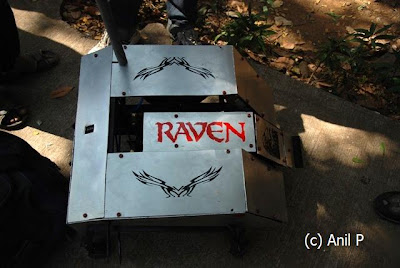

The names chosen for the robots sought to add further menace to the creature, like the Raven that Team Raven from R.R.S. College of Engineering and Technology, Medak, Andhra Pradesh, had entered in the Robowars.


They had a hard start to the day. I happened upon them sweating in the Sun before their turn in the SOM Well arena. A team member I spoke to pointed to one corner of the robot they had leaned over for repairs and said, “There’s a problem with the valve.”

Pneumatic design can be tricky at times, more so in the hurly burly of two combating robots. The robots are allowed to operate pneumatic devices and are limited from using an outlet nozzle pressure of no more than 8 bar.

The Raven was sleek, and resembled a tank. Its entrails were hidden behind solid armour, a contrast to most of its opponents.

Everything about Team Raven looked right. They were dressed for the kill, only they turned out to be the kill.

The team was crushed at the result.

In the late afternoon I picked my way through robots and teams resting after their bouts and made for Team Raven.

“What happened?”

“We didn’t make it,” a team member replied.

“What went wrong?” I pressed him.

Pointing to the undercarriage, he said, “The floor in the fighting square was not even in some places. The wheel stumbled and stuck, limiting its maneuverability.”

The Raven had been immobilized as a result.


Even as we spoke I could hear the roars behind me as the audience massed on the steps of the SOM Well egged on the combatants. The elimination rounds were well and truly in progress. With 65 teams from engineering colleges across India having made the shortlist for Robowars, the event promised thrills and heartbreaks in equal measure as each pair of competing teams squared off in the SOM Well.

The Well is entered through two openings in the transparent fighting square, with controlling wires of the two combatants trailing over the wall at opposite ends.


Before the combat the teams check their respective machines outside the transparent enclosure before carrying it through the door to the fighting square. Like in a boxing ring the battle commences with the two robots ‘meeting’ in the centre of the square.
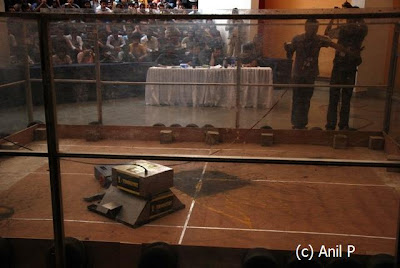
What follows next is attempted mayhem as weapons are unsheathed to loud clangs, their movement controlled by teams outside the enclosure, excited, nervous, and tense in equal measure.

The crowd watches every move, cheering their favourites on as cameras flash.

Even as the SOM Well ebbs and falls to the raucous cheers of the audience watching Robowars, in the pavilion located on the approach to the SOM Well, robots of another kind are engaged in showing off their skills and combating one another in CROSS_OVER.

Here, students are crowded along a perimeter watching participants snap bridges open in an open Arena and have a remotely controlled robot drive over it and negotiate the Arena.

The challenge is to create a “manually controlled machine which crosses a pit and competes against another robot in a one on one knockout event.”


The Arena in turn is divided into four zones, each zone presenting a navigation challenge. The competing pairs of contestants are expected to design a slide-open bridge that bridges Zone C to allow the competing robots to navigate from Zone A to Zone B before negotiating Zone D to the finish line. The Bot quickest to the finish line eliminates its competing Bot and progresses to the next round.
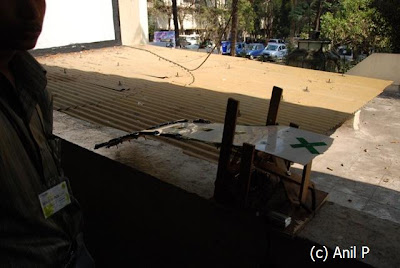

Each competing unit in the event was made up of two machines, a bridge and a traversing Bot, the latter controlled remotely, and the former launched mechanically. The bridge had to snap across the pit quickly to allow the Bot to traverse / cross it. It presented a challenge to the students.

The contestant was allowed the option to control the bridge remotely or using wires. However the machine / Bot traversing the bridge had to be controlled remotely.
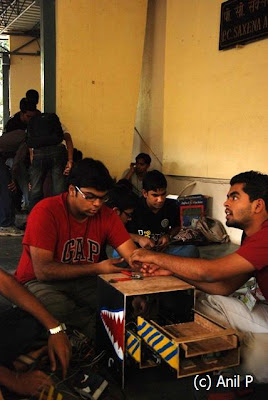

Awaiting their turn in the shade of a resting area, teams were seated on the floor testing their machines. The bridge offered a greater challenge. Any delay in snapping open would mean the traversing Bot got off the blocks late.


A buzz enveloped the venue as final checks of their machines kept the participants awaiting their turn at course in the CROSS_OVER Arena.


Others settled around open circuits, oblivious to the heat of the mid-day Sun while they grappled with last minute issues, worrying over their machines.

Many have traveled over long distances to participate in the Techfest, carrying along machines they’ve fashioned back home, hoping to win.

Even so, to know they’ve competed well will go a long way in helping them believe in their own ability. It is a springboard that education seeks to achieve.

The rest as they say is up to destiny.


Related Links:

1. IIT – Mumbai Techfest, 2010
2. IIT Techfest - Robowars
3. IIT Techfest - Cross_Over Arena

January 24, 2010

Morning Rounds in Delhi Neighbourhoods


In the winter, when it gets too cold to step out of the house, women in Delhi neighbourhoods are relieved to hear the vegetable vendor outside their homes calling attention to his cartload of vegetables as he cycles past squat buildings with Sintex and Raj water tanks dotting the walls on the outside. Sintex tanks have steadily given way to Raj, the latter apparently cheaper than the former.

Dogs curled up in corners by staircases twitch their ears on hearing the vegetable hawker list in a sharp, loud voice the vegetables heaped in his cart. Behind curtained windows ears anticipating the morning call tune in to the list of vegetables as it floats up in the morning chill. Occasionally a window will be flung open, and a head appears asking the hawker below for a particular vegetable. If it is too cold the voice will issue forth from behind the closed window. The hawker replies to the voice from the window.

The quiet of the morning ensures the exchange is heard by all.

While the Delhi cold will immobilize most dogs into immovable lumps of unknown lineage, the enterprising among them will stir from their place and lift their heads in anticipation of a door opening so they can wander nonchalantly to the cart and remind the lady of the house come to buy vegetables of their presence. It can result in a biscuit or two, sometimes more.


It is not uncommon for Delhi neighbourhoods to have resident strays who’ve made them their homes after warming their way into happy consciousness of children before establishing nodding familiarity with adults, in turn ensuring food from kindly souls. In the winters the strays can count on old mattresses sent their way where they’ll curl up and lie inert until awakened by unfamiliar feet before letting out a mandatory bark or two. If it is too cold they’ll gladly pass up the opportunity to bare their teeth.

The call of the vegetable vendor stirs the morning as families prepare for the day ahead, beginning with breakfast. In the winter the familiar call of the hawker cycling into the neighbourhood dawns even before the Sun does.

Folks who’ve lived and survived Delhi winters will point out that the fog last December made a late appearance, reducing visibility severely in the first week of the New Year instead of Christmas time as is its wont.

Hearing the vegetable vendor call out on a bitingly cold winter morning, it is easy to feel for him as he pedals along from neighbourhood to neighbourhood, house to house, his voice ringing against walls graying from lack of paint.

After waiting by the side of the road for early morning walkers and joggers eager to make a quick purchase before heading home, the hawker will then make rounds of neighbourhoods in time for women looking for fresh vegetables to get through the day. A hawker who knows his way about the neighbourhood will in turn remember customer preferences, calling out the preferences accordingly as he nears their homes.

It’s not uncommon for Delhi neighbourhoods to see more than one vegetable hawker come calling. In time housewives learn to identify hawkers by voice, favouring one over the other and answering the call accordingly.

Sometimes the choice of hawker has more to do with the time of day - children waiting for their tiffins to be packed before being sent their way, husband at the table before leaving for his job.


While hawkers will circle through the neighbourhood they’ll arrange among themselves to avoid coming calling on a neighbourhood at the same time, each typically cycling through for a fixed duration before leaving the place to the next hawker. The first call will typically sound around half-past seven, continuing through the morning.

When their presence does overlap as happens occasionally the hawkers will help each other with vegetables should either of them run out of any.

A quick glance out the window as women step over to the cart to buy vegetables and you can fairly predict the lunch menu at the Guptas, the Kapoors, and the Sharmas.

The diet common to a Delhi winter has much to do with the winter crop – Gobi (cauliflower), Matar (green peas), Gaajar (red carrots), and Aloo (potatoes). Among Aloo, the pahari variety is favoured for its taste.

Lunches packed for the office will usually vary between preparations of Aloo-Gobi, Matar-Paneer, Aloo-Matar, and Sarson-ka-Saag, accompanied with Chapatis or Makkai-ki-Roti. Methi (fenugreek leaves) is used in preparing Methi-Aloo and Methi-Parathas. Parathas topped with butter will do just fine with Methi-Aloo or Paalak-Paneer.

For the diabetic, Gaajar-Matar will substitute Aloo-Matar.

Gathering at the vegetable cart each morning the women catch up with their neighbours, exchanging news, complaining about water shortage or inefficiency of the maid common to their households, and sharing a laugh or two before going their separate ways, carrying vegetables home.

Shortly after, the hawker prepares to cycle away, calling out as he pedals past more homes, stopping for familiar voices answering from behind closed doors.

Sure enough, more doors open.

January 20, 2010

Morning of the Mumbai Marathon, 2010


Turning up on the morning of the Standard Chartered Mumbai Marathon soon becomes a habit if you’ve been living in Mumbai for as long as I’ve been. I ran as a participant in an earlier edition of the Mumbai Marathon but have subsequently chosen to take a train to Fort and walk around and watch others run instead.

I relish the early morning start. Sunlight streaming through the window as the train pauses at each station, a sudden burst of activity as passengers get in and settle around the compartment before it pulls away, the station receding from view, leaving early morning activity on the platforms trailing in its wake. It's no different an energizer than a cup of tea on a cold morning. I never get enough of it.


Each year it is the same. This year it kicked off on 17th January, a Sunday.


Mumbai Marathon is held on a Sunday in the month of January, and starts from Azad Maidan opposite Victoria Terminus in what was once known as Fort because there used to be a fort where Victorian Gothic public buildings now stand. The fort and its ramparts were brought down in the 1860s to make way for building space but the name stuck.


On the morning of the marathon local trains heading into town fill up along the way with participants making their way to the starting line. By half past seven in the morning the place is buzzing with the young, the middle-aged, and the old, men and women, with the electronic media out in full force, anchors reporting live from the venue.

There’s much talk and laughter. Colleagues representing their corporate sponsors co-ordinate their arrivals with those joining them at stations along the way, frantically calling on their cell phones and confirming meeting points.

Outfitted to reflect the causes they’re supporting on their run and/or the companies they work for, groups are easily distinguishable from the others by the colours and designs they’re sporting. Participants hail from varied backgrounds, profess different motives, and have a variety of running options to choose from.

This year the options open were the Marathon (42.196 Kms.), the Half Marathon (21.097 Kms.), the Dream Run (6 kms.), the Senior Citizen’s Run (4.3 Kms.), and the Wheelchair Event (2.5 Kms.).

There’s much excitement in the air. I suspect it is as much because of the promise of a day out on a mild winter morning in Bombay as for the satisfaction from joining hands with others for a cause, and not in the least for the inevitable bragging points to be had from participating in an event that is now recognized as the biggest Marathon in Asia.


Last Sunday the numbers participating in the marathon were reported to exceed 40,000.

Like the Haj is to a faithful Muslim, the Mumbai Marathon is fast turning into an event that one must make it to atleast once in their lifetime. And this was only its seventh edition. It’s an experience to behold when you run with a number stapled to your t-shirt and are cheered on by enthusiastic onlookers who’re there as much to find out what the big fuss is all about as for catching glimpse of Bollywood celebrities.


It’s a complete package. A running picnic no less except maybe to among few others the Sikh family I see each year as they coax the spirited man in turban as he wills his handicapped body forward even as the elderly Sikh man motivates him by holding the chair in front.

It is a moment that threatens to still time.


Elsewhere, for anyone stumbling onto the venue outside the imposing Victoria Terminus, a World Heritage structure, they could be forgiven for mistaking it for a carnival until they spot runners sweating their way past under a strengthening Sun on a humid day, the cheer of bright flowers notwithstanding.

The local trains to Victoria Terminus and Churchgate have fewer passengers on Sundays since much of downtown is home to corporate offices and remains closed on Sundays save private enterprises. Moreover a Sunday event ensures ready participation even if many got back home late Saturday night from attending deadlines at work.

In the days leading upto the Marathon, various NGOs pitch to corporates for sponsorships, making representations to decision makers while the call goes out to office cubicles for employees to sign up for the marathon to run on behalf of chosen NGOs. Typically the corporate or ‘dream run’ lasts 6-7 kilometres. The company commits to the NGO a fixed amount on behalf of each participating employee. It can range from Rs. 1,000 to Rs. 7,000, and more.


T-shirts bearing the name of the beneficiary are printed along-with that of the corporate sponsor and employees are flush with enthusiasm, looking forward to the D-day.

It is easy to recognize groups from the colour and design of their t-shirts.


The enterprising among them carry signboards on their run. Soon the atmosphere turns into a mass of causes competing and complementing together.


While some sport their causes, others sport their attitude – I'm so not listening. Either way it livens up the marathon route.


Children are not to be left behind either, balloons et al, lending colour to shadows.

Last week as we made our way to D.N. Road the marathon was winding down to a close by half past ten. Stragglers strove past the finish line. Nearing the finish they couldn’t be bothered to coax their legs into a final sprint, instead walking to the finish.


The elderly sauntered past as they neared the last five hundred metres in their section of the run, talking shop as they walked past, worrying about work back at their offices.


Visitors busied in capturing memories of their outing on camera phones. Along a stretch of D.N. Road onlookers cheering in the shade of umbrellas bearing Kingfisher logos grew fewer, shading their eyes with their hands as they craned their necks out to catch sight of the thinning numbers running past as the event began to wind down.


Open-top buses requisitioned for the event and home to photographers busy clicking away all morning now prepared to move out as the driver took the steps up to clear the open deck of photographers.


An anchor-cameraman duo from a news organization that I could not quite identify from her mike walked back past the bus to where I could hear announcements being made from the stage erected outside Victoria Terminus. Announcement for the prize distribution ceremony was being made when I stepped off the open-top bus.

She was smiling away as I pointed my camera at them. There was cheer in the air.


The Sun was surprisingly fierce for mid-January. A few rested in the shade watching fellow runners go past.


The Marathon Flame burned bright at Flora fountain. Visitors posed by the flame and had their pictures taken. At Flora Fountain the marathon route turned right, onto Veer Nariman Road where a large board under the shade of trees at the turn indicated an alternate route for motorists and the marathon route for the runners.


This year there was much buzz over the changed route for the marathon set to include the 5+ kilometres long cable-stayed bridge over the Arabian Sea.


The Veer Nariman Road, formerly known as Churchgate Street, is named after K. F. Nariman for his role in the protests he waged against the Backbay Reclamation Scheme in the 1920s.


The road runs past the Central Telegraph Office, a solid impression from the Victorian Gothic era constructed in 1874 in the period following Governor Sir Bartle’s Frere’s demolition of the Fort in the 1860s to free up space in the city. Muncherjee Murzban, the Assistant Engineer, was in charge of its construction, building it from W. Paris’ designs.


Secured to a tree by the Central Telegraph Office, a loudspeaker played a FM station, the RJ screaming encouragement between songs to runners filing past the majestic façade.


Intrigued by all the hoopla two employees in uniform stepped out of the Central Telegraph Office and partook of the enthusiasm on the street.


Schoogirls in uniform stepped off the pavement across the road from the entrance to the Bhika Behram Well that was constructed in 1725 by a Parsi gentleman. Their plaits bouncing as they hurried across the road.


Later, we walked past Oval Maidan where players in cricket whites took shine to the ball in preparation for their Sunday match, their backs to the Veer Nariman Road while a batsman took guard at the wicket.


The cricketers were not the only ones oblivious to the runners as they pounded past on the street that mesmerizes in the imposing architecture opposite Churchgate station.


A couple walked past us. The youth sporting the adorable Snoopy from Peanuts lying on his back and contemplating while declaring MR. LAZY, on marathon day!


Note: In the Men’s category, Denis Ndiso from Kenya took the first place in 2:12:34, followed by the Ethiopian marathoner, Siraj Gena, in 2:13:58. Samson Limareng of Kenya was placed third at 2:14:24. The first ten places were taken by Kenyan and Ethiopian runners. The results declared are subject to dope tests and verification.


Related Link(s):

1.
Standard Chartered Mumbai Marathon, 2010.
2.
NGOs listed for the Mumbai Marathon, 2010.
3.
Mumbai Marathon, 2010, Provisional Race Results.