The younger among them go on pilgrimages like Appu Kuttan once did long before he turned 86 in the year I met him. But I’m not sure if I’ll be returning to Kollur anytime soon unless I make an impromptu decision to pack my bags and take off to Murudeshwar like I did that year when I went backpacking down south along India’s West Coast.

But I must tell you his story even if it is over three years old, not that there is much to tell because I was in a hurry to get back to the hotel in Murudeshwar that day since the last bus for Byndoor left Mookambika temple at quarter past seven in the evening. To get to Murudeshwar I had to change the bus at Byndoor for Bhatkal before changing again at Bhatkal for Murudeshwar. So Appu Kuttan and I spoke for barely an hour before I sprinted to the Mookambika bus-stand just in time for the 4.45 PM bus to Byndoor.
Kadavil Appu Kuttan told me nothing earth shaking in that one hour. Actually I had serious difficulty understanding what he was saying for, his native tongue, Malayalam, weighed heavily on his Hindi. Moreover, he was old, all of 86 years, and that added to the problem. But somehow, Appu Kuttan and I managed to talk to each other – an old man and a young backpacker trying to connect in a place that was neither’s home.

Earlier in the day I left for Bhatkal after lunch at the newly opened Kamat's eatery down the street from the Murudeshwar temple the village takes its name from, in the backdrop of the gigantic statue of Lord Shiva rising majestically over a narrow stretch of beach where fishermen set off for deep waters early each morning, and mending fishing nets at other times. Narayan Naik waits tables at the Kamat’s eatery and on learning that I was visiting Murudeshwar he said, “Tourists prefer Surmai and Pomfret fished off the coast around here. They don’t have a taste for Noglaa and Bangda.” Narayan of the ready smile was built thin and came from a nearby village. I finished the vegetarian thali, paid the bill and left the hotel. Outside, fisherwomen sat by the side of a rutted path that led to the temple behind me, selling fish from cane baskets lined with sliced rubber tubes sourced from used truck tyres. Glassy-eyed fish lay still in small pools of water in rubber tubing drawing interested customers.

After changing to a Kundapur bound bus at Bhatkal, passing Gulmohar, Copper pod, Cashew, and Casuarina trees along the route I got off at Byndoor and sat out twenty minutes at a wayside inn before boarding a privately owned bus for Kollur. A short way off Byndoor the bus veered left, off the NH17 that ran on 69 kms. to Udupi, Mangalore lay 60 kms. off Udupi. “Government buses do not ply to Kollur, you’ll get private buses though,” the Inn keeper had told me while we were discussing the Raghavendra Swami Muth, a local landmark. The stretch to Kollur from Byndoor ran 27 kms. through lush green fields, isolated homesteads, and past little or no traffic on the narrow winding road through dense forests in the Mookambika Wildlife Sanctuary, home to the dreaded King Cobra.
Narrow strips of wood ran diagonally across from opposite sides of windows of houses scattered along the route, forming diamond shaped openings encasing deep pools of black of the rooms. I could only imagine what must lie behind those openings, and of how the light might play out once the Sun came in through the windows. A brooding sky hug overhead, overcast and threatening heavy rain. Mist covered the mountains in the distance as a light drizzle fell outside. Vyavashaya Seva Bank disappeared round the bend as we drove through Yedathare in the hills. In a clearing by an Areca Nut plantation a group of village boys were playing Kabaddi. We passed a school, scattered houses, and a few shops before the jungle swallowed us again.
I had a sadhu for company in the bus. He sat to my left and remained silent the entire journey, never once turning to look at me after I slid into the seat beside him. Leaning my head against the backrest of the seat in front I looked past the sadhu through the window at the vegetation flashing past as the bus rumbled on to Kollur. Somewhere deep in the jungle Agnitirtha and Sauparnika flowed, regenerating life far beyond their banks, and steeped in history they carried downstream echoes from centuries ago.
 Kollur lies on the banks of the Sauparnika at the foot of the Kodachadri hills where Adi Sankara, the pioneering Hindu philosopher, is believed to have meditated on his travels across India. It was known as Maharanyapura in the Skanda Purana before changing to Kolapura after Kola rishi, the sage advised by Lord Shiva to worship Shakti, the lingam that is believed to have appeared on its own (swayambhu) in Maharanyapura, promising him that in due course Mahalakshmi would manifest from Shakti. After Vagdevi, the Goddess of Speech, struck the demon Kaumasura dumb or mooka, eventually killing him to end the reign of terror he had unleashed on the ascetics of Kolapura, including Kola rishi, the goddess came to reside in the swayambhu lingam in the temple and came to be known as Mookambika. In due course, Kolapura changed to Kollur.
The bus pulled up into the Mookambika bus-stand shortly after and I got off and made for the temple. It was Onam and large numbers of devotees from Kerala and elsewhere had traveled to the temple to offer prayers. Clad in pale white saris with gold borders, flowers adorning their hair, women waited by the side of the road that ran by the temple. On nearing the Mookambika temple I saw the stone structure and the golden gopura through the entrance, rising against the backdrop of Kodachadri hills in the distance. As I walked past a group of workers laying the courtyard floor anew and entered the main temple, a priest hissed at me, “Take off your shirt. Take it off.” I took off my shirt and joined the queue of bare-chested male devotees inching in a single file between ancient stone pillars.
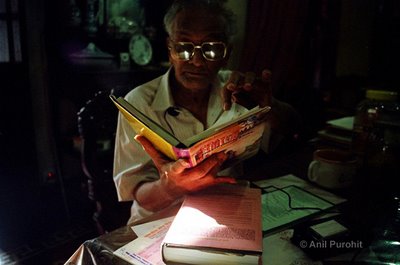
Later I walked across the courtyard to the other temple entrance that led out the perimeter wall enclosing the courtyard. On my way out the high wooden door I passed two stepped platforms flanking the passage to the entrance I had just exited. Elderly sadhus in saffron sat conversing on straw mats spread out on the red oxide coated platform. Some of the sadhus were deep in sleep, their worldly possessions stuffed in bags that doubled up as pillows. It was while he was spreading the cardboard mattress on the platform, possibly preparing for a nap, that I first saw Appu Kuttan, a solitary figure in deep pink lungi that came up to his ankles as he bent over the platform to adjust the cardboard mattress.
Introductions in place, Appu Kuttan allowed himself a gentle smile on seeing me taken aback after he had just told me that he had served in the British India army. On demobilizing in 1948, and without a job he began drifting, not becoming a sadhu until he had turned sixty. “I didn’t get any job after my discharge from the army so I became a sadhu,” he said matter-of-factly as I crossed my legs and sat across from him, warming to the conversation. He lit up a beedi and sat cross-legged on the edge of the nylon mat, the beedi stayed firm between his index and middle finger. Recalling the good times when he earned a ‘good salary’ while working in Aurangabad where the “Quartermaster also worked”, Appu Kuttan soldiered for the British Indian Army for eight long years during World War Two, serving in Singapore for a year where the British Army retreated under the Japanese onslaught, and six months in Rangoon where the Allied Army led by the British fought the Japanese to a standstill in the jungles of Burma before routing them in the same jungles, then in the mountains and across the Burmese plains, possibly handing Japan their biggest land defeat until then, and largely orchestrated by Indian soldiers in their thousands, fighting alongside the Burmese, the Karens, and the Kachins.
“I did not swing guns on the battlefield,” Appu Kuttan recalled. “I served in the 37 Field Ambulance Unit on the frontlines. We took our lunch in the trenches, sheltering from Japanese planes on bombing runs.” At this juncture he raises his hands, imitating the Japanese planes swooping down to drop their loads behind British lines. Allied troops were battling to keep China’s overland supply route through Burma open while Japan sought to cut it off. The Burma campaign began disastrously for the British in the December of 1941, with thousands of Indian soldiers in the British India army losing their lives to the Japanese and disease, malaria being rife in the swamps. By mid 1945 the tide had turned, and the Japanese were in full retreat.
“We took many Japanese prisoners in Rangoon,” Appu Kuttan said, a smile breaking on his lips at the memory as he exhaled after drawing deep on his beedi. “Japanese Officers were made to sweep. They would ask us for Goodbye cigarettes,” he said. “Eighteen of us in the Army company did not smoke, so we gave the prisoners our stock of Goodbye cigarettes.”
On joining the army at the “age of 18”, his first posting was Pune, then Aurangabad, before he was sent to Shillong for a year where he was entrusted with the logistics of distributing ration to Army Companies. “Gaadi leke ration ke liye chalo,” he recollects Karunakaran, a driver from Thiruanantpuram, telling him one day at the army camp. From Shillong he marched with the army to Rangoon serving with the 37 Field Ambulance Unit before leaving for Singapore for a year. I turned my head for a brief moment in the direction of animated voices behind me before quickly turning to Appu Kuttan.
“Capt. Lakshmi Sehgal of the INA was arrested in Singapore and held in our prison camp for a day,” he recollected, his eyes lighting up at the memory which I took to be less for the arrest as for her presence in their midst. As he spoke of her I couldn't help noticing his voice rise up a notch in what was otherwise a phlegmatic undertone that sometimes shook, struggled and faded. His age showed up in his voice, again.
Long before Lakshmi Sehgal, born Lakshmi Swaminathan in a Tamil brahmin family, joined the Indian National Army, she was putting her medical education to good use among the poor of Singapore after leaving India for Singapore in 1940, and after the British army fell to the Japanese in the ill fated Singapore campaign in World War II, she served the Prisoners of War, a significant number of whom were Indians. It was inevitable that she came in contact with the Indian National Army headed by Subhash Chandra Bose, born in an affluent Bengali brahmin family, then actively recruiting Indian POWs from the British Army to staff the Indian Liberation Army. The Japanese were only too happy to see this happen. And when Subhash Chandra Bose arrived in Singapore in July, 1943, and raised the Rani of Jhansi Regiment, a women’s regiment, the mantle of Colonel fell on Lakshmi Sehgal, fighting the British on the side of the Japanese.
Appu Kuttan turns back the years. “Lieutenant Colonel Satchidananda Swami commanded us in Singapore and Major David reported to him at the time. Now Swami Satchidananda lives at Anandashram in Kanhangad in the Kasargod district of Kerala.” Known as Anantasivan in his pre-monastic years, Swami Satchidananda came to the Ashram on being urged by one of his former colleagues (possibly Sam Rose) from the Army in 1948, the year Appu Kuttan returned from Singapore and was demobilized from the British India Army soon after India’s independence.
Pauses punctuate his recollections. Never once in the entire duration did he take his eyes off me. When I ask him if he visits his native state Kerala, he replies, “Aata hai, Jaata hai. Time doesn’t pass there. But here (at the temple), time passes. We (the sadhus) talk, and time passes. We sleep by ten in the night.”
After visiting temples all over India, and barely surviving malaria after the Badrinath yatra, and living at the Krishna temple in Ujjain for six years, and six months in Goa 'in between' where he claimed “some Malabari people know me well there”, Appu Kuttan eventually made Mookambika temple his home the last nineteen of the twenty five years as a sadhu. He sleeps in the temple shelter after he left the pujari’s (a priest) house on being asked to pay a monthly rent of 450 rupees, money he didn’t have. “I get meals twice a day at the temple here, and a paratha (a type of bread) from a shop nearby, and then I sleep here,” he said.

A short distance away to our right, under a makeshift tent that kept out the September sun, twenty-odd artisans chiseled away in a random yet rhythmic melody of chisel striking stone, fashioning largish stone slabs that four youth loaded into their handcart before carrying it through the door and into the courtyard where workers were laying a part of the floor anew. Then they came back for more, laughing and joking as they pushed their handcart to the rhythmic clicks of metal against stone in the time that Appu Kuttan and I sat conversing while the clock ticked to the beat of those soothing metallic clicks at a place that history had seemingly rented out for posterity.

As I prepared to leave, I motioned to the camera indicating that I wanted to photograph him. I barely noticed him smile under the white beard. While I readied the camera he told me that he was filmed along with another sadhu in Trichur when he was visiting his sister sometime ago, “TV ne pakda,” he said. I took a few pictures, cautious not to run through the three film rolls I had carried along for the trip. Then I shook his hand and swung my legs over the platform, onto the floor. After sitting there facing Appu Kuttan and the wall behind him, it took my eyes a few seconds to adjust to the glare of the Sun beyond the shade of the platform.
With a short wave of his hand he saw me off as I got down from the platform. By now we had attracted the attention of other sadhus sitting on the opposite platform, his ‘other family’ far away from a home he never really had, and with no one to wait for him in the night and wonder where he was if he got late, Kadavil Appu Kuttan had made the sky his roof and the earth his home. Freedom would come from fires entrusting him to the winds, scattering him where he had once walked, and in the rivers he once prayed to, before carrying him to the ocean, back to where some people say life began.


 An occasional vehicle passed by on the narrow road behind me. The paddy fields were empty of farmers who had recessed for lunch in the shade at the base of the bund where I sat watching Cattle Egrets poised attentively over water channels irrigating the rice crops, their eyes peeled out for fishes floating in the water sourced from the lake behind me.
 A scarecrow stood in the middle, set off by the green of the paddy crop. For a scarecrow I thought he was dressed well. Peering through the lens I waited for the Cattle Egret to move into the frame before letting the shutter land. I believe the scarecrow did not take too kindly to someone picking off from under his nose even if it was only fishes that the Egret was after and not grain because no sooner had I snapped the lever back to load the next frame the Egret took off.
 We took the gravel path in Kerim at the turn guarded by a small semi circular temple called Bhooth Khamba, where cane baskets and small change are offered by worshippers and travelers to appease the resident ghost, believed to menace lonely travelers. Saffron flags fly from staffs affixed to the top of the temple. Across the road from the Bhooth Khamba, bang opposite the gravel road running past the hill we were now making for lay the memorial to Nilesh Naik, a local youth killed in the police firing during the anti-Nylon 6,6 agitation. Thapar-DuPont eventually pulled out of Kerim in face of implacable opposition to the project by local villagers who feared pollution from the plant. It was possibly among the few successful ‘environmental’ agitations in independent India. The gravel path ran on to the now abandoned offices of Thapar-DuPont. Amid broken bottles littering the place, grafitti covered walls stand testimony to plans gone horribly wrong. Occasionally village youth sit among its ruins, drawn to it as much by an association that defined Kerim as by its desolateness in the middle of seemingly nowhere. I had sensed a strange disquiet among the ruins on an earlier trip there.

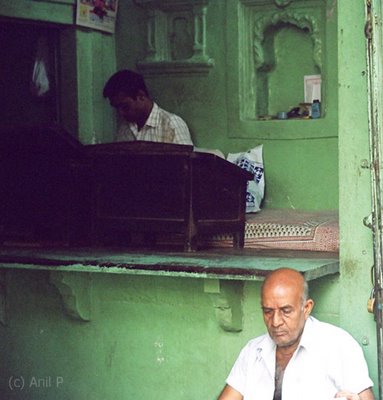

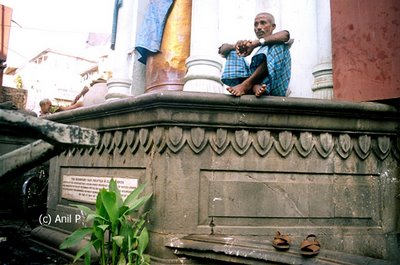
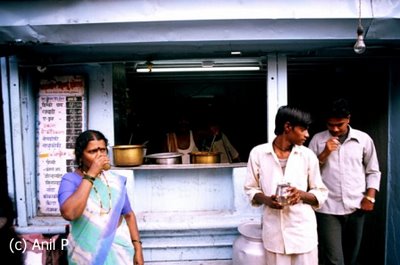 I walked past the fountain to what was essentially a chai shop but was named Mahavir Hindu Hotel. Pausing in front of the chai menu on a large board outside the shop, I mulled the choices of chai listed on the board.
 I asked for Disco chai. The owner welcomed me in where I took a picture before drinking Disco chai. It tasted different though I couldn’t place my finger on what made it different. He smiled at me. I smiled back. Outside his shop, people sat nonchalantly on a wooden bench, watching the world go by while a truck emptied its load.
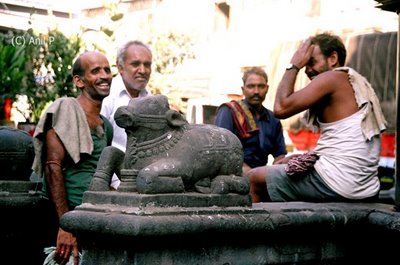
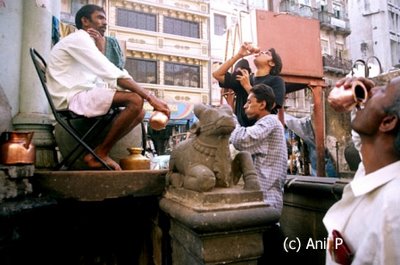 The previous day these lanes were choc bloc with people, some of whom had stopped by the fountain where a man in a loose fitting shirt with sleeves rolled up to the elbows sat on a folding chair on the fountain’s raised platform, a brass vessel in hand, and filling brass tumblers with water for thirsty passers-by. The man in green vest would pass the man on the chair brass pots filled with water from the water carrier which he placed by the side of the chair to fill the brass vessel that he used in pouring water into tumblers. Behind the fountain was the office of the Haath gaadi association. Several empty haath-gaadis were parked in front, and some of the haath gaadiwallahs operating in the area sat on a low platform, talking. There was a relaxed feel to the place.
 I never attempted to bicycle to Tambdi Surla ever again. Once was enough.
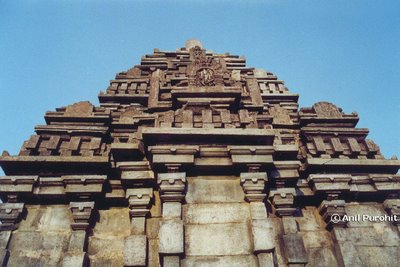
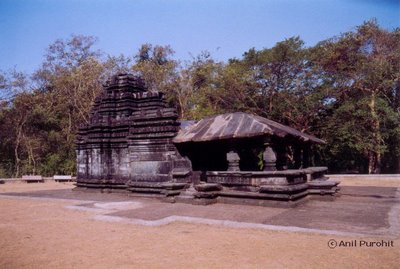 After I got off the scooter and thanked the scooterist for the ride, I walked the final stretch to the stone temple at Tambdi Surla, passing silent trees, and dodging the shadows they threw on the even quieter road. Traveling to Tambdi Surla, known to be home to the ‘only known specimen’ of Kadamba-Yadava architecture in basalt available in Goa, is a pilgrimage I’ve undertaken several times over the years. The fact that it nestles in the mountains, far away from tourist-traffic, often overwhelming, that other temples in Goa are witness to, starting with the end of monsoons in Oct-Nov, and petering off as Carnival comes around on the eve of the season of Lent when Christians fast and offer penance, makes it an attractive travel destination in my scheme of things. In two months time after the Carnival the first monsoon clouds wind their way across the Arabian Sea for their rendezvous with the Western Ghats. And I imagine the stone temple at Tambdi Surla, nestling in the Western Ghats mountain ranges, is among the first to welcome the monsoons to Goa.
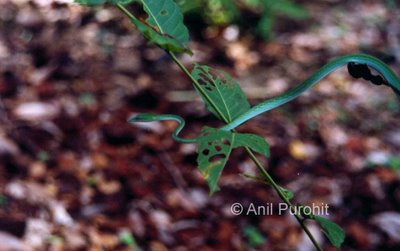 The temple is situated in the Bhagwan Mahavir wildlife sanctuary. I particularly remember one trip when I was showing Jai around the place when he jumped up in alarm at seeing a Green Whip snake crossing his path. I set off in pursuit as it dodged stones and plants until I cornered it by blocking it path. Promptly it climbed up a small plant, curving up in classic Whip snake pose. As I moved cautiously in a semi circle, covering its exit, it swayed gently, as if undecided on its future course of action. It was a beautiful specimen; setting off its fluorescent green against the brown of the earth. I took pictures, framing it on the green plant. Then it left. However, photographing the Skink proved to be more difficult.
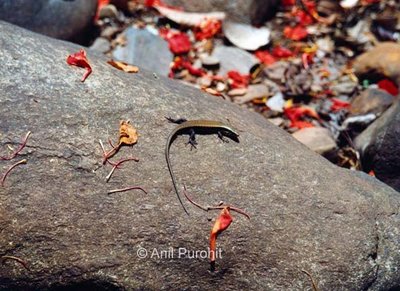 Where the road comes to an abrupt end not far from the tree, visitors cross a small bridge to get to the temple. From here, the temple unveils itself between branches of trees that crowd the cobbled path leading to the temple. In the spring of 2001, I took the flight of steps down to the dry stream bed in search of a Laughing Thrush whose call I had heard while exploring the length of the temple plot adjoining the stream. Instead, on rounded stones set off by brightly colored Gulmohar flowers blown free from Gulmohar trees on the banks of the stream, I saw several Skinks quick-stepping across the stones that littered the stream bed. It was awhile before I finally managed to take a picture of one skink basking on a stone amidst petals of Gulmohar flowers. By then I was sweating from chasing them only to find them disappear under the stones just when it appeared that I might pull off a good photograph.
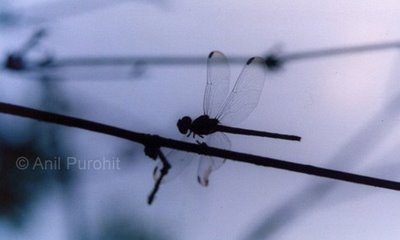 As the shutter came down in a booming click, heightened by the silence, the Dragon fly took off.