Showing posts with label Goa. Show all posts

March 23, 2012

Remembering Shigmo On Gudi Padwa


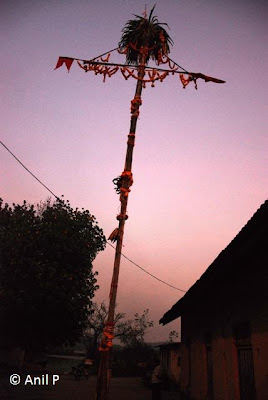
“You should’ve been here at 1:00 O’Clock,” a middle-aged, local man said, probably indicating the time of installation, as I stopped in the temple courtyard to photograph a high ceremonial mast likely constructed from Areca Nut trunk and bamboo and decorated with marigolds, and bananas among other nature offerings, the top surmounted by leaves, similar to the Gudi hoisted on Gudi Padwa.


It rose from a notch in the centre of a raised, square platform where people had made offerings of coconuts to the deity.


Jags and I were returning from a walk along the mudflats and mangroves in Karanjal when I first noticed the high mast erected in the temple courtyard. It was two days after Holi early this month and Shigmotsav celebrations had kicked off across Goa, particularly in the North of the state where traditionally Shigmo (Konkani for the month of Phalguna, the last month in the Hindu calendar) is celebrated from the day of the full moon of Phalgun month to the end of the month that culminates in Gudi Padva, the first day of the Hindu calendar year, that is today.

Only the day before, following Holi celebrations commencing on full moon in the month of Phalgun and lasting a day, I had seen the same sight in the vicinity of a temple in Bhoma as I rode a bus to Panjim. The bus had paused by the temple that sits off the highway, waiting for throngs of people who’d gathered for the installation of a similar ceremonial mast, to make way for the bus. One by one local villagers had come up to the platform from which the mast rose and broke a coconut on the platform as a ritual offering to the deity.

Elsewhere, depending upon the tradition followed at the temples, villagers erect Mango tree trunks or Areca Nut tree trunks though not necessarily restricted to the two. And in the days to follow, given that Shigmo is essentially a festival of music and dance observed largely by Goa’s farming community celebrating the arrival of Spring, villages, and particularly the temples, are transformed by the holding of folk dramas and dances like Khell, Romat, Jagor, Ranmalyem, Talgadi, and Ghodmodni among others.

Villages are not bound by a particular date on which to install the ceremonial mast, each dictated by tradition observed at the temple. Even the commencement of Shigmo celebrations varies across Goa, with South Goa observing it on the beginning of the month of Phalgun and concluding it on Phalgun Punav (Full moon of Phalgun month), while North Goa observes its commencement on Phalgun Punav and concludes it on Padva, today. However, exceptions can be found within each of the two regions. The difference in its observance had to do with the Portuguese banning its observance leading to the colony’s ingenious subjects cleverly disguising its observance along with the Carnival to escape censure and retribution.

“We will keep it until Padwa,” the middle-aged man said when I asked him how long will the ceremonial ‘trunk’ be retained. Today is Gudi Padva, and I believe, with much fondness and piety the ceremonial ‘mast’ will have been lowered. However, the actual Shigmo celebrations involving folk dramas and dances would normally extend only five days from the date of commencement of the Shigmo festival.


The middle-aged man was supervising a few local youth busy putting up a makeshift stage in the corner of the temple courtyard. “Dramas will be staged from tomorrow night,” he said. It’s a scene that repeats across Goa in temples where these celebrations take place. Not all Goan temples celebrate similarly.

“No. Around here you’ll get to see this in Durbhat,” a youth said when I asked him if every temple hosts these celebrations as in dances and dramas and the ceremonial ‘mast’ that he referred to as Shigmyache Holi, a term I felt might not be the original reference. He mentioned two other temples in the vicinity that I cannot remember clearly now.

A sodium vapour lamp cast a gentle glow on the activity below as the men discussed ways to reinforce and shape the makeshift stage where local artistes would stage their plays to villagers crammed in the courtyard. Curious of the atmosphere I made a mental note to ride over to the temple the next day and watch the plays with the villagers. I could not make it to the venue the next day.

However, the rhythmic beating of the drums, that familiar Ghanch-katar-ghanch, ghanch-katar-ghanch had floated on the Spring breeze in the days leading upto Shigmo and in the days since, quivering along quiet roads, stepping across lush green paddy fields, skipping over village ponds, all the while strengthening and waning depending on the breeze carrying the hypnotic beats towards or away as bands of drummers carried their drums from Vaddo to Vaddo, beating the familiar, throbbing beat pulsating with the energy and the promise of Spring, and of life itself.


A day earlier, on our way back through Chorao as we headed for the ferry crossing to Panaji, Philip and I had rounded a turn in the narrow road just before it ran through an open field and happened upon an enthusiastic band of drummers on the roadside hard at their drums.

A few shops and homes with sloping roofs lay on either side of the road, and local men stopped by to talk and offer encouragement. The Sun was descending behind the trees and the evening pulsated to a familiar rhythm from my childhood.


“Will you be participating in the Shigmo parade in Panaji?” I asked one of the drummers as he handed the sticks to a young child before turning to me to answer.

“No, no,” he said, smiling. “For the duration of the Shigmo celebrations, we’ll be moving from waddo to waddo, drumming our way through them.”

In the countryside, Goa resonates to the beat of Spring in Phalgun. Like the season itself, the drums regenerate the landscape, and memories.

And standing on the roadside I imagined children stepping out, as I once did, and dancing to the beats of an ancient people of an ancient land following an age-old tradition.

October 23, 2011

A Sunday Morning On The Mandovi


From Old Goa the road to Panjim meanders along the Mandovi, often at the same pace as the river, conducting vehicular traffic along its gentle curves to the faint fragrance of the river marching steadily to the Arabian Sea off Panjim, Goa’s capital city located at the confluence of the river and the sea.

This is the stretch I look forward to on my forays into Panjim. On clear days, and the skies are usually clear on either side of the monsoons even if not always blue, the breeze sweeps in on the stretch of road and the rumble of the bus turns into a steady lulling drone, only changing on the driver shifting gears up or down the inclines when it isn’t trying to overtake another.


Occasionally a loud blast of horn will sound from large river barges navigating the Mandovi and ferry goers awaiting river ferries for Chorao and Diwar will turn their face in the direction of the horn. If they’re lucky a second blast of horn will reverberate through them, bouncing off the narrow streets before the quiet lays claim to the streets once again.


The stretch of road past Old Goa offers glimpses of the river in snatches of streetside conversation interrupted by coconut trees, groves, whitewashed chapels set off by gulmohars in spring blaze, shipyards, fisheries, shopfronts, fishing jetty, fishing trawlers, and verandahs along the front of old homes, the cast iron railings lending the street a hint of relief, and on Sundays even more so.


Sundays empty urban and rural landscapes not so much of people as they do of purpose, of urgency, of the necessity of travel, of having to be someplace you’d rather not.

In arriving as Sundays do at the end of the week or at the beginning depending upon how you choose to see it, they seek to serve as a prelude to the moment the body, freed of encumbrances, fleshes out a new beginning, shaking off the sluggishness of the week before, not unlike acquiring a new skin as the old one is lost to the mandatory weekly moulting.


While awaiting a river ferry to take one across the Mandovi, there’s little to distinguish the waiting from any other on a weekday, except maybe there’re fewer vehicles awaiting a ride across the river on a Sunday than on a weekday.


The river itself is a picture of calm, barely a ripple in the sunshine unless fishes try to break surface. Kingfishers continue to perch on overhanging branches before speeding into a dive and returning with equal alacrity, a wriggling fish held firmly in the beak if lucky. Off the road life goes on as usual, and the week is but days that’re no different from any other except maybe Sundays on the Mandovi but not by much.


The spring reveals itself in Goa as flowering trees blossom among the chatter of birds calling on them as much for the succulence on offer as for reveling in the warmth of sunshine on the banks of the river on a Sunday morning.

The Silk Cotton tree in particular is insistent with its blood red blossoms setting off the quiet of the street and the blue skies. Like blood shot eyes lined on bare branches, the flowers seem intent on being seen from afar by birds and meanderers alike.

After the mild Goan winter the first sight of colour breaking out in the trees is an occasion to pause along the way and step out for a closer look. On the banks of the river it’s the time to gaze along its length and steady the morning rush into something more manageable and peaceful.


The Red Silk-cotton tree is among the first to blossom and is the harbinger of spring. If you see a Silk Cotton tree in bloom while most other flowering trees haven’t began blooming yet, it’s likely you’re out in January like I was when I came upon this tree on the banks of the Mandovi on a salubrious Sunday morning on the river.

The tide was out, exposing laterite stones along the sliver of land below the road. In the shade of an overhanging tree, local villagers cast lines out in the river from slim bamboo sticks, watching in silence for signs of fish taking the bait.


Watching them perched on stones and gazing fixedly in the river after the lines that’d gone under, I wondered if necessity had driven them to fish in the Mandovi that morning for, fish are plentiful roadside in the villages that dot the Goan countryside as vendors make their way into village centres early each morning, and while not everyone can afford all the fishes on display there’ll always be a variety or another available in cheap and in plenty.

However, it’s entirely possible that they’d time on hand from their vocations on weekdays and had chosen to go fishing for a bit of quiet and sport on the river, hoping to land some for lunch but not overly disappointed if the Mandovi refused to yield any for their effort that Sunday morning. Moreover, fishing brings a Sunday feel to the activity all by itself as any slowing of pace through the day inevitably will.


Across the road from the three fishermen, a local youth stepped to a roadside Cross bearing white candles. After a brief moment of prayer, he lit the candles at the Cross with a deliberate precision that comes from doing it over time. An act of faith strengthens in belief from enduring time, and tide.

Once the candles he had lit were burning bright at the altar of the Cross, he bowed his head before stepping out onto the road. Whether he had petitioned the Cross or was offering thanks for realizing his prayers is something I would never know. It was equally likely he was paying homage to departed memories as is likely he was infusing his day with piety from offering candles at the Cross.


Later, as we boarded the ferry to Diwar, I leaned against the deck as it pulled away from the landing at Sao Pedro before affecting an about turn in the middle of the river as it headed for the opposite bank.


A fisherman on the river bank we had just left swiveled on his heels as he expertly looped the fishing net into the air, pausing mid swivel to watch it settle in a billowing circle, setting off little ripples where it hit the water.


On the river ferry, framed by an open window a woman in red corduroys lent her gaze to the river in silence. Like a painting of a river hanging from a wall, the open window framed the stretch of river behind her as the ferry neared Diwar.


Soon mangroves and fishing nets replaced the river scene in the open window and the clattering of iron chains sounded as the boatman lowered the landing.


Then there was silence as we stepped past the gangway and made for land and beyond, for the tree from my childhood travels.

Its leafless outline has been a constant from the time I first landed in Chorao on a Sunday bird-watching trip from school, subsequently making my way to Diwar for no better reason than it was there to be explored. It was there I first saw it, and subsequently ever after. It’s home to the great Kites that hover in the skies over Diwar, a place to land for a breather before opening their wings for a foray in the skies.


The stark outlines of the barren tree relieved the empty rice fields of Diwar midway through their stretch against the hills inland where a whitewashed church stands from before, from way, way before.

Here, on the power lines that run along the narrow road that takes the traveler deep into the island off Panjim, Roller Jays launch into the air playing in the same frame as do Black Drongos and Small Green Bee-eaters, each carving their empty space in which to hunt insects, each dancing to their own rhythm bequeathed them by their own kind.


Occasionally a bus will trundle past on its way to the ferry point. On Sundays, even fewer buses will.


Stepping off the road in the direction of a large, shady tree ringed by a platform for travelers to pause and take in the quiet we find company, of locals who’ve ridden to the shade of the tree for a bit of beer and quiet.

Soon another villager joins them bearing snacks (Vada Pao) to complement the crate of beer and soft drinks. It’s likely they’ve stocked up on liquor to go with beer and have taken time off from home to lighten up their Sunday with a bit of beer and talk while the Mandovi courses past them behind the bank of mangroves at the edge of the field.


They’ll have planned the Sunday morning outing over the week, calling up to confirm the time before riding out to the tree by the lonely road, looking forward to doing nothing in particular and reveling in the thought of it. Soon the Sunday on the Mandovi will pass and the week will be upon them.

The anticipation of doing nothing, even if limited to a day, is a salve for having to live with choices made as a matter of course, compulsion or necessity. The anticipation exults not so much in the freedom to do as one pleases as in reverting to a natural state of being, floating freely and away with time, like the birds in the skies over Diwar on the banks of the Mandovi.

April 07, 2011

A Goan Landscape in Salcette


I cannot remember ever seeing Purple Herons work the water in a pair or more. Most times I spot Cattle Egrets in greater numbers than Purple Herons, fishing together in harmony, the Purple Heron easily recognizable among its shorter, fairer companions.

The image of a lone Purple Heron in its habitat is riveting not in the least because the lone ranger is a powerful metaphor for survival. It’s an image that can abide, and last time. And one which I’ve marveled in in the silhouette that distance will impose on the traveling eye early mornings and late evenings.

It is one reason why when I pass the waters off Borim in the direction of Margao, past a network of wetlands fed by the Zuari, Goa’s best known river after the Mandovi, I’m reminded of the lone Purple Heron outlined in the winter mist at dawn some years ago, poised in the stillness of its reflection, beak pointed at the sheet of water, not a ripple stirring the sheet to life.

In the moment I first saw it, it had metamorphosed into a painting, and I had paused to take it in.

Behind me the Chowgule Shipyard loomed over narrow waterways snaking inland, sheltered among mangroves fencing off the Zuari. I had turned my back to the Shipyard in the hope of ridding human encroachment in the unfolding scene, framing it so I could commit it to the primeval frame of reference that nature is best experienced in.

Across the Zuari, tracing a diagonal with Chowgule Shipyard, lay Mandovi Pellets Ltd.

Not for one moment did the Purple Heron move in the minutes that ticked by. In the urgency of its morning bite, it had delivered grace to the morning stillness that winter day, the wetland gradually revealing itself in the mist.

The wetlands, much of which are Khazan land, serve as a constant in a fast-changing landscape, and stretch some distance along the road in the direction of Margao before disappearing from view as the road turns South-West approaching Raia.

In late February this year, Ajay and I had turned off the highway at Tembim, riding South-East before turning left at Ganapoga where the waters parted on the landscape to reveal a road we might’ve missed if it wasn’t for a motorcyclist riding the barely visible ribbon.


"It looks like he is floating on water,” Ajay remarked. The road approximated a dyke barely rising above the water even as it kept the water at bay from harvested paddy fields turned to a shade of brown at the far end. It didn’t help that the tide was in, the water almost drawing level with the road.

The rumble of the motorcycle came in a series of gentle waves, fading out just as the next wave breached the quiet of the Salcette countryside, riding the light breeze that blew our way. If it wasn’t for the sound washing up at our ears in steady rhythm with the silence, we’d have been oblivious to the breeze.

The Sun was mellowing down for its date with the evening sky as we rode past a bus stop at the turn that straightened up and ran along, piercing a swathe of trees sheltering Portuguese-era homes before pulling up at Rachol Church adjoining the ferry crossing connecting Rachol with Shiroda to the east.

But before we made for Rachol Church dedicated to Our Lady of Snows, we paused briefly at the Chapel Nossa Senhora De Bom Parte in Caver.


Crunching to a stop in the gravel extending the narrow road on either side, we made for the Chapel Nossa Senhora De Bom Parte set back from the road and facing west.

As we walked up to the Chapel, the wetland stretched east behind us. The motorbike was long gone and silence had returned to the fading patch of sunlight dropping steadily on the Zuari hidden away among mangroves.


Behind us, in the distance the freshly whitewashed Rachol Church appeared like a piece of chalk flung into the trees and held fast by branches delighting in the prize, and history, cast their way for, the Rachol Parish Church is among the oldest churches in Salcette.

A gentle incline stretching a little over fifty yards brought us to the Chapel. The Chapel of Nossa Senhora Do Bom Parto stood alone, unlike most Goan Chapels that exist cheek by jowl with homes in the neighbourhood.


Standing in front of the whitewashed Chapel, I trailed my eyes along the contours of the mountains rising in the distance, their brown contrasting with the sky above while the wetland flattened the landscape to the colour of water reflecting the heavens above.

Decorative lights strung out on wires hung from the chapel, likely put up in the event of a feast in the honour of Our Lady, or possibly marking a thanksgiving function. I didn’t know for sure and there was no one about to check with.
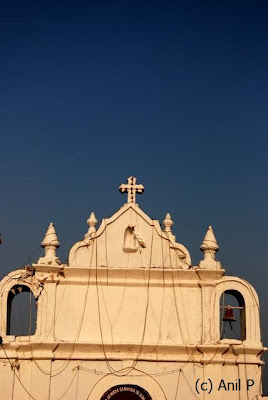


Nossa Senhora De Bom Parte. It was an uncommon title to happen upon in Goa, surely not in my experience traveling around Goa. The title of this devotion to Mother Mary, Capela De Nossa Senhora De Bom Parte, is associated with the birth of Jesus Christ, and consequently sought by expecting women to offer prayers for their well being in the period, and that of their child while promising to bring the child up in a manner befitting the humanity Jesus Christ preached and lived by. The prayer likely including –


I promise to guide my son
Always the right way,
The way that your Son, Jesus,
Traced for all men,
The path of good.


Built in 1899, the Chapel would have been among the earliest to cater to Salcette’s Christian neighbourhoods springing up in Ganapoga. Amid paddy fields and the Zuari abutting inland in the form of wetlands, the Chapel will have witnessed life steeped in and sustained by agriculture and fishing, with rural folk working as farm-hands and combining as community during religious festivals, first as Hindus, then as Christians upon their conversion by Christian missionaries as Portuguese influence swept inland upon their conquest of Goa, devouring the land with an intensity equaling their missionary zeal employed in forcibly converting the largely native Hindu population to Christianity.

It was a long time ago. It was not a long time ago. It depends on whom you talk to.

About us, serenity had triumphed, laying its card face-up. Floating on the breeze, voices of womenfolk walking along the road the motorcyclist had ridden over a short while ago, nudged us to the presence of humanity. Ahead, past the Chapel, a narrow road ended at the gate of a house shaded by trees and coconut palms (Madd in Konkani) in the front-yard. A dead-end.


Coconut husk lay in a large heap where the road ended at the gate. Walking up to the heap I noticed it to be of recent provenance, resulting from coconuts most likely harvested in the neighbourhood. Coconut groves, known as Bhaat in Konkani, are a common sight around Goa. Later I would come upon similar heaps of coconut husk piled up at Xeldem, and then at Pomburpa, all within days of each other, leading me to conclude January and February to be the coconut harvesting months in Goa, though not necessarily restricted to those months.


The open area fronting each house in the neighbourhood was planted with flower beds and trees. Clothes hung from clotheslines. A Goan catholic woman in a skirt was working in the front yard when I made my way across the road just as Srikant, the Podhyer or Poder (a bread vendor selling Pao from a basket covered with the once trademark blue plastic and hitched to his bicycle at the back), came cycling along, honking his hand-held horn, the signature sound much of Goa stirs to in the early mornings and late afternoons and is as much a part of its identity as its swaying palms.

A little girl ran up to him and asked for Kakon (bangle-shaped hard and crisp bread variously spelled as Kakna or Kankan). Kakon (or Kakna/Kankan) is Konkani for bangle.

The leavened, oven baked bread known as Pao (also spelled Paav) and offered up in several varieties is relished by Goans and is a local institution, owing its origins in the tiny state on the West Coast to the Portuguese, with the possible exception of Kakon.

The Kakon I saw growing up in Goa was favoured by Goans at tea time instead of biscuits. As children we would delight in slipping the bangle-shaped crispy bread up our slender arms and wave them in the air before slipping each off and breaking it before dipping it in tea, or occasionally milk, to soften it. Kakon (Kankan/Kakna) is kneaded hard in very little water and fired up in over 270 degrees C. In the lunch-break between classes the mischievous among my classmates would sometimes gather for an impromptu session of Catch using Kakon in the manner of a Frisbee.

The game would invariably end in the Kakon splintering to pieces but not before it had held its own over several flings, necessitating hectic cleaning up before classes recommenced after the lunch-break.

Placed atop each other and held together by a string, the Kakon you see hanging on the wall in the picture above is from my meandering in a village bakery in Bandora.


Srikant had run out of Kakon. He offered the girl the other variety of bread he had in his basket, Poyi or Poee, holding two out as she wavered with her purchase on being confronted with a choice different from the one she had skipped along for.

The Poyi, made from coarsely ground whole wheat flour as opposed to the finely ground Maida used in making Pao, is generally acknowledged as relatively healthier and not just for the whole wheat flour but as much for the absence of sugar in its preparation as for its fibre content, the latter acquired from rolling it in bran, easily visible on the surface. Poyi with sugar content is also offered up for purchase by traditional Goan bakeries.

Personally I favour Undo or Katre Pao over Poyi, unless if I’m offered a batata-vada wrapped in Poyi. Even so I’d prefer my batata-vada wrapped in Pao.

I had half-expected Srikant to offer her Undo or at the very least Katrecho or Katre Pao (Cut-bread) since the latter’s crust approximates the Kakon in crispiness as compared to Poyi, which is softer and more in the mold of Chapati. There’re people who’ll pronounce Poyi as Poli, the latter usage alternating with Chapati among Marathi-speaking people.

For a moment the little girl was undecided, probably wondering if she should buy Poyi after being sent skipping along to buy Kakon.


Soon he had another customer asking for Kakon only to disappoint her as well. Instead he sold her Pao. Kakon or not, nobody went back from him empty-handed.

“Don’t you bring Kakon along?” I asked him.

“I do,” he said. “They got over along the way. They’re in much demand.” I was surprised to hear him say that for, in a village bakery in Velim a little over a year and half ago, the baker I met with had told me that they no longer make Kakon since few favour it now. Hearing Srikant note the contrary, I assumed it must have to do with changing neighbourhood tastes though it seemed unlikely.


Srikant spoke in the heavy Konkani accent that usually distinguishes Goan Catholics uniquely from Goan Hindus, and particularly those hailing from Salcette. But that is not to say that Goan Hindus will not speak in the Konkani accent of fellow Catholics if they’ve lived and grown up in majority Christian neighbourhoods.

There was no one else on the narrow dead-end road separating the mostly Goan Catholic neighbourhood from the Chapel. I gathered it was tea time, a time for quiet, reflection, and a bit of rest from working all day.


A badminton court stretched out empty in front of the Chapel, aiding a spot of recreation for neighbourhood youth, more likely womenfolk for, the men and boys likely favoured football, evident in the page affixed to the Chapel door, listing names of donors contributing to the “1st All Goa 1ASIDE & 3ASIDE Tie-Breaker Football Tournament held on 15th Jan 2010,” organized by Caver Youth Association.

‘2010’ was probably a typo. The page had not yellowed with time and exposure to elements. It should have been ‘2011’ and not ‘2010’. Human beings are creatures of habit and it takes more than a month into the new year to get the year right on paper.

Thirty local residents were listed as donors to the Tie-breaker Tournament, a common sight in Goa, particularly among largely Goan Christian neighbourhoods in Salcette, and to an extent in Tiswadi. While most Tie-breaker Football Tournaments in Goa will split the prize money between Winners and Runners-up, some will stage the tournaments to raise funds for the local parish church, or to local charity supported by the church or otherwise. The tournaments draw feverish competition and much of the village turns up to cheer the contestants on.


The Caver Youth Association had managed to raise Rs. 4,750/- from the thirty donors - Anthony Alemao, Xavier Cardoso, Santan, Gloria, Melinda, Joswin Dias, Erkin Dias, Agnelo Moraes, Wilroy Cardoso, Joy D’Souza, Vinya Monteiro, Jose Gomes, Afi Moraes, Inacio Vaz, Joel Fernandes, Anand Bandekar, Janny Vaz, Stanley D’Silva, Kapil Fernandes, Nobert Pinheiro, Soccoro Dias, Richard Oliveira, Samsan Dias, Mary Dias, Agnelo Oliveira, Rosario Oliveira, Fraser Rodrigues, Costao Pinheiro, George Oliveira, and a ‘Well Wisher’ who didn’t wish to be named.

I was intrigued by the cheeky line below the list of donors that read: “Thank you, may God bless you and help you as much as you have lend a helping hand to us.”

While most donors donated Rs. 100, with a few donating Rs. 200, barring two donors who donated Rs. 500 and Rs. 1,000 respectively, I'd imagine they'd be generally happy with receiving God’s blessings equally, excepting the few who donated Rs. 50 and could not have been pleased upon learning of Caver Youth Association seeking for them, God’s blessings commensurate with their donation, half the blessings of those who'd contributed Rs. 100, and a quarter of those contributing Rs. 200!

Calling out his presence to the neighbourhood one last time, the Poder paused for a few moments before cycling back the way he had come, soon disappearing out of sight past the bend in the road.

And stillness reigned once again.

February 09, 2011

Trucks Roll On, Roll Off Konkan Railway


Before the Konkan Railway came into being, connecting Mumbai with Goa along the Konkan coast, I would travel to Mumbai and back by bus, along roads winding through villages and hamlets hidden among trees and interspersed among rice fields. To watch a villager walk by in the backdrop of mountains would be watch tranquility nudge time along.


Sometimes the bus would pass close enough for me to make out the farmer’s features as he ploughed his rice field in ankle deep slush, goading his oxen on with short guttural commands. In the next square would be another farmer with his bullocks, the scene repeating for many miles along the Konkan stretch.

The sameness never jarred, instead it sought to connect me with a tradition, even if fleetingly, that’s barely changed since the time humans first began to work the land, rooting them to the earth just as surely as wings root birds to the skies, and as irresistibly as a bend in the road draws a wanderer’s feet to it.


If the skies were blue and an occasional cloud were to be making its way across, the water in the rice fields would reflect it just as clearly as if I were craning my neck out the window to sight it in the skies. And in the water I could see the breeze I felt on my face pressed to the window.


The pastoral scenes along the Konkan stretch filled in the hours well. Soon enough the rumble of the bus became a steady hum, receding to the back of my mind like an insistent fly buzzing about in a room stilled by the noon silence. I might’ve been in a theatre watching a slide show of picture postcards play out and not know the difference.


The Goa - Bombay journey was a long one, and the only time I was brought up to a thudding break in the middle of the scenic slide show was when the driver would occasionally swerve wildly to sway out of the path of an oncoming truck joyously muscling his way past a terrified bus-load of staid passengers. I’ve had my share of these untimely thrills over the years to an extent that I began to keep a wary eye out the window for an oncoming truck if only to give me a momentary head-start for a bracing impact, helped no doubt by the occasional wreck left to rust along the Bombay - Goa route, macabre installations that might yet be turned into art someday if only to remind a traveller of the perils that his Karma might’ve in store for him.


I needn’t have worried much, for I’ve lived to tell the proverbial tale. It’s just that having shifted to traveling by the Konkan Railway, and my encounters with trucks on the highway having reduced to seeing them waiting alongside bullock carts at railway crossings, watching my train thunder past, I was nevertheless reminded of my highway journeys when, three years ago, the Mandovi Express I was traveling by pulled up alongside Konkan Railway’s RO RO service for trucks, shortened from Roll On - Roll Off.


The Roll On - Roll Off flatbed rail car was headed the opposite direction with its cargo of thirty trucks transporting goods when we passed it shortly after leaving Khed.

Doors open, the drivers and cleaners were probably twiddling their thumbs, or maybe playing cards awaiting Kolad, their Roll Off point 145 kms. short of Mumbai. In all likelihood they’d Rolled On at Verna in Goa, or maybe at Suratkal, 20 kms. off Mangalore.


The Konkan Railway operates the Roll On – Roll Off (RO RO) service for truck transportation between (1) Verna – Kolad, (2) Suratkal – Kolad, and (3) Verna – Suratkal. The Verna – Kolad stretch is 421 kms., while the Suratkal – Kolad route spans 721 kms.


A little over a year ago reports had suggested that Konkan Railway had made profits to the tune of 120 crores from their RO RO service over ten years, the service having commenced in 1999 before recommencing after a minor suspension of service in between.

The trucks have to obtain height clearance before they’re permitted to Roll On the rail car at the loading point to ensure a safe clearance through the slew of tunnels along the Konkan Railway route.


It must be a welcome change for drivers to sit back and take in the picturesque Konkan stretch from the safety of their cabins as the rail car proceeds to their destination along the coast instead of keeping up through the day, and the night hunched over the wheel.


Needless to say it saves drivers long hours of driving, cuts down on transportation time between the destinations serviced, saves trucks from the wear and tear of the road, and the owners of fuel costs, bypasses check posts and the inevitable greasing of sundry palms along the way, primes the business for quick turnarounds on account of reduced travelling time, and most importantly reduces the probability of accidents resulting from reckless, drunk, or fatigued truck drivers. The opposite is also true, saving truck drivers from accidents resulting from reckless, drunk, or fatigued drivers behind the wheels of sundry motor vehicles.


Watching the trucks idling in silence, I couldn’t help wonder if my own journeys by bus might not have benefited by fewer ‘thrills’ on the highway if this service was up and running back then. It’s another matter really that if Konkan Railway was around ‘back then’ I might never have traveled between Mumbai and Goa by bus to start with, though I’d continued with traveling by bus to elsewhere.

Watch Video: Roll On, Roll Off (RORO) trucks, Konkan Railway


While 30 trucks ‘removed from plying on the highway’ might seem too few a number to make a significant difference to the health of other motorists on the highway, and which might indeed be the case more so now than when I used to travel infrequently to Bombay and back by bus as a school boy, it’ll nevertheless make highways safer considering the service runs each way and is set to be increased with rising demand for the same besides the likelihood of being adopted across the country.