October 26, 2006

Visiting Dadar Kabutarkhana


I got out of Dadar station and passed under the bridge to the west before taking the left turn that runs past the Kabutarkhana where pigeons mill around in an open enclosure, feeding on grains that people toss over the waist high fence.

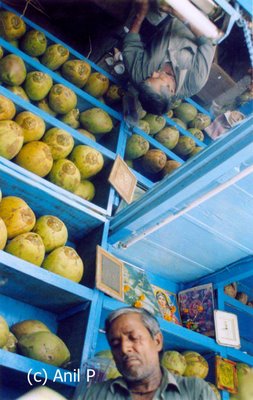
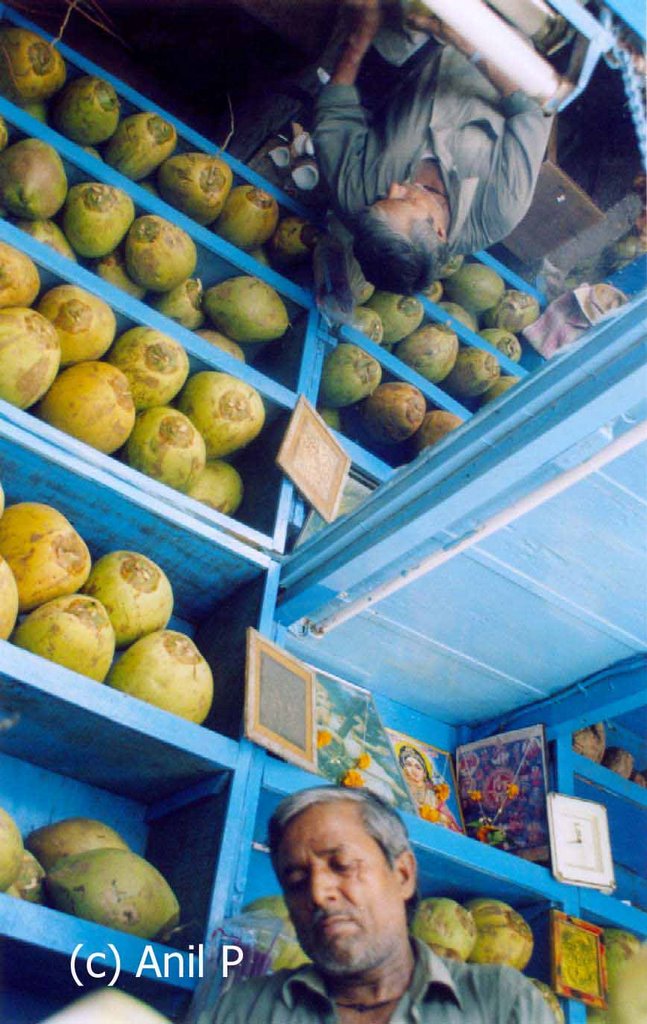
Further up, devotees visiting the Siddhivinayak temple in Prabhadevi await BEST buses at the bus stop near the Kabutarkhana where, in the heat of summer, they step up to a coconut vendor behind the bus stop for tender coconut water (nariyal paani). The vendor sits under a ceiling made of mirror so when you look up, the coconuts stacked up on the floor appear to hang over your head. I visit the vendor for nariyal paani whenever I happen to pass that way.

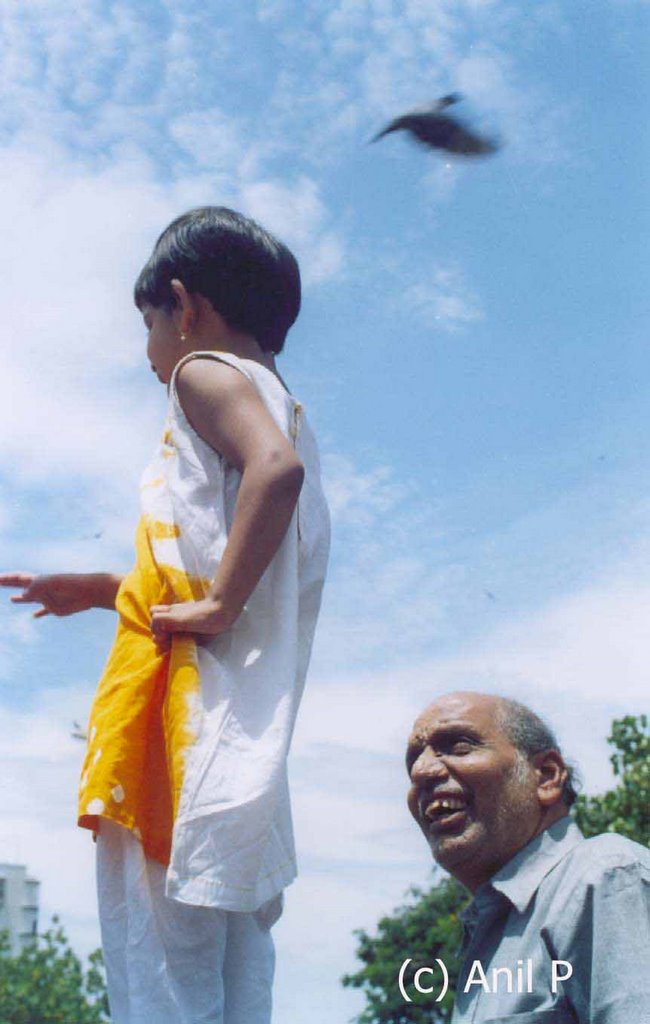
As I began to walk past the enclosure that was fairly abuzz with busy pigeons I saw an elderly man hoist a young girl on the fence to enable her a better view of what the pigeons were up to. There was just about enough space for her to balance herself on the fence that ended in iron spikes set at regular intervals. She was oblivious of the spikes once up there on the fence, pointing excitedly at the pigeons and relaying information to the elderly man standing behind her, whom I took for her grandfather, and engrossed in what she was saying. Clouds inched past in the sky overhead as the sun beat down gently. I took this picture as a pigeon took off from the enclosure just then. The tender expression on his face as he looked up at the little girl, taking in her excitement, stayed with me long after I took the bus to Prabhadevi later that day.

It took me back several years, to another place, to another elderly man who sat attentively while I, all of ten years, held forth on cricket, sharing my enthusiasm for the game and the dreams I saw for myself in it. My maternal grandfather is no more, but occasionally if I’m lucky, like that day in Dadar, I see him reflected in another’s eyes.

Sometimes when I look back I cannot help feeling that they used to be simple days.

September 25, 2006

Time and Again to Tambdi Surla

I never attempted to bicycle to Tambdi Surla ever again. Once was enough.

And moreover the road to Tambdi Surla through Sacorda where it turns left off the national highway 4A that runs on to Mollem on its way through the Anmod ghats to Belgaum in Karnataka, demands of the cyclist a strong heart to negotiate the undulating terrain in the heat of a Goan summer. It took me a long time to pedal to Tambdi Surla that summer day many years ago. However, halfway through the journey after I had pedaled about twenty kilometres, I propped my bicycle against a mud-house in a village along the way, smiled at the owner who’d come around to see what the commotion was about, and hitched a ride on a two-wheeler to the temple. To my luck, the rider was headed to Tambdi Surla the village where the temple is located. Before I got off his scooter, he assured me that if I waited long enough at the turn in the road near the village I’m bound to find someone who would offer me a ride back the way I’d pedaled. “Then you can get off where you’ve parked your bicycle and cycle back home,” he said. Then he asked me why I had chosen to bicycle such a long distance – twenty kilometres in the middle of a Goan summer is a very long distance. I was drenched from sweat, and was wary of pausing for breath lest my legs cramp up. “I enjoy bicycling in the countryside, and thought the route to Tambdi Surla might be a challenge,” I replied.

The bicycle offered me an escape from the textbooks. That morning I started early, and stopped on the way at Khandepar for pao-bhaji at a local inn opposite the road to Opa that runs past the ancient Saptakoteshwar temple by the banks of the Khandepar River before culminating at Opa water works, the source of water for much of Goa. Years later, Ajay and I frequented the inn for mirchi-bujjiyas until the cook lost it quite inexplicably. The color of mirchi-bujjiyas turned to a consistent burnt red from the rich blend of pale yellow with a warm brown to it that we so enjoyed eating even as our mouths caught fire and eyes watered from ingesting the extra spicy green chillies cooked in besan. Later that year when my school closed for the vacations, I would return to Khandepar where I helped with paperwork at the tractor yard, getting them registered at Margao. I had a good time the three months that I cycled the six kilometers to Khandepar each day and back the same way. And, the days when there were no new tractor arrivals, I got back on the bicycle and pedaled further up, along the way to Bondla with the wind in my teeth. Those blue skies above me were irresistible.

After downing the pao-bhaji, I mounted the bicycle in the direction of Mollem, and just before the bridge over the river I pedaled past a narrow road to my left that goes up an incline before skirting a playground where a fig tree fruits in the summer and down a rocky slope where three caves cut in laterite face a fourth one in silence. They rest in the side of a gentle hill after they were excavated decades ago. Legend has it that Pandavas built it during their exile as they traversed the country. If it is true then their origin is set back by thousands of years. However, I’m perplexed by the sheer number of such caves around the country whose origins are attributed to the Pandavas.

When Jagdish and I visited the caves last April, A explored the narrow pathway cut in the banks of the Khandepar river that flows from under the bridge a short distance away, and sweeping past the bend that hid the bridge from us. Now, when I occasionally stop by the caves, I walk down the narrow pathway where it disappears beneath the river surface, and sit on the edge with my legs in the water. Invariably I spot a Kingfisher diving for fish from an overhanging branch. Usually I spot the White Breasted Kingfisher doing the honors; sometimes it is the Small Blue Kingfisher. I never tire of watching Kingfishers skimming the surface of the river at full tilt before taking up position on another of the many overhanging branches of trees that line the banks. Occasionally I spot a narrow dugout anchored to the bank with nylon ropes. If the water is clear, and chances are the water is clear in the summer, fishes are visible beneath the surface; sleek, black creatures.

Clumps of bamboo in front of the caves line the banks of the river. In spring time, Magpie Robins seek the upper reaches of the bamboo and let their melodies float in the breeze. Then the bulbuls join in and quicken the pace, letting out their own chorus. I used to try and separate the conflicting melodies in my mind but soon gave up. After a time, it really does not matter, they invariably mesh well together. Also, it was here that I saw a Tree Pie for the first time as it flew past me and into a tree to my right. Jasmine fragrances from plants that circle the caves trail me in the spring when I ride down to the laterite caves. I’ve rarely seen people visit the caves and it suits me just fine.

As I pedaled on the road in the direction of Mollem, a gentle breeze stirred in the mango trees along the route. Gulmohars were in bloom. Occasionally an Indian Laburnum (Amaltas) burst forth in golden melody in the brown hills. As I scoured the countryside for these bursts of colour, reveling in their enthusiasm, I remember thinking that I could not have been happier that summer. Ahead, a man in loin cloth herded his buffaloes to the side of the road near Usgao to make way for a Karnataka State Transport (KSRTC) bus on its way to Belgaum. It had left Panjim an hour and half ago, covering forty kilometers through the countryside. Belgaum lay 115 kilometres ahead. I slowed down behind the herd of nervous buffaloes before passing them in the cloud of red colored dust swirling in the wake of the bus where it had swerved off the road to make way for a mining truck hurtling from the opposite direction. Then more mining trucks passed us on the rutted road.

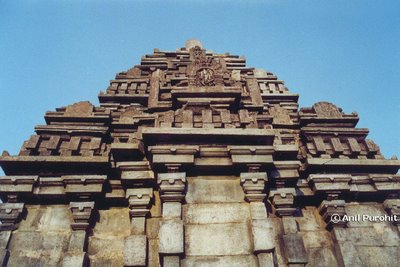
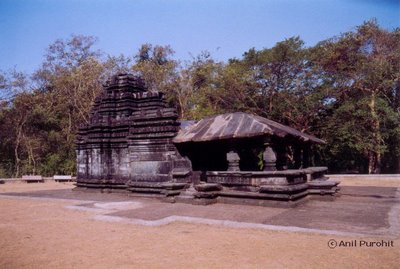
After I got off the scooter and thanked the scooterist for the ride, I walked the final stretch to the stone temple at Tambdi Surla, passing silent trees, and dodging the shadows they threw on the even quieter road. Traveling to Tambdi Surla, known to be home to the ‘only known specimen’ of Kadamba-Yadava architecture in basalt available in Goa, is a pilgrimage I’ve undertaken several times over the years. The fact that it nestles in the mountains, far away from tourist-traffic, often overwhelming, that other temples in Goa are witness to, starting with the end of monsoons in Oct-Nov, and petering off as Carnival comes around on the eve of the season of Lent when Christians fast and offer penance, makes it an attractive travel destination in my scheme of things. In two months time after the Carnival the first monsoon clouds wind their way across the Arabian Sea for their rendezvous with the Western Ghats. And I imagine the stone temple at Tambdi Surla, nestling in the Western Ghats mountain ranges, is among the first to welcome the monsoons to Goa.

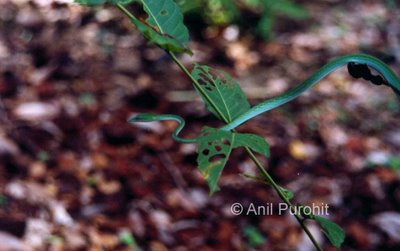
The temple is situated in the Bhagwan Mahavir wildlife sanctuary. I particularly remember one trip when I was showing Jai around the place when he jumped up in alarm at seeing a Green Whip snake crossing his path. I set off in pursuit as it dodged stones and plants until I cornered it by blocking it path. Promptly it climbed up a small plant, curving up in classic Whip snake pose. As I moved cautiously in a semi circle, covering its exit, it swayed gently, as if undecided on its future course of action. It was a beautiful specimen; setting off its fluorescent green against the brown of the earth. I took pictures, framing it on the green plant. Then it left. However, photographing the Skink proved to be more difficult.

A flight of steps opposite the entrance to the temple leads to a stream below. It runs hundred-odd metres in the direction I had come before meeting a bigger stream where the road bringing visitors to the temple ends. For years, under a tree where the road draw up short, a flower seller had set up shop, selling coconuts, incense sticks, and flowers to devotees who offered them to Lord Shiva in the temple. My regular trips to the temple had induced a familiarity between us. “Visit Tambdi Surli during Mahashivratri,” he told me once. “It is quite a sight at the temple.” I nodded, and resolved to do so. Somehow I haven’t made it to Tambdi Surla during Mahashivratri. Now he is no longer the only flower seller there.

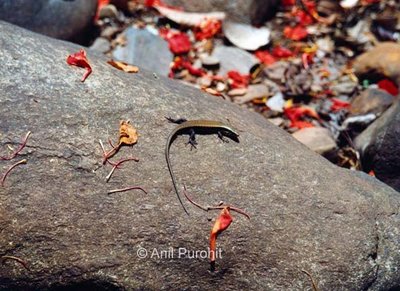
Where the road comes to an abrupt end not far from the tree, visitors cross a small bridge to get to the temple. From here, the temple unveils itself between branches of trees that crowd the cobbled path leading to the temple. In the spring of 2001, I took the flight of steps down to the dry stream bed in search of a Laughing Thrush whose call I had heard while exploring the length of the temple plot adjoining the stream. Instead, on rounded stones set off by brightly colored Gulmohar flowers blown free from Gulmohar trees on the banks of the stream, I saw several Skinks quick-stepping across the stones that littered the stream bed. It was awhile before I finally managed to take a picture of one skink basking on a stone amidst petals of Gulmohar flowers. By then I was sweating from chasing them only to find them disappear under the stones just when it appeared that I might pull off a good photograph.

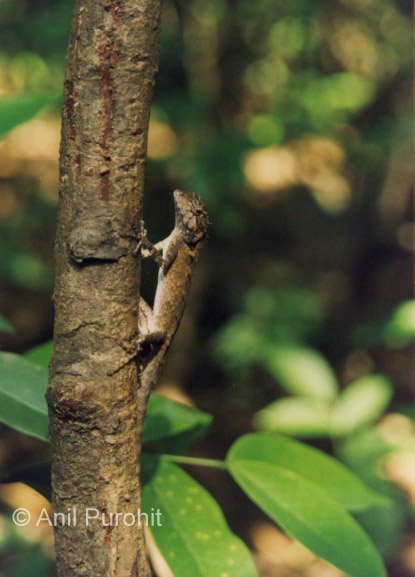
Butterflies are aplenty in the wildlife sanctuary, and so are various lizard species. I particularly remember seeing a mass migration of Common Crow (a butterfly species) near Caranzol in early 2002, not far from the entrance to the wildlife sanctuary in Mollem. Philip and I had paused on seeing the sight unfold before us, dodging them lest we trample any. They must have numbered over six hundred. Three hours later when Philip and I returned by the same path there was no trace of them. On another sojourn to the temple, I managed to photograph a Common Crow as it rested under a leaf in a thicket by the temple. I suspect it was laying eggs though I couldn’t be sure in the gathering dusk. By then, Jagdish and I had spent the last daylight moments clicking a Forest Calotes on a plant near where we had gone to relieve ourselves. Talk of unlikely opportunities!

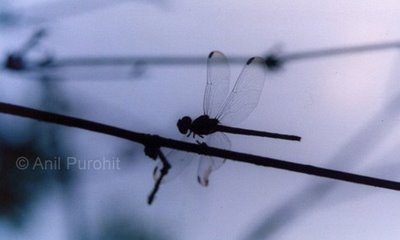
Later, as Jagdish and I sat on a large rock in silence watching several insects enact a riveting drama in a pool of water stagnating in a depression in the rock, I took my eyes off a frog that had disturbed a Stick insect in the pool to look at a Dragon fly that had landed on a bamboo shoot overhanging the small pool. Behind the Dragon fly, dusk had fallen, silhouetting it against the faint blue of the sky. An occasional noise in the jungle alerted us to life beyond the stillness where we sat on the rock, covered on all sides by vegetation, but from where we sat those noises took shape only in our imagination. Jagdish sat leaning on his hands stretched out behind him. His Pentax K1000 rested by his side. After several hours walking in the vicinity of the temple, looking for butterflies and birds we could photograph, he was relishing the drama being played out in the stagnating pool in front of us. Without getting up on my feet, I dragged myself forward, cautious not to startle the dragonfly and took a photograph.

As the shutter came down in a booming click, heightened by the silence, the Dragon fly took off.

August 27, 2006

A Late Afternoon in Fontainhas


Each time I step off the street in Fontainhas and walk into Percival Noronha’s house, I leave time behind.

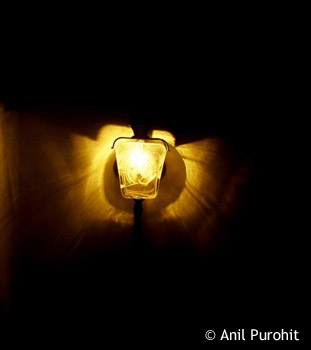
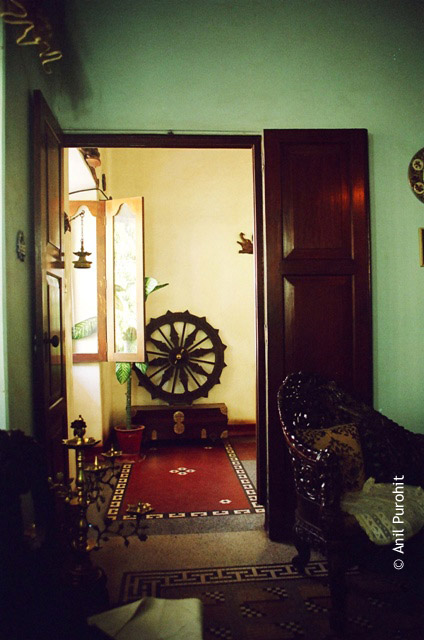
And, each time I pass the Victoria lamp on the wall behind the door where the stairs wind their way up, passing among other artifacts statues of Hindu deities, and a steering wheel of a ship, I cannot help but wonder about the horse that drew the Victoria carriage along quiet roads in the light of the lamp. Sometime ago the lamp cracked, and a thin line now snakes along its length. But the glow of the bulb it houses is undiminished, like the spirit of the man who put it up there. Percival Noronha turned 83 last month.

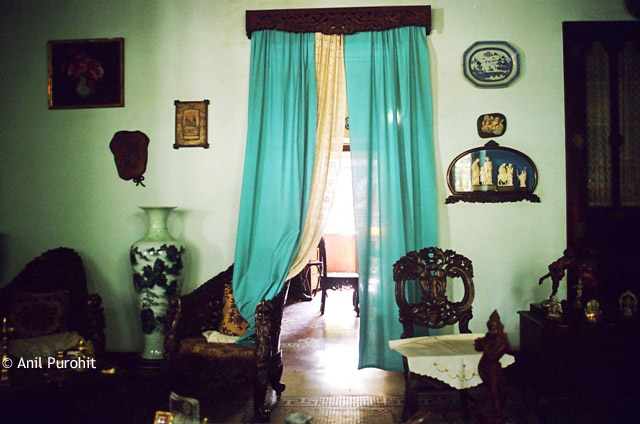
The landing, covered by red carpet and lit up by light from the window that Percival Noronha uses to peer out to check on visitors ringing his door bell in the street below, opens into a sitting room. A brass-lamp stands in the corner by the door, and another hangs from the wall above it. Inside the room, intricately carved furniture wear their Portuguese influence in the same easy manner that Fontainhas, Goa’s Latin Quarter, wears its Portuguese identity in the heart of Panjim, its Indian context inextricable from its Portuguese past. Then, as always, after looking around the room I rest my eyes on the black and white pictures of his parents framed on the wall.

I let my eyes drop to the glow from the two lamps under the framed photographs as it reaches up, and crawls across the wall, casting memories in the shade of the wall, green. Monsoons got through the coat of paint, and green paint flakes in a corner by the window flanking the photographs. ‘Not everything green is coloured green’, I remember thinking while A looked around the room, running her eyes over the mantle pieces and wall pieces that Percival Noronha picked up over the years on his travels across the world, lecturing on Goan heritage and architecture in universities overseas. He had excused himself to answer the phone in the adjoining room where, under a framed map of Goa rendered in a Portolan style reminiscent of maps that sailors centuries ago used in navigating the seas by compass bearings, a vintage telephone receiver rests regally in a matching rest. I hear him talking to someone on the phone. His voice rings out from the room in clear tones. I find this tonal quality of voice unique to old Goan houses, particularly those home to Goan Christian families.

Seeing the map again later that day reminded me of the first time I saw it on my visit to his house in 1998. We were in the middle of a conversation about the quality of workmanship in the years gone by when Percival got up from his chair and said, "Come, I'll show you what I mean by quality of craftsmanship." I followed him into the adjoining room where he keeps the telephone. There, he pointed to the map on the wall and said, "This is Budkuley's creation. Budkuley was a master draughtsman, the best I ever saw. He did all this by hand." I watched him stand there, his hands folded behind his back, admiring the map. It was brilliantly crafted.

"Budkuley was thin, his wrists barely the size of two fingers put together," Percival said. "The last time I saw him was eight years ago. He was ill, down with fever and barely able to get up." Percival got him medical help and he got better.


We wait in the hall while he answers the phone in the other room. I picture him standing by the window overlooking the narrow street, the map facing him. Eventually, I turn my face up to look at the picture of his mother, Aurora Vital e Noronha (1896-1980). She was from S. Matias in Mallar (Divar), an island near Panjim that I last visited with A. K. Sahay three years ago, and where Percival Noronha once found a piece of meterorite years ago as it crashed down near where he stood in the countryside. He showed it to me sometime back. I doubt if he remembers where it is now. It must have passed hands, and ‘disappeared’. His mother has a kindly face. Light from the verandah to the back of the house streams in through the open door where his cat sits watching us, and reflects candle-like off the spot where her collar bones meet. I hear his cat purr. Not too long ago, the cat knocked a large vase off its rest, breaking it. Later in the evening as we prepared to take leave of him I asked him the name of the cat. He smiled and said, "One of the students named the kitten Priti taking it to be a female. As the cat grew up I realised it was a male, so I changed its name to Pritam."

Standing there and looking around, it’s like nothing has changed in the years since I first met him when I was in college, starting out in life. I’m still starting out. Percival Noronha has grown older, and so have I. Once in a while I go to Fontainhas to visit him, and we spend time talking. And each time, I leave his place amazed at the energy and enthusiasm he brings to bear in our conversations.

His father, Antonio Jose de Noronha (1884-1962) came from Loutolim, a sleepy village near Borim where Mario Miranda, the legendary Goan cartoonist, has his home. Antonio Jose left Goa for Uganda in search of work, bringing up young Percival in the African country. In 1929, the year Percival Noronha turned seven, the family returned to Goa, and Percival went to Lyceum to complete his schooling. That he did not is another story, and it probably helped him be his own person. In 1961, India reclaimed Goa from the Portuguese. At the time Percival Noronha was the Chief Information Officer and reported to the last Portuguese Governor General of Goa, Vassalo da Silva, a man Percival describes as 'efficient, and very energetic'. Talking of his time working in the Portuguese administration, he said, "Each Saturday morning, I accompanied the Portuguese Governor General to Daman by plane."

"The Governor General used to check on the progress of development projects, and attend to routine administrative work before traveling to Diu to check on the same. Sometimes, we flew to Diu directly before traveling to Daman. In the evening we returned to Goa," Percival said. Goa, Daman and Diu, along with Dadra and Nagar Haveli were part of Portuguese India for over 460 years. After India drove the Portuguese out in 1961, Goa, Daman and Diu were administered as a single union territory before Goa was granted statehood in 1987.

Percival's house dates back a long way as do most houses in Fontainhas. Its façade is painted deep red, the colour of red oxide. “When I was renovating it in 1987, I found a corroded beam that was marked 1884. I asked the carpenter to cut out the dated portion of the beam and save it. The rest, I asked him to dispose off,” he told me recently over the phone, his voice betraying disappointment as he continued, “and that carpenter, dunno what he did, disposed off the whole lot.” His voice trailed off.

In the other room I hear him return the receiver to the telephone stand. Footsteps sound in the room behind the wall as he walks in through the door, hair askew on his head from the breeze blowing in through the door that opens into a balcony. He pats the few strands down and smiles. He leads us through the door to the dining room that functions as his study. Piles of books and papers are scattered across the large wooden table. Its legs end in finely carved lions. I pull a chair back and sit down, taking care not to place my feet near the lions.


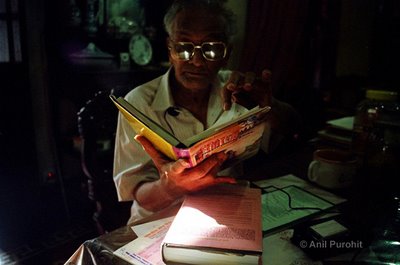
Light streams in through the balcony in the corridor behind us and bounces off a book on the table before glinting in his spectacles, lighting up the book in his hand. It is late afternoon in Fontainhas. His fingers turn the pages in the book where his paper titled Old Goa in the context of Indian Heritage is published in the anthology Goa and Portugal: Their Cultural Links. He presented the paper at the International Symposium on Inter-cultural Relations: Portugal and Goa organized by the University of Cologne in 1996. The book is a collection of 21 papers presented by scholars attending the symposium. Silence settles in the room. I catch sight of the cat siddling to its food bowl in the verandah. As I sit there waiting for him to turn to the page, I take in the smell of wood, books, and life, and it feels good. It's been a long time.


"Ah, here it is,” he says, his eyes lighting up as he holds the book, Goa and Portugal: Their Cultural Links, out to me. I bend forward to read the title on the page: Old Goa in the context of Indian Heritage. Behind me, another cat joins the first one at the food bowl, and the first cat, Pritam, is not amused.

August 17, 2006

A Temple Chariot


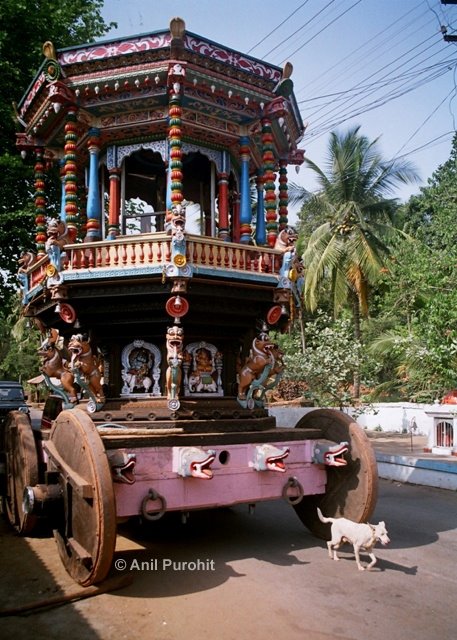
A temple chariot made of wood parked outside a Goan temple. I waited until the last of the group of canines made way before taking this picture. Behind the chariot, houses lined the narrow road on either side. Two roadside inns were open to public, and served tea and fresh pao-bhaji. A provision store lay across the road. There were not many people about the place when I went near the chariot for a closer look.

The chariot was being readied for the annual rath yatra in Chaitra Purnima (March-April) when the temple deity is taken in a procession through the village. The temple is decorated and stalls selling traditional sweets are set up in the space around the temple while flower sellers, usually old women, sit with their baskets of flowers on either side of the steps leading into the temple complex, holding flowers in outstretched hands, and entreating worshippers to buy them to offer to the deity. Many people do.

Families from all over the state of Goa, and beyond, whose ancestors hail from the village where the temple is located, travel long distances to partake of the festivities, and participate in the rituals. Each temple deity in Goa is family deity to people whose ancestors hail from the village, and also to those from nearby villages who’ve offered prayers at the temple and taken blessings on all auspicious occasions like marriages, thread ceremonies, and the like in their families.

In olden days when there were fewer instances of people migrating from their village of origin in search of jobs, celebrations drew the entire village to the temple. You can still see the devotion, and involvement, but as with all geographical communities, the new generation of people from families that’re longtime inhabitants of the village, migrated in search of livelihood and better prospects, weakening to some extent the continuity in participation that has existed over the years. But, many of them travel long distances in Chaitra Purnima when it is time for the chariot to be led out from its resting place to carry the deity in a procession around the village.

Then it is time for the breeze to carry the holy chants in its folds and deposit it in the air and the trees, and in the souls of villagers, renewing their ties with the land that bore them to the light of day.

August 11, 2006

The Road Taken


When Philip suggested Kaskond, I readily agreed. What drew me in were the leopards. “It’s good to have you along,” he said. “Last time I went this way alone and heard a leopard growling nearby. It was scary.” As much as I feared meeting one in the jungle, for I’m no Tarzan to tame a wild cat, the opportunity to see one on our trek led me on, and I agreed.

The Bhagwan Mahavir wildlife sanctuary in Mollem, Goa, is known for its big cat. But, hunting, loss of habitat, and aggressive eco-tourism have reduced their numbers and those that remain are elusive, whether out of compulsion born of fear of humans or out of an ingrained nature I cannot be very sure.

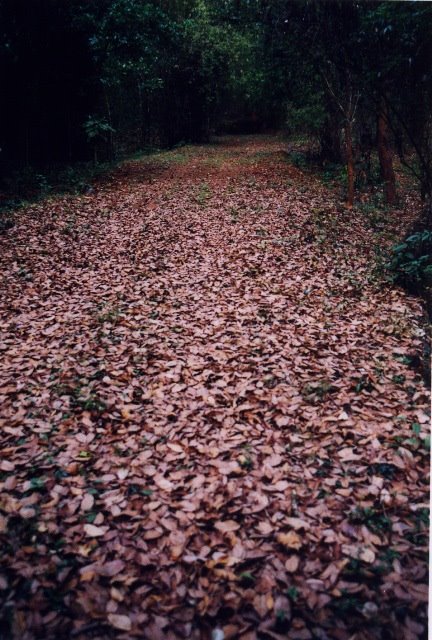
After we entered Kaskond by a side entrance along the highway 4A that runs on through Anmod in the Western Ghats mountain ranges, to Belgaum in Karnataka, I stopped and held my breath. Ahead lay a jungle path covered with leaves. Silence hung in the air. No wind stirred in the trees, and the birds were quiet. The sun had kept out that morning and low light had turned the atmosphere surreal. The shadows the jungle threw fell weakly along the leafy path, and the thought that a leopard might be lurking round the corner heightened my anticipation. We stood side by side, and I took the picture posted above.

As I stood there, staring at the leaves that covered the road that narrowed further on, and the bends hidden from view in the undergrowth and bamboo, I knew I must take this road, and so we walked, passing leopard droppings by the dozen, and 'bumping' into Giant Wood Spiders' webs that stretched across our path. Though it wasn’t until much further that the road diverged, we kept up on this one. The leaves were moist from the morning dew, and lay silent, in peace from prying feet. As we walked on the road, stepping lightly on the leaves, they whispered jungle secrets and tempted me with what the bends in the road ahead might reveal, and I hoped the road would never end. Looking down at the leaves as we walked in silence I was reminded of Robert Frost’s The Road Not Taken . . .

Two roads diverged in a yellow wood,
And sorry I could not travel both
And be one traveler, long I stood
And looked down one as far as I could
To where it bent in the undergrowth;
Then took the other, as just as fair,
And having perhaps the better claim,
Because it was grassy and wanted wear;
Though as for that the passing there
Had worn them really about the same,
And both that morning equally lay
In leaves no step had trodden black.
Oh, I kept the first for another day!
Yet knowing how way leads on to way,
I doubted if I should ever come back.
I shall be telling this with a sigh
Somewhere ages and ages hence:
Two roads diverged in a wood, and I-
I took the one less traveled by,
And that has made all the difference.

July 30, 2006

Overloaded


A mild summer day on the incline that runs past IIT Powai campus,
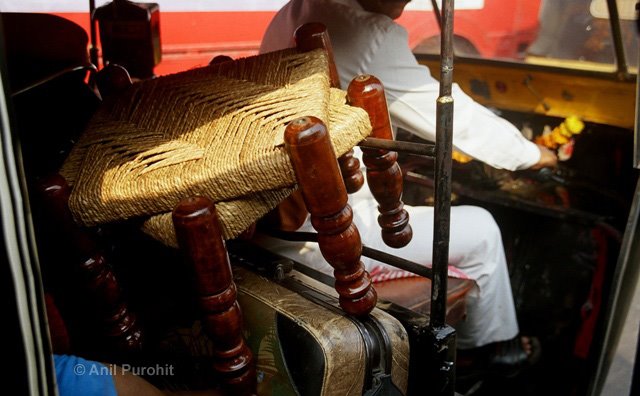
so much seating that leaves little seating space!

July 14, 2006

Passing Ratnagiri in the Konkan


On my travels by the Konkan Railway on the Mandovi Express that leaves Mumbai for Goa at dawn, I usually pass the Ratnagiri-Dadar-Ratnagiri train coming in from the opposite direction from Ratnagiri. It leaves Ratnagiri for Dadar at about the same time that the Mandovi leaves Mumbai.

While my train waits on an adjacent track for the Ratnagiri passenger to pass us so that we get a clear track to Ratnagiri I keep my eyes peeled out for crowded compartments, especially in the summer when schools close for vacations. For, when the Daily Passenger comes to a halt alongside us, waiting for our train to commence its journey to Ratnagiri, and beyond, so that it gets the green signal to proceed to Dadar in the opposite direction, I scan faces looking out the windows at us. I usually stare back, and try to read the faces.

Since the time I first took the Konkan Railway many years ago, I’ve been curious about Ratnagiri, and its people, almost as if I were searching in their faces for traits that’re uniquely Ratnagiri. I believe it has to do, in part, with the fact that I grew up relishing Goan summers to the taste of the Ratnagiri hapoos. Unlike the chikki that hawkers announce in Konkan-bound trains, "Lonavala chikki, Lonavala chikki," even if they were to be made in a crowded Mumbai gully far from Lonavala, cashing in on the strength of the fame that the chikkis from Lonavala acquired with travelers years ago, there is no such chance with mangoes from Ratnagiri, they belong there. I’m a big fan of the mankura, a Goan mango variety that dad got us by the dozens in the summer, but the hapoos from Ratnagiri are a species with few parallels in the Konkan. They’re unique to Ratnagiri, its soil, and its people.

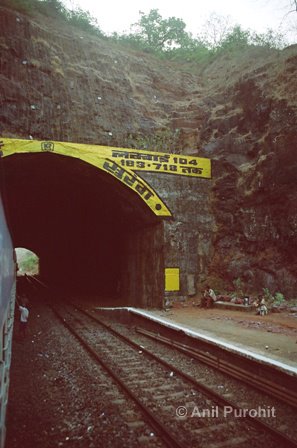
In the two and half hours that it takes the Down train to cover the hundred kilometers stretch from Khed to Ratnagiri, the railway passes over three bridges spanning the rivers Vashisthi at Chiplun, the Gad at Aravali, and the Shastri near Ukshi, then through sixteen tunnels, the last six of which are strung together in close succession across twenty-odd kilometers before Ratnagiri. The train plunges through the first of these six tunnels after crossing the bridge over the Shastri. On emerging from the sixth tunnel at Karbude, before Bhoke in the Ukshi-Bhoke section, the train floats in the air when inching across the two viaducts at Khedshi, and Mahalaxmi before pulling into Ratnagiri to a swarm of vada-pav vendors awaiting its arrival. The fragrance of hot vadas would tempt the stoutest heart into eating them. As the train comes to a halt in Ratnagiri, the stillness of the windswept Konkan is broken by vendors calling attention to rows of vadas and pavs they’re hawking, and it happens as suddenly as when the landscape outside the window is abruptly terminated when the train plunges into tunnels. And when the breeze blows in strongly from the west in the summers I smell salt in the air, the same smell that wafts in from the sea along narrow Goan roads that criss cross dwellings along the coast before ending up on the beach. On occasions, the Konkan breeze brings in the smell of fish mingled with that of salt, washing my lungs with old memories by boats by the sea at Colva, near Margao in Goa.

As the train slows down on its approach to Ratnagiri, I trail my eyes over large factories set back from the tracks. From the train I can only imagine what they might be. It is a relief to emerge from the slew of tunnels and feel the warmth of sunshine streaming in through the windows.

I get off the train and stretch my legs, and walk up to a board nailed to a wall to read a notice written in chalk in marathi language. A mustachioed railway porter in red shirt watches me read the notice posted by the railway employees’ trade union NRMU (National Railway Mazdoor Union). The NRMU dislodged KRCEU (Konkan Railway Corporation Employees Union) that was affiliated to Geroge Fernandes-led HMKP in the elections held in February 2005. NRMU is an affiliate of the Hind Mazdoor Sabha and All India Railwaymen Federation (AIRF).

The notice on the board reads

Since the inception of the Konkan Railway, lack of foresight by incompetent officials led to their commencing the train service without any thought to Konkan Railway’s development.

According to rules, the running-staff cadre is revised each year or when there is requirement for the same. But since the last 7 years this has not been done. This was achieved only after NRMU came to power. But because of some incompetent officials in the administration, there has been a delay in filling vacancies for running-staff. But because of pressure exerted by the Union, exams to fill vacancies for Co-drivers were held on 19 March, 2006.

On account of these incompetent and immature officials in the administration, Central Railway staff has to run some of the trains on the Konkan Railway. We condemn such irresponsible and incompetent officials. Condemn. Condemn. Condemn.

I smile at the porter, Namdeo Tukaram Bharge, who’s now sitting on a bench in front of the board. Through the window in a room behind him, two people watch me while I photograph Namdeo. His eyes fix on my camera. I take his picture. Then he tells me, "This looks like a good camera. I’m sure the picture will come out good. Send a copy to me. Write my name on the envelope, and mention my badge number – Number 38 porter – and address it to the Ticket Booking counter. The photograph will be delivered to me." I reply, "Yes, I’ll send it." I look around the station and while away time and wait for the train to move. Elsewhere on the platform, Ratnagiri hapoos lie packed in boxes that've attracted the attention of passengers. I see an elderly couple bend down to check the mangoes in one such box. It is the second week of April and the sun is out in the sky, and it’s a relief to be out in the open after riding the slew of tunnels.

I’ve named these six tunnels ‘the dirty half-dozen’ because, of the twenty-odd kilometers before Ratnagiri where the Konkan opens up near the sea, these tunnels take up half the distance, shutting out the landscape along the route, and hardly has the train emerged from a tunnel before it plunges into the next one, then the next, and the next. The last of the ‘dirty half-dozen’ at Karbude, near Bhoke, is over six and half kilometers long, making it the second longest railway tunnel in India; the longest is at Pir Panjal in the Banihal Pass.

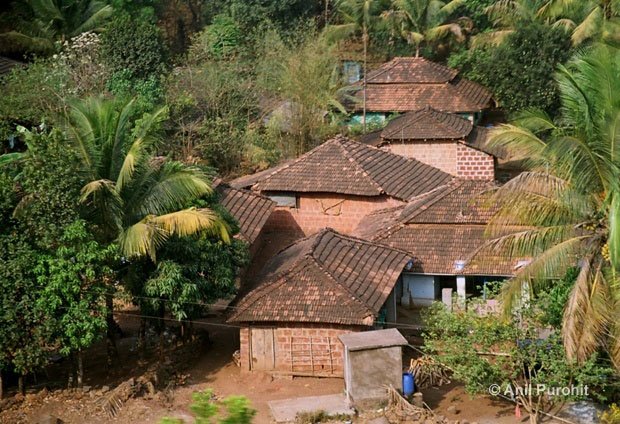
I buy Ratnagiri Times, the local marathi-language newspaper. A headline reports the Jodhpur court verdict sentencing the wayward film star Salman Khan to five years in jail for killing a Black Buck on a hunt in Rajasthan. The station resonates to conversations of people milling on the platform. An old lady gets into the train with a basket of bananas and looks up and down the length of the compartment to check if there’re sufficient passengers around to buy bananas. The train pulls out of the station, and later passes by houses with sloping roofs made of tiles and nestling among trees. Their walls are made of uncovered laterite stones. I steady my hand and take a few pictures. Past Ratnagiri, five more viaducts and three tunnels line the fifteen kilometer stretch between Ratnagiri and Nivasar. Of the five viaducts, the Panval Nadi viaduct, eight kilometers off Ratnagiri, spans 424 metres across the Panval river, and glides high over canopies below, and is among the tallest railway bridges in Asia, its piers rising sixty-four metres above the bed. As the train runs the length of the viaducts off Ratnagiri in quick succession I find myself riding valleys in the sky, keeping pace with pigeons riding the breeze alongside.

July 01, 2006

Far from School, Far from Home


I moved to the door of the compartment on the train bound for Goa so that I could lean out and take some pictures of the countryside. On my way through the narrow corridor I dodged a group of fifth-standard students in blue t-shirts and shorts who had colonized the place, giggling, chatting away, ribbing one another, and playing cards while they were not chasing one another on the bunks.

I stopped to look at a plump kid with an irritated look on his face telling his classmate in a sing-song voice,"Tu mujhe irritate mat kar yaar," before turning his attention to the playing cards in his hand.

I couldn't resist a smile. My head brushed against a knee in the upper berth. Another of their classmates was squeezed into that little corner, a magazine balanced in his lap. I ducked my head to avoid brushing his other knee, and moved ahead to where a side-lower berth seat opposite a quiet-looking boy lay empty. He sat with his bag to his back, looking out the window while his classmates were engrossed in playing cards in adjacent bunks. Gagandeep Singh, a student of Bishop Cotton school, Shimla, told me that there were eighty-one of them on a tour to Goa, accompanied by 'five teachers' and a Minder whom I saw later scold the students in English in a Malyalam accent when the train stopped over at Karmali. Not realising that the train stops only for a few minutes before leaving for Margao, some of the students lolled about on their way to the exit, inviting a swift rebuke from the Minder who lifted his muscular hand agressively and threatened them, "GET DOWN, or I'll give you one." By 'one' he meant a slap. They hurried to the door thereafter, herded by lady-teachers who promptly ordered them into two columns along the length of the narrow platform at Karmali opposite the famous wetland where thousands of migratory birds used to fly down to roost, escaping the harsh winters in their countries. But that was long ago, before the Konkan Railway cut through the wetland.

I sat opposite Gagandeep. He told me that they had stopped over in Mumbai where they saw the Taraporewala Aquarium, and a museum. Now, they were looking forward to Goa.

I tell Gagandeep that he has rosy cheeks the kind that lend kids a happy innocence, and that they are well rounded, at which he smiled and said, "Once, a photographer who had been called to take a group photograph at my school pointed out to me after taking the photograph, and said, 'Woh beechwala bada gol hai', (The bloke in the middle is well rounded.)." We both smiled. I watched him look out the window every now and then. He had a calmness about him that belied his years. He showed only a passing interest in what his friends were doing. I didn't know for sure if it was because this was only his second journey by train ever (The first one was last year, on a similar tour to Rajasthan) or whether the countryside that flashed by along the West Coast was a new experience, or if it was about something beyond all this. Often, thoughts that course the mind zig zag around 'corners' in roads that run ram-rod straight.

Every year, in Dec-Jan when the school, dating back to the mid-1800s, and spread over 35 acres, closes for vacations, he visits his parents in the United Kingdom before returning to Bishop Cotton for the new year. He told me that his younger brother studies with him at the same school, the oldest boarding school in Asia. Then we talked about his hobbies and places he has visited in his time in India, and about his trip to Rajasthan last year. After a while he turns to look out the window again as a small pond draws up outside. Two children about the same age as him are merrily dunking one another in the water, and wave out spiritedly as the train thunders past them. Then he turns to look at me before turning away again. I try to read his thoughts, but get nowhere because where eyes are calm, thoughts run deep, rarely rising to the surface.

Then we both turn to look out the window. I latch onto the blue sky and watch my thoughts sail across the blue expanse, drifting away with the wind.

June 25, 2006

A Cinematographer, A Film Shoot, A Conversation

It was a quarter past eleven in the night when we packed up and prepared to leave Manori. The scenes scheduled for the day had been canned. The marathi language film was nearing completion and only a day’s shoot remained. It was scheduled for completion the next day at Madh Island. Sanjay and I walked down to where he had parked his bike at the entrance to the Gagangiri Maharaj ashram and called someone on his cellphone while I waited, watching unit members leave the film location in ones and twos, and sometimes threes. They walked slowly, silent, thinking. Two dogs kept a wary eye on them from the side of the road. I listened to their footsteps as they made their way past me, heads loose on their shoulders, chins tilting down a bit. One of them waved out to me. I waved back. We were among the last to leave the place.

The main leads in the film, Rita Bahaduri, and the Marathi actress Aishwarya Narkar had left Manori an hour back after winding up the scene at the temple in the ashram where Aishwarya, on waking up finds her mother-in-law, Rita Bhaduri, missing from her bedside in the room in the ashram where they’d come looking for a cure after Rita Bhaduri was paralysed waist-down in a car accident in the film. Then Aishwarya runs barefeet to the temple and finds Rita Bhaduri praying to Lord Dattatreya, and Gagangiri Maharaj, on finding herself miraculously cured of her ailment. It was the culminating moment in the film telling the story of a family, the divisions within, their faith in Gagangiri Maharaj, and their eventual reunion. The film is named after Gagangiri Maharaj. Back in the temple, Sanjay had quickly set up the lights in preparation for the film sequence. I sat on the floor beside Sanjay while he instructed the unit-hands on where to place the lights. He was looking for a sedate effect. It required him to improvise to fit his equipment in the space available, and there wasn’t much of it to go around. Earlier that day while they were filming the accident scene on the road that led up to the temple, I visited the temple and shared conversation with Satyaprakash Karambelkar, the temple caretaker. He had just finished up with scrubbing the floor when I walked in. Looking up at the statue of Lord Dattatreya now, my eyes almost reached up to the roof. Wires snaked all over the floor, leading to cameras, sound recorders, monitors, and to things I couldn’t quite identify in the jumble. Then the camera rolled. Ashish Ubale okayed the take before calling it a day after twelve straight hours of filming. All along, I watched from the sidelines, turning every once in a while to look at the Manori creek shimmering in the moonlight behind me, setting off the Mumbai skyline on the other side like a Christmas tree resting sideways, all decorated and nowhere to go.
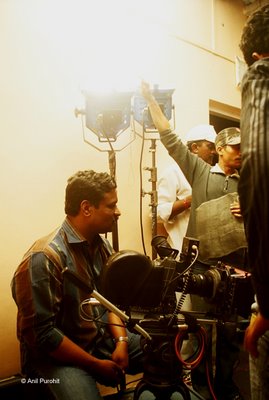
Earlier in the day to get to Manori I took a ferry from Marwe after alighting from the train at Malad where I hired a rickshaw to Marwe, then sprinted across the beach just in time as the ferry pulled out from the beach and set off across the Manori creek that is fed by the Dahisar river draining into it. As I struggled to keep my balance, I remember thinking that beaches are the same everywhere, and that it is never easy running in the sand. Earlier, the train ride on the Western line from Borivali to Malad took me hardly any time. But to get to Borivali I boarded the Thane Muncipal Corporation (TMC) bus from Thane (West), passing through Ghodbunder, Kashimira, Mira Road, and Bhayander, taking me over an hour. I watched as the ferry cut through placid waters and deposited us at Manori fifteen minutes later where rickshaws were lined up to make a killing, charging twenty-five rupees to take me to Manori Talaav bus-stop, barely over a kilometer away. I sat out the time it took a BEST bus to drive over to the ferry point. I got in and sat by a window on the driver’s side of the bus. The bus was fairly empty. A group of Christian women sat in the front. On the ride along the waterfront, I passed fisherfolks, their homes, fishing nets, small fishing boats, and dugouts before getting off at Manori Taalav where the film unit was filming a ‘car scene’. Sanjay was behind the camera, shouting instructions every now and then while Nilesh Shetye scribbled in a notebook, keeping tab over scenes, takes, and the like. I went over to a shop at the intersection of four roads and got myself a cold drink. It was hot in the sun and it had taken me three and half hours of changing buses, trains, rickshaws, and ferry to get here. About then I heard Ashish call over the din, ‘Camera, Action’ as the cameras rolled. Then, ‘CUUUT.’ It was my first time this close at a film shoot.
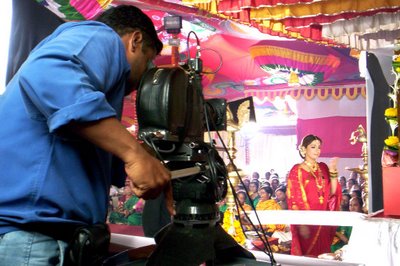
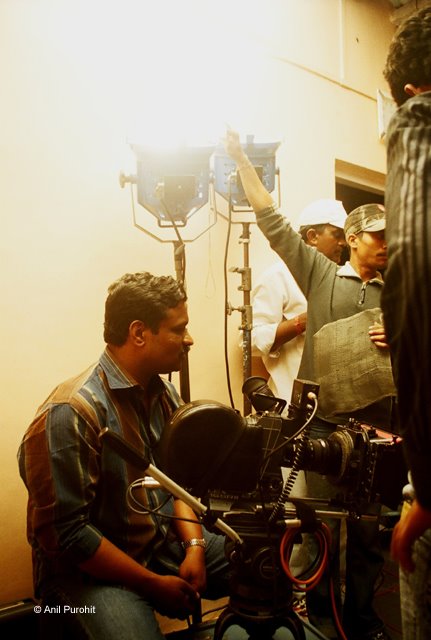
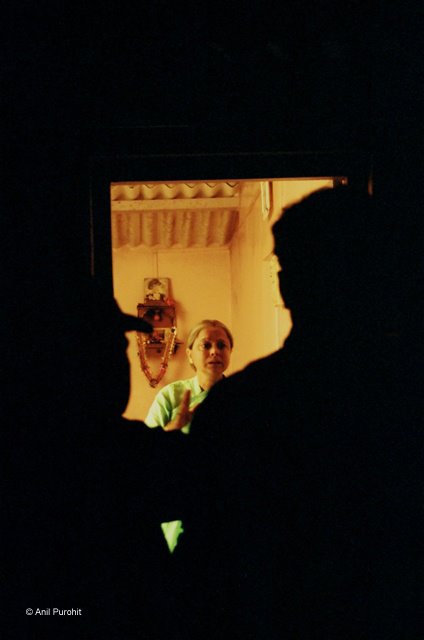
Sanjay Khanzode had a lot at stake in this film as did Ashish Ubale. The film also stars Vikram Gokhale, and Asavari Joshi. I missed out on the shoot involving Asavari Joshi. Sanjay was particularly happy about how that sequence turned out. "The lighting went well, and Asavari stands out wonderfully in her short cameo in the film," he told me later, and mailed me the picture above. The film was Sanjay’s first independent charge as a cinematographer after several assignments working in teams, sharing camera duties. Likewise, the film was Ashish’s first directorial venture after several stints as an Assistant Director. They both go back a long way to the same institute in Pune in the early Nineties when they passed out with a Diploma in their respective disciplines. I first met them in 1996 when they were staying at Yari Road in Versova, sharing their apartment with two others, each searching for a toehold in Bombay, like I was. Bombay was still Bombay in those days if you know what I mean. Over the years Sanjay and I kept in touch through M Satish, a mutual friend. By then Sanjay had shifted out of the Yari Road apartment to Thane, got married, kept up with a steady stream of assignments in Hindi, Marathi, and Punjabi television serials, music videos, documentaries, advertising films, and feature films. Jai Jai Gagangiri Maharaj was his first independent assignment as a cinematographer. Interestingly, Randhawa, a Punjabi, was producing the marathi language film, a fact not lost on Sanjay, a Maharashtrian brahmin. “It’s his first foray as a producer,” Sanjay told me.

Outside the room where the unit was filming a dream sequence featuring Gauri Karyekar, Randhawa sat patiently on a sofa in front of a monitor, his large face betraying nothing, while Sanjay passed instructions to the crew outside as they adjusted the cutter in front of the window, controlling the light streaming into the room from a powerful studio light source placed outside the window. Inside the small room, barely measuring eighteen feet by fifteen feet, I sat on a chair between Sanjay and Ashish watching silently while technicians went about their jobs, my camera loaded and ready.
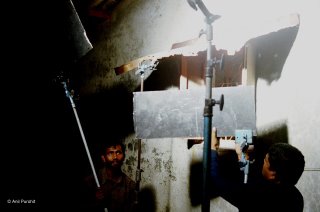
The room was transformed from an ordinary pad with a rustic bed and scattered items of everyday use, into a dark room with black curtains setting up the dream sequence featuring Gauri Karyekar, Rita Bhaduri’s other daughter-in-law in the film. Eventually, the cutter was in place lighting up Gauri to Sanjay’s satisfaction. The room tensed up in anticipation. Then, Ashish called out ‘Camera, ACTION. The camera rolled. Three takes later they canned the shot.
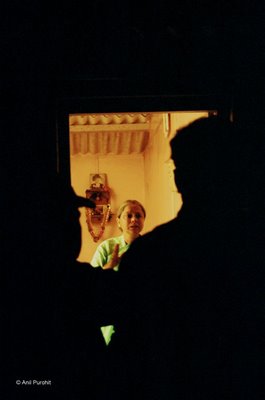
The film unit broke up for a round of poha and chai before getting back into the room to film the scene where Rita Bahaduri sees a vision of Gagangiri Maharaj, feeling his presence heal her of her ailment before hurrying to the door looking for the vision she just saw, a surprised look on her face. Then she heads for the temple, followed a little later by her daughter-in-law, Aishwarya, who comes looking for her on finding her bed empty.

All the film sequences I saw that day were about lights and lighting. Sanjay went about methodically setting them up, displaying an innate ease that only comes from spending time with what you like doing, and doing it well.

When Sanjay left his hometown Akola for Mumbai, his first stint was with Debu Deodhar, the legendary cinematographer who filmed most of Amol Palekar’s films, starting with Ankahee (1984), Bangarwadi (1995), Daayraa (1997), Kairee (1999), to Anaahat (2003).

Speaking of those early days, Sanjay said, “Debuda said to me, ‘Sanjay, pehle backlight seekh lo,’ (Sanjay, first learn to use the backlight). Then he told me, ‘Understand why, for a camera position in a film sequence, the backlight is sourced from position A, and not from B.’ My learning curve took off from there.”

Sanjay started off on the sets of Sukhi Sansarachi Bara Sutra in the mid-nineties, a Satish Films production starring Ashok Saraf, the evergreen comedian from Marathi films, and Sanjay’s favourite actor. Debu Deodhar was the cinematographer, while Sanjay picked up the nuances, watching from a corner. It didn’t come easily. Remembering those early days, Sanjay said, “The first few days after the filming commenced all I did was make notes and diagrams of where the lights were placed for each scene in relation to the camera, and the subjects. I said nothing the whole day nor interfered with their work. Debuda noticed this and one day he called me over to his side and asked me what I was doing standing in a corner and making notes. I showed him the pages. Then he pointed to one of my diagrams and asked me, ‘Do you know why I’ve set up the lights in these positions?’ I replied, ‘No’. Then he said, ‘To know why is important. The day you learn why I’ve set up the lights in a particular way, you’ll have learned lighting. Once you learn lighting, it’ll mean you’re on your way to becoming a cameraman’,” Sanjay narrated, adding, “Tab se main kyun ke peeche lag gaya (Since that day I’ve been pursuing the ‘why’ of things.).”

Sanjay believes that many cinematographers in the film industry belong to the ‘Old School’, ‘Old’ as in their approach to lighting. “It has to do with the lack of adequate equipment, technology, and assistive tools like Video Assist in those days, limiting their scope, and forcing them to improvise, eventually shaping their approach. It’s not easy to change later.” Video Assist is mounted onto a movie camera (inside the viewfinder) to optically tap what the camera ‘sees’ and to transfer it to a monitor, usually placed away from the scene, where the director gets to see what the cinematographer is filming to ensure that the sequence is being shot exactly how he visualized and planned it. Video Assist came to be used widely in the Indian film industry in the Nineties. “But the advertising people got hold of it first,” Sanjay said. “Eventually the filmwallahs latched on to it.”

Abhi aapko director kis tarah ka shot bataya, aur cameraman usko kis tarah se ley raha hai .... aapko monitor pe dikhta hai aaj, Video Assist hai (Today, the director can get to see how a cameraman executes his scene requirement on the monitor while he is filming it.),” Sanjay explained, continuing, “In the days before the monitor came to be widely used, when the Director described the scene to the cameraman, nobody except the cameraman knew what he was filming.”

Things were no different when Sanjay started off with Debu Deodhar. “I used to take permission from Debuda to peer through the viewfinder to see his frame compositions, querying him on his choice of lens for a given scene. It helped me to understand the role of lenses. Later, I tried predicting to myself the lens Debuda would use for each scene, to see if I’m getting the thinking right. Over a period of time I began to get my predictions correct most times. It was a step forward. I did the same with the lights,” he said.

Kisi bhi shot mein lens ka selection important hai (In any film scene, the selection of the proper lens is important),” Sanjay said, adding, “Lens ka selection ke baad hee agey ka sab hoga, lighting hoga, trolley shot istemaal hogo, job hi baki ka techniques woh lens lagne ke baad hee hoga. Sab se pehla selection hai lens ka. Tho woh Director ko kya chahiye, aapko kis tarah ka scene establish karna hai, scene kis tarah se aagey progress hoga, woh isaab se lens ka selection hota hai. Shot actually choreograph hota hai. Tho ek scene ko kayee shot mein divide kartey hai apne requirement ke isaab se. Tho woh sabse important hai . . . lens ka selection.” As I listened to him, his words shook free in the night air and floated past, their passion powering them past me.

By then I was beginning to feeling thirsty. Back in the temple while they were filming the last sequence for the day, I had emptied the bottle of water I found on the window shelf. I suspect it belonged to the temple caretaker. Now I was feeling thirsty again. “Come over for the shoot at Madh tomorrow,” Sanjay said to me, tilting his face sideways so I could hear him over the rush of night air, and the phut-phutting of his bike. “Sure, I will try,” I replied.

The night air enveloped us as he took the left turn and headed out of Manori, towards Gorai. It was nearing midnight, and the roads were still. The wheels churned up the road as Sanjay picked up speed, slowing down as we came upon groups of people walking ahead, holding plastic chairs. It perplexed me to see so many people out on the road this late in the night. I wondered aloud to Sanjay if the Manori-Gorai stretch was readying for a film show out in the night, under open skies. Up ahead, over hundred people milled around a makeshift screen strung across the road, and held down by stones dangling from strings tied to corners of the screen to keep it from swaying in the stiff breeze blowing in from the west. People were gathered on either side of the screen, watching a black and white film. As we slowed down looking for a way past the open air film show, Sharmila Tagore made an entrance on the screen. Sanjay couldn’t help smiling. I held his suitcase tight while he negotiated the bike past people scattered all over the road. The stones brushed my leg as we squeezed past.

After we got to the other side of the screen I turned back to see the scene as it steadily receded behind us before disappearing after we took a right turn, slowing down at a speed-breaker. I doubt if I’ve ever ridden over the number of speed-breakers I did that night on the Manori-Gorai stretch. We had a long ride home, through Gorai, Mira Road, Ghodbunder, stopping over at a roadside stall for a cup of ice-cream.

“That is what I call spirit,” Sanjay said of those people enjoying an old hindi classic in the middle of a quiet road late in the night, opening the visor of his helmet so that I could hear him in the nip of night air rushing past.

“Yes,” I replied, rewinding to my memories of similar settings for films I saw under the open skies back in Goa. I particularly enjoyed Amitabh Bacchan’s Zanjeer in the backyard of an Electricity Sub-station long ago. It’s not an experience one easily forgets.

“They’ll never enjoy a film at Inox the way they’ll enjoy it out there in the open, under the night sky,” Sanjay said, “And that’s how a film should be seen.” His time back in Akola where he grew up aspiring of films were not very different from the rustic setting of Manori where people bring their chairs along for a film show on a road, or for that matter of my own memories of traveling theatres back in Almel, in North Karnataka, where they put up tents, advertised the film from a hand held loudspeaker and mounted on a bicycle, screened daily shows before moving on to the next village, repeating the same cycle all over again. I missed none of them on my vacations from school.

I went quiet for a while, lost in thought, and reflecting ‘Oh, to watch stars parade their talent on screen while stars ‘ride’ in the night sky many, many light-years away.’

Note 1 : The two pictures showing Sanjay Khanzode behind the camera filming Asavari Joshi (in red sari), and the scene in the balcony were passed on to me by Sanjay, the rest of the pictures I took during my time on the sets .

Note 2 : I got a sms from Sanjay today that said: 'Chandigarh me hu, punjabi film ka shooting chalu hai. Sab sardaronke sath me full timepass ho raha hai. 30th ko vapas . . .'

June 22, 2006

Two Tourists at Churchgate, Mumbai


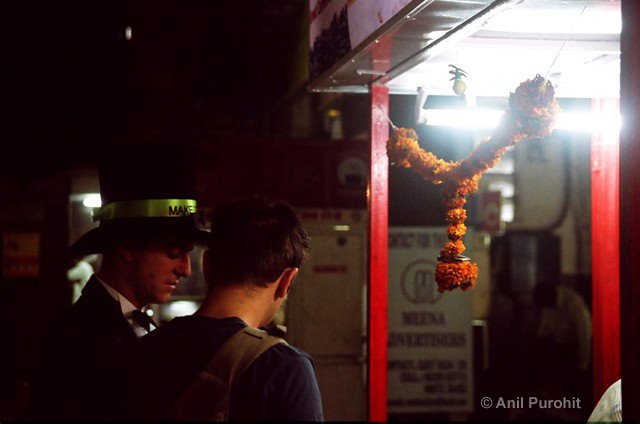
Churchgate railway station was designated the meeting point for the team. Thirty of us from our company had signed up for the Dream Run section of the Mumbai Marathon early this year. The station was awash with runners, mostly the 9-to-5 office lot, and for once the commotion of participants talking, exchanging notes, changing into their running-clothes, and frantic calling out to team mates drowned the buzz of trains. Colourful t-shirts with slogans printed on them, espousing causes the runners sponsored, turned the station into a holiday mood.

While we waited for the rest of our team members before leaving for the starting line, I saw these two tourists oblivious to the buzz, busy deciding what to buy at a stall inside the station. One of them wore a hat that caught my attention. I’m accustomed to seeing pictures in newspapers showing tourists to India welcomed with garlands. For a change, a garland hung from the stall in welcome, and not from their necks.

June 17, 2006

A Feni Consultant in the Jungle


Two things surprised me this April as we drove through the Bhagwan Mahavir wildlife sanctuary in Mollem, Goa. Firstly, I didn’t expect to find a cashew feni bhatti (feni distillery) in the middle of the jungle, and that too this late in the season. Elsewhere in the state, most local distilleries that spring up with the advent of the ‘Feni season’ that coincides with Gudi Padva, the Hindu New Year, are done with processing feni by mid-April, some complete it even earlier. On a passage through Ponda earlier this month, Nagesh, a local cashew farmer near Priol, a short distance off Keri, told me that cashew growers in Quepem and surrounding areas begin feni production earlier than those in Ponda. “It has to do with the type of soil,” he told me. “Once rains start, the cashews grow heavier, and though they appear juicier because of increased water content, the quality of feni is below par. We try and finish up before the monsoons move in.”

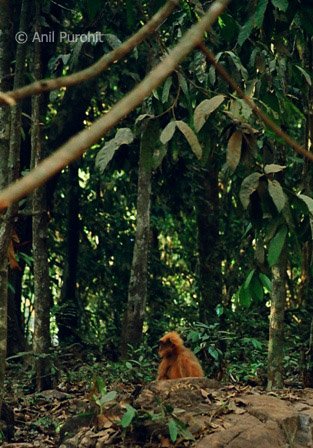
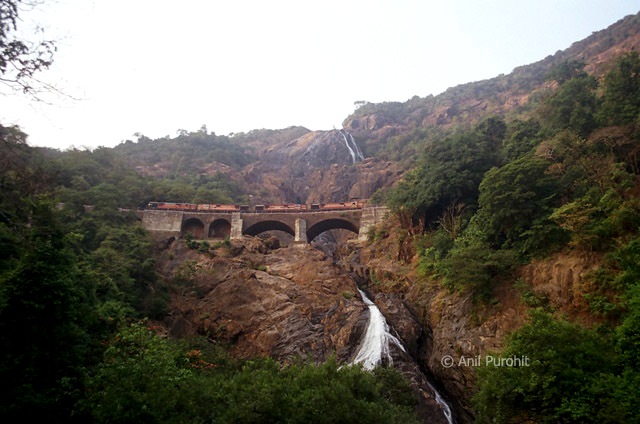
Back on the road it wasn’t until we slowed down on catching sight of a family of Langurs frolicking in the middle of our path that I realized the mud was unusually red. The langurs had changed colour to that of the mud. For just a moment I was perplexed on seeing these red creatures until one of them loped off the path with others following suit in that graceful manner of langurs. It was about then that I tasted mud. We pulled the windows shut but a thin layer of red had settled all over us. I tried wiping my camera clean but without much success, then drank from the water bottle to remove the taste of mud from the mouth. Phillip gripped the wheel hard as the jeep bounced uncomfortably on the mud-road that ran on to the Dudhsagar waterfall where rocky stretches in the road laid bare the pounding the thin ribbon of red winding through eighteen kilometers of deciduous forest gets from local jeeps ferrying tourists to the waterfall that cascades 600 metres down a cliff as it rises steeply, almost abruptly it would seem, over the South-Central railway line connecting Vasco to Londa, stopping by Collem in the Western Ghats mountain ranges.


The waterfall passes under the railway bridge and drops rapidly over the grey rock face. Seen from below trains passing on the narrow bridge high up in the sky and camouflaged by the cliff behind appear to float suspended in the air. Jeep-loads of tourists flock to the waterfall each year, the highest in India. Each trip to and fro net the tourist-jeeps a good sum, upwards from rupees 1,800 per trip, making the scramble for potential tourists fiercely competitive. The Goa Forest Department shuts down the route by ‘three in the afternoon’ to limit the damage to the eco-system but churned incessantly the mud-road turns red and the constant commotion of vehicular traffic on the route to the waterfall keeps the birdlife and animals away.

“The maximum tourist-jeep trips recorded for a single day is 90, and this does not include private vehicles visiting the waterfall,” the Range Forest Officer, Mollem Range, told us when we met him before setting off into the jungle. I got the impression that he was not particularly well disposed to the disturbance this causes to the habitat in the sanctuary. Elsewhere in sanctuary spread over 240 sq. kms. of deciduous forest in the Western Ghats mountain ranges, jungle paths are usually pale in colour. Beaten by the sun, dried grass binds the soil firm, only occasionally tested by vehicles passing on their way through the deciduous forest that in the summer is populated by barren trees as they shed their leaves and acquire new ones.


In my years trekking intermittently in the Bhagwan Mahavir Wildlife Sanctuary, I consciously stayed away from the route to Dudhsagar after trekking the 18 kms to Dudhsagar once, returning the same way in a summer vacation many years ago. I would’ve imagined that 36 kms of walking I did that November day would’ve ‘fetched’ me bird sightings that would fill pages in my diary. It was not to be. Instead, a short sojourn in the sanctuary in mid-October two years ago, with Phillip, and Colin, an elderly Frenchman visiting India, and lasting only a few hours over seven-odd kilometers in the direction of Vasant Bhandara and beyond landed us more bird sightings than I could ever imagine seeing along the ‘disturbed’ route to Dudhsagar. That October day, the three of us sighted in fairly quick succession a variety of birds, most notably in and around a Ficus tree at the edge of a grass plot that the then Range Forest Officer developed as a feeding spot for the Indian Gaur (bisons). We saw the Malabar Grey Hornbill, Crimson Throated Barbet, Pygmy Woodpecker, Heart Spotted Woodpecker, Small Green Barbet, Great Black Woodpecker, Bronze Drongo, White Headed Myna, Raven, Pied Flycatcher Shrike, Fairy Blue Bird, Ruby Throated Bulbul, Green Bulbul, Red Whiskered Bulbul, Quaker Babbler, Racquet Tailed Drongo, Verditer Flycatcher, Orphean Warbler, Malabar Whistling Thrush, White Throated Ground Thrush, Velvet Fronted Nuthatch, Grey Wagtail, and Small Sunbird.


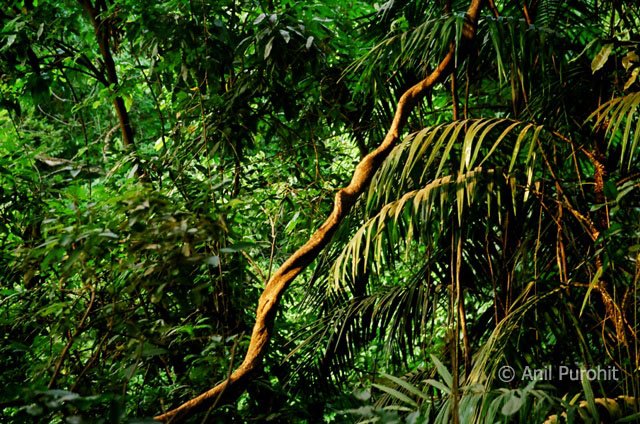
A . . . sat behind, rocking side to side in rhythm with the jeep as we motored ahead. She had seen nothing like it before. I sat in the front with Philip. On the way back from Dudhsagar I exchanged places with her. Philip fixed his eyes on the road ahead, catching rocky bumps as they mysteriously emerged in the road. From the rocking and rolling we sat through, I’m sure we hardly missed any bump the jungle path threw at us. We passed a jackfruit tree with fruits hanging from the trunk. The temperature had dropped a notch. Creepers hung tantalizingly from trees, spanning the silence between them, and swaying ever so slightly with the breeze that meandered past.


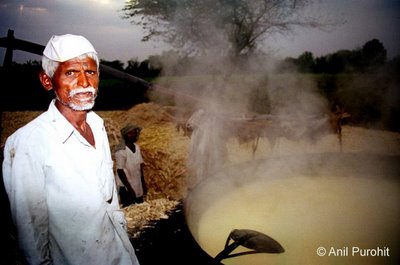
We stopped by a herd of buffaloes grazing in the forest. They were tended to by an elderly woman who edged out of the way and into the trees on seeing us emerge from a bend in the jungle path. Two alert dogs kept her company. They stood on the go watching me get off the jeep with my camera. I kept a wary eye on them as I inched closer to the herd grazing to my right. A few Cattle Egrets floated amidst lazy legs and silent tails, picking off insects in the bush disturbed by the buffaloes. The two dogs watched me closely, steadily moving nearer. One look and I knew these were a nasty pair, untempered by human presence and ready to spring at the slightest provocation, or order whichever came first. I suspect the woman had brought them along as protection from leopards that roam the jungle and whose droppings Philip and I have seen aplenty on our treks together over the years. It is illegal to graze cattle in the wildlife sanctuary, and she will have known it. I got the pictures I needed and hurried back to the safety of the jeep. It kicked to life and we motored away. It was about then that I caught a flash of blue through the trees, and we slowed down to a stop where a narrow path led past six blue drums with tops sawed off, holding freshly extracted pale white cashew juice left to ferment. Small bubbles rose silently to the surface.


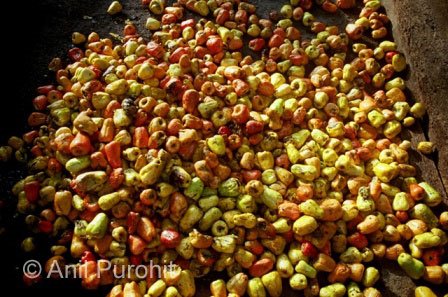
On a raised platform, divided into two roughly equal sections and enclosed by a raised strip the width of a brick placed lengthwise that ran along their sides, cashew fruits, freshly plucked from a plantation behind the dwelling, were heaped in mounds of lemon yellow, pale orange, flat green, and deep red. I doubt if there is any fruit available in a similar range of colours and shades as the cashew. Three men were engaged in separating the small, kidney-shaped cashew nuts from the fruits, before tossing the fruits into the section further up from them. In a corner lay two pairs of gum-boots, the kind I wore to school in the monsoons. After the cashew nuts are separated from the fruits, two men will wear these black rubber boots, and climbing onto the raised platform they’ll stomp the cashew fruits while the juice runs off into a pitcher through a opening in the side of the enclosed section. The pitcher is then emptied into a blue drum where the juice is left to ferment for a day or two before it is transferred to a large earthen pot housed in a dwelling behind the platform.

Manuel, a wiry man in a tight fitting t-shirt with coloured strips running across his chest led us inside to show us the distillery. On a slow fire sat a large earthen pot. A metal pipe, possibly brass or some alloy, connected the earthen pot to an open water tank where it spiraled to the bottom through still water, cooling the vapour passing through it before turning it into clear liquid now emerging in a steady trickle and collected in a plastic container placed on the floor. If the liquid measured 17 and above on a Alcometer (a device similar in construct to a thermometer), then Manuel, hired to oversee the entire process would certify it as feni, else he would cycle the distilled extract back into the pot, and add more fermented juice and distill it again to improve its 'strength'. “Sometimes we cycle it 3-4 times before it attains the ‘strength’ that feni is known for. If the distilled extract's ‘strength’ reads above 14, but below 17, it is called urraq, a drink widely favoured by many in Goa."


Manuel is from Margao, a coastal city 16 kms off Ponda. He returns home once in a while. Speaking to us in the narrow confines of the mud-walled room, he said he expects busy times ahead until the last lot of cashews change form into feni. While we stared in fascination at the pot and the water tank in silence, a shaft of light lit up Manuel against a clothesline. A coat hung carelessly from it, retaining its carriage even as it lurched and fell over undignified among commoners heaped every which way. I wondered if the coat belonged to Manuel. The way he carried himself, erect, alert, and light-footed, suggested an honest man who knew his job well, and who took his clothing seriously even as he kept to himself. A man you could depend on to deliver results. It didn’t look like he spoke much. I imagined him wearing the coat to the church on Sundays. There was scarcely a soul around in the time we were there. As we prepared to leave, Philip asked Manuel is he had feni he could spare. “Yes, yes,” he said, “I’ll keep a bottle ready. You can collect it on your way back from Dudhsagar. The urraq is good too. I’ll keep some of it ready as well.” Then he smiled. With some people, their smiles dissolve their wrinkles; with Manuel it had the opposite effect, heightening his wrinkles. We stepped out of the rustic dwelling and prepared to leave.

The Feni Consultant accompanied us out, smiling. A quick wave of the hand and he disappeared from view as we lurched forward on our way to Dudhsagar where trains sail in the sky in the backdrop of rushing water that turns to milk as it crashes down the mountain.

June 09, 2006

Ranvar's East Indian Charm


On our way to Ranvar we took the left-turn before Balaji hotel, a short way off Lucky restaurant in Bandra, entering a narrow lane in Waroda, where we rode past houses that sat on the edge of the road; their balconies seemed to bend over the road in fatherly concern. We circled the place at slow pace while I looked out to see if I could identify houses with old world East Indian or Goan charm. There wasn’t much of a hint of it from the road. One would need to criss-cross the narrow lanes that bisected the road at regular intervals to catch a glimpse of those houses. When we got off near Mehboob studios after circling the area in search of Ranwar, the rickshawallah said he had never heard of the place, I decided it would be a better idea to walk it out. In the end it turned out the right thing to do.

Stopping at a house parallel to the Rebello road we asked for directions to Ranvar. An elderly man in white vest, joined by an elderly lady, possibly his wife, and curious to know what this was all about, pointed out a cross-road a short distance away and asked us to take it, and on turning left ‘walk straight, and you’ll reach Ranvar.’

After walking down the cross-road, we turned left, into Rebello Road, passing old-world, colourfully painted houses, some with wide fronts and gates with peeling paint. I read the names off buildings and bungalows that lined the road on either side – Joylyn, Butter Cups, Tulips, Kylemore, Beryl Apartments. There were many more, but I was too engrossed taking in the feel of the lane to write them all down. The names were very Goan, maybe East Indian too, the latter I wouldn’t know for sure as I haven’t seen much of them in Goa. The original residents of Bandra, the East Indians, originally hailed from Bombay Salsette, Bassein, and Thane, and worked for the East India company, hence the name – East Indians. Later, as Christians from Goa, and Karnataka arrived in large numbers, often sharing the same surnames with the original residents, the latter took on the name ‘East Indians’ to distinguish themselves from the new arrivals. Together they gave Bandra a unique cultural thread that is visible in part in the houses we were looking for.

We crossed a road and continued down the Rebello road before coming upon Veronica road. We took a narrow lane off the road, stopping to buy two bottles of flavoured milk from a shop in the lane that led further on to Ranvar; in olden days the Ranvar club was well known for its Christmas, and New Year Eve dances. The Ranvar road ran parallel to Veronica Road. Later in the day we realized that sandwiched between these two roads were houses that sat cheek-by-jowl, connected by narrow lanes that criss-crossed the locality. Some of those lanes, maybe I should call them passages, were so narrow as to allow space for a single person. In a squarish area hemmed in by houses on all sides stood a Cross with space in front where the faithful could gather for prayers. While I took its picture a middle-aged East Indian lady leaned out her first-floor window and called out to me to ascertain my identity. Convinced that we were upto no mischief she smiled not before telling me that "Even Thane has East Indian population." Passing through those narrow passages constrained by houses that rose above them on either side, it was almost as if I was seeing a bit of Portuguese landscape from pictures exhibited at the Fundacao Oriente back in Goa three years ago. While we stood on the road, contemplating our next step, Krishna and I met a elderly drunk wearing soiled clothes. He looked amiable alright. He saw us for what we were, tourists.

“You come to see heritage?” he asked us.

“Yes,” I replied.

“Come this way, I will show you,” he offered, pointing further down the road. But I was wary of any offer from a drunk, not only for where he might lead us to in an unfamiliar place but also for what he might demand from us at the end of it.

“No, it’s alright. We’re waiting for a friend,” I offered, hoping to shake him off. But he displayed the tenacity of a drunk. It took us some time before we could convince him that we were fine by ourselves. Finding us steadfast, he went his way, which wasn’t very far, stopping at a house for a chat on seeing a familiar face in the verandah. We quickly walked past, pausing at the turn where Nagrana lane ran between a tallish building and a compound wall to our left that was spray-painted with Gangsta Rap messages. We took the lane, emerging out onto a busy road that led to the Holy Family hospital a short distance to our left. We returned back the way we had come. We had barely emerged from the narrow Nagrana lane when we heard a voice behind us call out sharply, “Go straight, and turn left, and you’ll find what you’re looking for.” We turned around, and saw the drunk gesturing to us. “Walk straight, and turn left over there,” he said, pointing to a narrow lane further up the road. We did as he said, walking past a blue Maruti car parked in front of a large house that looked more an entrance to an Army barrack than a residential dwelling, and found what we were looking for – the East Indian locality in Ranvar.

June 05, 2006

At Mount Mary Church in Bandra


I met Santan Monteiro at her stall outside the Mount Mary church last month. It was a chance meeting that summer day since Krishna and I hadn’t planned on visiting the church when we landed in Bandra on a late May afternoon. We didn’t expect our walkabout in Waroda and Ranvar to finish early, leaving enough time on our hands for a quick visit to the Mount Mary church. There, Santan Monteiro smiled at me when I stepped into her stall with my camera. As we got talking, she told me that she hails from Verna, in Goa. I asked her if she manages to visit Goa. She said, "Yes. yes. I do." Then she told me that she will be visiting Saligao (a Goan town) the next month, in June. “I visit Goa once a year to meet my relatives,” she added.

It was early evening when we took the turn past the Bandra Bandstand on our way to the Mount Mary Church in Bandra. The monsoon was three weeks away but clouds straggled across the sky from the west, in ones, twos, and threes, sometimes more. In days to come more would follow. The rickshaw laboured up the hill, flanked on either side by residential high-rises and bungalows that sat pretty facing the sea a short distance away. I read Parsi names on a building or two. I like Parsi names. Jeejabhoy, Merchant, Taraporewalla, Daruwalla. As we motored up, every once in a while I saw people gathered on terraces facing the sea, gazing fixedly at the ocean. There is something about vast landscapes that I find soothing, so vast that there is no single point of focus to gather my attention to the exclusion of others. Sometimes, I find that vastness showcases a sameness that offers me a continuity that is absent in closed spaces, ‘closed’ as in by structures which even if diverse do not intrigue me like vastness does since they have forms I can identify, and relate to. Vastness has no form; it is continuous, end-to-end.

Mid-way up the hill, the road narrowed; I cannot quite remember if it was because of a tree, or on account of road repairs. Vehicles coming down the slope showed little consideration for those going up the incline, blocking way and forcing us into braking, losing momentum. The rickshaw stalled in its attempt to drag us up the incline, it had lost power, eventually I asked the driver to return to the base of the hill and give it another shot up. We turned back and rode down, and waited until there was no vehicle coming down the hill and gave it full power. He left us on the road passing by the Mount Mary church.

Outside the church, stalls selling candles and wax dolls line the compound wall enclosing the church on either side of the narrow entrance leading up to the church. The compound wall has the same feel as the façade of the church, made of stones demarcated by white lines. From a distance I imagine it must look like someone has draped a checked shirt over it. The church is dedicated to Christ’s mother, Virgin Mary, whose statue Jesuit priests brought from Portugal in the 16th century and constructed the chapel on the mount in 1640 where they housed it. The church was rebuilt in 1761 after the original Chapel of Mount Mary was destroyed in what is believed to be a Maratha raid in 1738. The statue of Mother Mary was shifted back to the rebuilt church from St. Andrews church where it was temporarily installed after fishermen found it in the sea. The original statue was re-adorned with the child in her arms after marauding Arab pirates cut off the hand to get at the gilt-lined figure of the child in her arms.

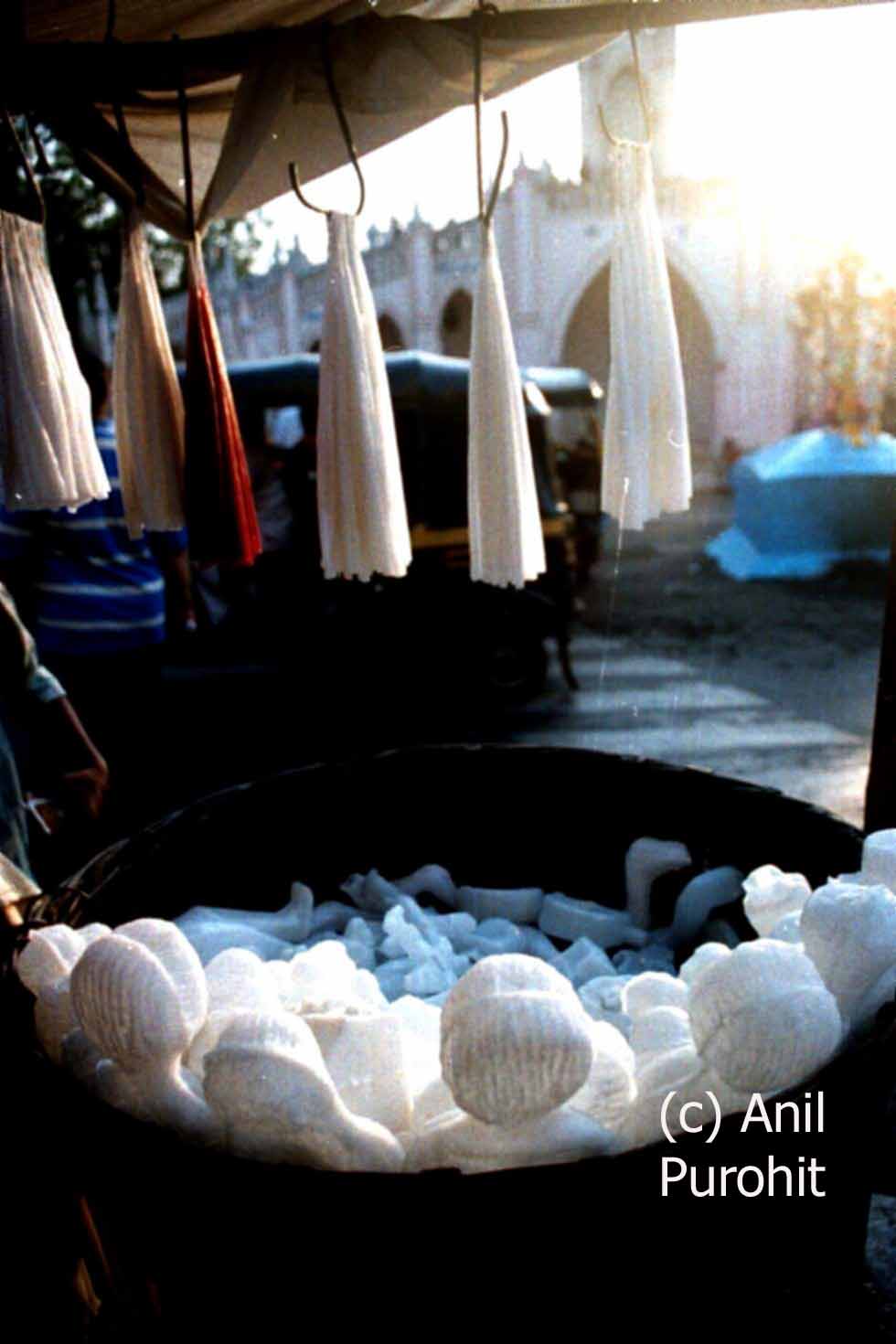
Santan Monteiro was alone in her stall. She was dressed in a frock and had a kind face. When I first met her on alighting in front of the church, I had a feeling she was originally from Goa. Time had etched its passage on her face. Hers was a makeshift stall. Candles coloured white, dark blue, light blue, red, and orange, hung from hooks looped around a horizontal bamboo support held up by bamboos fixed to the ground. In a basket by her side, wax figures shaped as hands, legs, spine, head and other parts of the human body were neatly stacked along the circumference of the rim. Actually, some of them were reclining as if resting easy while enjoying the view of the sun going down. The setting sun opposite lit them up in a translucent white. Devotees who come to Mount Mary to pray for cures for their ailments offer the wax figure that corresponds to their ailment. “Here, this one is for the stomach,” said Santan Monteiro, showing me a circular plate-like wax figure. “A patient suffering from a stomach ailment will offer it at the church by setting it alight, and saying prayers.” Then she held out a wax figure shaped like a back and said, “This one is for a back ailment.” As we talked in konkani, a steady stream of devotees came up to her stall to purchase candles, and the wax figures that she refers to as baulis (bauli is konkani for doll). Devotees belong to all religions, and their belief in Mother Mary’s powers to affect miracles is absolute, drawing them to the church from long distances. On the Sunday following September 8, the Bandra fair is held each year in the honor of Mother Mary. It carries on for eight days amidst much fanfare and piety.

About then a middle-aged couple steps up to Santan Monteiro’s stall asking her in hindi if they should offer the wax bauli at the church now or after they get a house. I listen on for I never tire of a Goan Catholic attempting hindi. It does not matter if they’ve lived in Mumbai for years, like Bandra’s Christians with roots in Goa, have, their Hindi shows the influence of konkani, lacing it with an edge that people up North would find a touch arrogant, insulting even. She advises them to offer prayers at the church for the house they hope to own someday, and return to the church to offer the wax bauli after their prayers are answered. “We prepare all these wax items at home,” she told me, “using molds.

“Baba accha sa pass hone ka,” (Baba should pass his exams well) she said to the same couple who mentioned about their son who was appearing for his exams. “You can pray for him at the church now, then offer a wax-book after he does well in his exams,” she told them. On a wooden plank near the front of the stall, she had stacked packets of gram. “My mother-in-law started this business fifty years ago,” she told me, running her hand in an arc indicating the stall she ran on her own. “She supported the entire family from her earnings from this stall. She is originally from this place. After I got married and came to Bombay, I helped her run this stall.”

I ask her how old is she.

“Sixty. To sixty, add three more,” she replied.

“Sixty-three?”

“Yes,” she said, smiling.

Santan Monteiro lives in Bandra. Then she told me of her children and her grand-children. I listened on, pausing only when customers stopped by her stall to make purchases, watching her treat them kindly and answer their queries patiently. The sun cast golden shafts our way, lighting up the stall in a soft memory.

I purchased candles for five rupees, thanked her and said that I would return to her stall with copies of her photographs. She smiled back, nodding her head.

Then, Krishna and I walked across the road, and took the stairs up to offer our prayers at the statue of Mother Mary. Candles and wax figures blazed bright on a metal stand where a steady stream of devotees set them alight in the flame, then folding their hands they offered prayers at the statue of Mother Mary. Behind her, the sun dipped low. A temple tree bloomed with a vengeance nearby. I bent over the wall to try and pluck a flower but couldn’t get close enough, but managed to get near enough to catch the fragrance wafting from the white and gold flowers I once lived with in my backyard years ago before we shifted to a new house.

May 29, 2006

A Sugarcane Morning in North Karnataka


On our drive past Sindgi enroute to Havalgi through Almel, before passing Afzalpur in the Bijapur district of North Karnataka, the road had not changed character from years ago. Until then, after the night halt at my relative’s place in Bijapur, the drive had been dream-like, with scarcely a bump in the road. Actually, it had been a revelation.

It was beyond Sindagi that I truly woke up that April morning as the jeep bumped and swerved on the road. I looked out the window to watch vast fields inch past in a sepia downpour of the familiar. That familiar mud, dark brown, freshly ploughed, brought memories of another day from another age flooding in.

This road used to be my cycling route in my vacations from school. Though I never managed to cycle the twenty kilometers that separates Almel from Sindgi for, cycling forty kilometers to and fro in the heat of summer meant a certain heatstroke, I regularly cycled ten kilometers of the stretch, enjoying the breeze before cycling back the way I had come. Dodging cattle on their way back from their grazing grounds, dismounting to make way for buses plying the route (Almel is eighty kilometers from Bijapur) between Bijapur and Gulbarga, racing bullock carts and waving out to farmers out in the fields served to make twenty kilometers of cycling rest easy on my knees. It helped me sleep easy on the terrace under the stars while the massive Peepal opposite brooded over me. I loved riding with the clouds, and in those landscapes of North Karnataka one can ride long distances with the clouds without losing sight of your nameless companions in the sky.

Every once in a while in the summer after a particularly furious bout of pedaling, I pulled up to the side of the road and walked across the field where farmers were extracting sugarcane juice to make jaggery. They offered me juice in brass jugs, filling it up until I had enough. Then it was time to pedal back to the calls of the Brahminy Starling and Mynahs. So when we passed trails of smoke emerging from the fields a few kilometers before Almel, smelling sweetly of sugarcane extracts, we pulled up to the side of the road and walked across Poddar’s sugarcane field to find Basanna tending to a large kadai (a large, wide metal utensil used for boiling extracts) filled with sugarcane juice. Behind him two farmers were crushing sugarcane in a cane crusher while the juice ran down a conduit to an open, circular pit in the ground. They had filled the kadai with sugarcane extract and placed it on an opening in the kiln while a low fire fueled by leftovers of crushed sugarcane fueled the kiln, manned by a farmer who stood by, watching the fire through an opening in the mud and brick construction.

Basanna was clad in a dhoti and a Gandhi topi, the attire common to older generation of farmers in that belt. He’s been working on the farm for over twenty years and told us that sugarcane extraction begins post-Diwali. The kiln was set up at ground level over a largish area, now turned white with leftovers of crushed sugarcane. Underground piping carried the exhaust to a bottle shaped chimney about seven feet tall, constructed a short distance away from the heat source over which the kadai, filled with sugarcane juice was placed. The kadai held over 950 litres of sugarcane juice, a white simmering mass.

It is boiled for over two hours before it is transferred to a rectangular holding area in a shed adjacent to the kiln where it is left to cool before it is poured into metal buckets to shape the resulting jaggery into cone shaped blocks, each weighing 15 kilos. We saw a few lined up along the length of the makeshift shed. It takes 950 litres of sugarcane juice to produce 11-12 such cone shaped blocks (called penti in the local language Kannada) of jaggery. Later they are shipped to the market. "950 litres of sugarcane extract will yield about 200 kilos of jaggery," Basanna said.

The farmers work through the day, starting at the break of day at 6 am, and continuing till six in the evening. Basanna happened to know my uncle from Almel well, and we exchanged smiles that only familiarity can induce. We carried back sugarcane juice in empty softdrink bottles for the road. Havalgi was still fifty-odd kilometres away. While on our way out I peeked inside a fairly deep well hewn out of the earth nearby before dodging a sleeping form wrapped in colourful quilt (called dhubti in the local language), lost to the world in a mass of crushed sugarcane leftovers that early morning.

The sun was breaking out in the distance as we hit the road again.