

Out on the road, after a time, it’s not so much your own experiences
that shape your journeys, as those of others you meet. Every once in a while I
intend to take a backseat and let fellow travellers, those I know personally
and those I don’t, paint their encounters here.
If you were to meet Delhites
returning to New Delhi after a sojourn in Mumbai, like I do on the occasions I
board the Rajdhani or August Kranti from Mumbai Central for New Delhi, it’s inevitable
that you’ll be treated to more than a robust comparison between the two Metros,
with New Delhi ‘trumping’ Bombay in all aspects, real and imagined.
It’s unlikely they’ll address you
directly for that would be rude even for a ‘normal’ Delhite of the mooh phat variety, instead they’ll make
certain their conversation is not lost on you, turning to throw a sideways
glance every now and then to ascertain that you are indeed tuned in to their
litany of woes about your city. And god forbid if they were to detect you
squirming; rest assured they’ll raise the intensity by a notch. Given a chance
they’d rub oil into a stone. If you can place Meetii Churi in a comparable context, you’ll probably understand
what I’m driving at.
But I must admit that I quite
relish the thread they play out. If anything it shortens the journey even if not
the distance.
High up in their list, and mind
you the list is long, as long as the faces Delhites will pull to get their
point across, is the grouse that Mumbai lacks public parks. I’m more than
prepared to concede this point. While Mumbai does boast of public parks or
gardens as many would refer them, it lacks them in the numbers Delhi totes up.

But that’s not the point I’m
trying to make. Even if Mumbai were to match New Delhi
in the size and number of public parks, I’ve no reason to believe it can ever
match New Delhi
for the sheer colour of characters one is likely to encounter in the capital
city’s green spaces, characters colourful enough to find a place in the park’s
flower beds, blooming through lean seasons.
And it were two such characters that
Sweetie encountered in the course of burning calories in a small neighbourhood
park in South Delhi that makes walking in Delhi’s green spaces simultaneously a
chore and a delight even if only briefly – one was invisible in the sense his
presence was revealed by his association with the garden, and the other, a not
inconsiderable Punjabi aunty whose witty repartees lightened Sweetie’s strides
weary from pounding the walking paths.
While I haven’t seen the
neighbourhood park myself, the narration (in italics) and the pictures Sweetie
mailed me left me with little doubt that this small patch of green is a labour
of love sustained over the years.

In poring over the pictures, it
soon became evident that while the patch of land probably belonged to the
Government, there was little else to indicate it had suffered silently in the
shade of indifference, and lacking in inspiration, as is wont to be with public
amenities managed by Government agencies. This was probably the work of an
individual driven to express himself in the service of his community.

While turning over public parks
to neighbourhood societies is not new, it’s nevertheless a revelation to step
into a public park and be greeted by an Albert Einstein quote on a water cooler set up for the public:

Only a life lived for others is a life worthwhile.
Translated into Hindi so his
thought reaches park visitors of all stations in life, the quote sounded even
better,
Kewal Vah Jeevan Kaam Ka Hai, Jisey
Doosroh Ke Liye
Jiya Jaey.
Jiya Jaey.

Whoever put up the quote was
either inspired by it and volunteered their service to others with the park, or
discovered it after being converted to the cause of service to the people. I do
not know which of the two was true with Mr. N. P. Thareja when he set up a
charitable trust – Human Care Charitable Trust – with like minded people and
set out to transform the public park into one the community would pivot around.
I was told that Mr. Thareja, a
Punjabi, retired as Assistant General Manager with State Bank Of India, is also
a practitioner of Palmistry and Astrology, both practices associated more with
Brahmins than with enterprising Punjabis who one would expect to say: Believe in the ability of your hands than in
the lines that mark them, before setting out to make time count its weight
in the money it earns them. Nevertheless there must be something powerfully redeeming
in a vocation that seeks to read destinies etched in palms to orient one in the
direction of service to fellow humans. And it might not be difficult to fathom
why. But that’s a story I’ll leave for another time.
In Delhi ,
and probably in much of India ,
more so in the north of India ,
do-gooders come in various forms. There’re those who’ll anoint themselves your subhchintak and offer you their opinion,
nee advice, on everything ranging from how to deal with neighbours’ pesky dogs
to neighbours who’re dogs, from how to put your daughter-in-law’s mother in her
place to why your son-in-law needs to wear better shirts to stop looking like a
unwashed rag.
Then there’re those subhchintaks, the kind Delhi must necessarily pride in for, these do-gooders
will put their money (and sometimes muscle) to use in playing the good Samaritan
to their neighbourhood, either as the President of the Resident Welfare
Society, a post that’s rarely earned on a platter, or like the elderly Mr. Thareja,
who formed a trust and took over the maintenance of the garden in this story,
turning it into a place of recreation and inspiration, starting with Albert
Einstein’s quote prominently displayed over a water dispenser to quench Delhi’s
thirst.

All manner of people, mostly the poor and those who cannot afford cold
drinking water, step into the garden and drink from the water dispenser. Many
fill their water bottles with chilled water and carry them back to their homes.
It’s a luxury that’s difficult to come by in Delhi
They (those who run the park – Human Care Charitable Trust founded by
N.P. Thareja) do not compromise on the quality of water just because most of
those who use it are the poor. The water is treated by two Aquaguard water purifiers,
and together with the water cooler cost the Trust two lakhs to set up.
This year, Delhi has been short of water in the summer.
Like Ramlila, water shortage visits New
Delhi each year, on the dot. And each year, Delhites’ nightmares
are relived as they scramble for motorised water tankers. It’s a time the
enterprising water carriers will push hand driven water carts into
neighbourhood colonies selling water at a rupee per litre, the business lasting
so long as the tap runs dry.

Everyone is affected by the water
shortage, some struggle to meet their own needs for water while some struggle
to meet others’ needs. And along Delhi ’s
streets it’s not uncommon to find rows of earthen water pots and tumblers arranged
by charitable souls for passers-by to drink from.
Water. The most elemental of the
elements. A force of reason, a force for reason.
In the moment one drinks water,
quietude settles about one, lending the moment open for contemplation and
aimless gazing as one gulps down the soothing liquid. It’s a moment no one
hurries with if they can help it. It’s a moment receptive to philosophy, to
matters beyond the immediate.

It’s likely that N.P. Thareja
sensed it to be the moment to reinforce the spiritual element lurking, even if
in varying degrees, within each human being for, adjoining Albert Einstein’s
quote, two Indian sayings in Devanagari script graced the second of the four
sides of the towering water cooler.

Dard Dil Ke Wastey Paida Kiya Insaan Ko
Warna Ta-aat Ke Liye Kuch Kum Na Thay Karu Bayan.
And,
Maang Le Jo Mangna Ho, Parwardigar Se Akbar
Yeh Waha Dhar Hai Jahan Jhukney Se Aabru Nahi Jati.
~
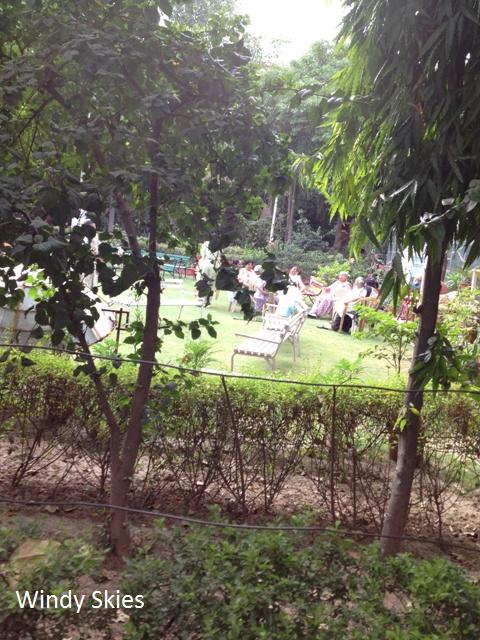
Sweetie added: Mostly elderly Punjabi women come to the park to exercise, atleast
that’s the intention but I suspect they’re here more for the company of others
their age. No sooner they step into the park in trim walking shoes they look
out for familiar faces, and before they break a hint of sweat on their
foreheads, the open space fronting Chintan Sthal turns into an impromptu adda
with the women settled in plastic chairs arranged in a circle, exchanging news
and gossip while sharing prasad from their morning visits to Hindu Temples and Sikh
Gurudwaras as appropriate to their beliefs.
Motee, motee auntiyan chahey walk karey ya na karey par joothey unkey
sab jadataar Adidas ya Reebok ya Nike se kam nahi hothey. Tumharey Bambai ke
tarah nahi, jahan auratein Paragon hawai chappal pahankey walk kartee hai.
I dodge the barb and duck but
smile away.

Robust laughter accompanying
spirited banter among the women gathered by the Chintan Sthal belies the profound nature of its name, Chintan Sthal – a place for quiet contemplation.
On the face of it there’s nothing quiet, and little contemplation if any.
However it makes up with much camaraderie.
The Chintan Sthal is used by the same Trust that runs the garden to
provide basic medical care free of cost to the needy, a service also availed by
elderly people from the neighbourhood who step into the park with aches and
pains common to their age. I’m told a Physiotherapist is available two days a week
to treat just these pains.
While companionship beckons, the
jamun tree in the park, more so in the Delhi
summer when it fruits and colours the park’s walking path, indigo, is too
tempting a sight for walkers to turn their backs on. Regular walkers slow down
as they approach the jamun tree and pick up stray jamuns lying on the ground while
others walk into the park for the fruit.

Aside from regular walkers, it’s common to see among others, security
guards, the gardener, and stray passers-by who include, maids, drivers and
cleaners servicing nearby residential neighbourhoods, take a detour through the
park for the jamuns in the summer.
They carry back handfuls of jamuns, much of which to savour on their
way back home or elsewhere.
It’s easy to spot the jamun tree.
Just watch out for people hunched over, scouring the ground. They’re looking
for jamuns. It was here Sweetie met the woman who left her smiling.
The elderly aunty I met in the park was carrying a walking stick to
support her after undergoing a knee surgery. She was a sprightly woman with
twinkling eyes that said from a distance: Gapodi aunty – embrace or steer clear
of depending upon how much time you’ve on your hands.
Bending over to pick jamuns was out of question, but it wasn’t enough
to deter her from wanting to sample them.

She stopped a passer-by and requested him pick jamuns shed by the tree.
The man acquiesced and began to pick the jamuns off the ground.
I paused to click pictures of the unfolding scene, and the kindly man
spread his palm filled with jamuns he had picked up for the elderly woman so I
could photograph them.
As I was about to continue past them, the woman, not content with the
jamuns handed over to her which she washed with water from a small plastic
bottle she said she carries for this very purpose, stopped me with a twinkle in
her eye and said:
“Meri bhi jamun khatey huey photo khich ley.”
I was more than happy to make her day.

After I photographed her, she was curious to see the picture. On seeing
her picture, a smile spread on her face and she couldn’t resist quipping:
“Arrey beta, kya lal surak lag rahee hun,
Mere aagey toh solaah saal ki ladki bhi fail hai.
Kal Agarwalji ke yahan raat ke khaney pe gayi thi,
Toh merey hee photo sab khich rahey thay.”
I couldn’t help smiling through the remainder of my walk.
The next day I kept a lookout for the aunty each time I passed the
jamun tree, only passing her briefly enough to catch her shouting out advice to
another woman:
“Arrey, uski bahu ko bol ki apni jethaani se yeh jagda salatwaley.”
I couldn’t stop chuckling on my way out.
It helps to have unbending knees,
for I believe it can sometimes make for an unbending spirit, for life, and
maybe beyond.
While trees and plants constitute
a garden, it takes spirited souls to breathe life into them.
And I can sense the unsaid coming
fast at me: “It’s here that Delhi
scores over Mumbai.”
Amen.
Glossary
Mooh Phat: Blunt-speak, often designed to pinch the other person by
way of a taunt.
Meetii Churi: Term used to denote a person who’ll sweet talk you while
hiding a dagger.
Subhchintak: Do-gooder, someone who purports to have your best
interests at heart.
Gapodi: Talkative.
Meri bhi jamun khatey huey photo khich ley: Photograph me eating jamuns too.
Arrey, uski bahu ko bol ki apni jethaani se yeh jagda salatwaley: Hey, tell her daughter-in-law to resolve her conflict with her elder sister-in-law.
Meri bhi jamun khatey huey photo khich ley: Photograph me eating jamuns too.
Arrey, uski bahu ko bol ki apni jethaani se yeh jagda salatwaley: Hey, tell her daughter-in-law to resolve her conflict with her elder sister-in-law.
Arrey beta, kya lal surak lag rahee hun,
Mere aagey toh solaa saal ki ladki bhi fail hai.
Kal Agarwalji ke yahan raat ke khaney pe gayi thi,
Toh merey hee photo sab khich rahey thay.
Oh girl, how rosy my
cheeks are,
Even a sixteen year
old girl will fade in comparison.
Yesterday, I was at
Agarwalji’s place for dinner,
And everyone was
photographing only me.
(Implying she was the centre of attraction there for her looks.)


