In my previous post there is no photograph of Krishnadas, the Keralite coconut vendor, for I never got around to taking his picture. In this post there is one of Hassan, a coconut vendor from Kerala whom I met in Mumbai on Onam earlier in the week while on an errand. Hassan is a Muslim. I was drawn to the
pookkalam, flower decoration, that he had put together on the footpath by his cart piled high with tender coconuts from Gujarat, wishing passersby ‘Happy Onam’. On August 27th Onam ushered in
Chingam, the first month of the Malayalam calendar (
Kollavarsham). Onam is also known as Kerala’s harvest festival.

“Tomorrow I’ll get the new load from Mysore,” he said when I asked him ‘How come you don’t get coconuts from Mysore while others do?’ Like Hassan, most coconut vendors that I meet in Mumbai hail from Kerala, and largely source coconuts from Mysore in Karnataka. Hassan buys tender coconuts from Gujarat and Mysore every alternate day, an unusual arrangement I thought.
I couldn’t quite catch his name the first time he pronounced it. Even a common Muslim name like Hassan sounds different when pronounced by a Malayalee (a Malayalam speaking native of Kerala). He smiled at me and said, “Call me Babu, everyone calls me that.” I knew another Keralite years ago who was nicknamed ‘Babu’. He used to amuse himself by peeling stickers from his new underwear and sticking them to the front door of the rented dwelling he shared with his elder brother and Bijoy. I used to visit Bijoy after school to go cycling. Out of earshot Bijoy and I took to calling him ‘Pintex’ after the brand he wore and whose sticker stared at me each time I knocked on the door to rouse Bijoy from his afternoon nap!
The festival of Onam owes its origins to the legend of the
Asura (demon) king Mahabali who ruled Kerala benevolently, and was much loved by his subjects. He was a staunch devotee of Lord Vishnu. However, the Lord was concerned for Mahabali for, King Mahabali was full of ego, believing nothing to be beyond him. To rid his devotee of ego and humble him, Lord Vishnu took the guise of a dwarf Brahmin, Vamana, and approached King Mahabali. Deluded by his abilities and blinded by ego, King Mahabali, oblivious of Vamana’s real self offers Vamana anything he would care to ask for, believing he could grant any wish asked of him. Vamana asks the King for three paces of land, to which King Mahabali agrees.
Vamana measures out his first pace and it spans the skies, his second pace spans the netherworld, covering all. Astounded and realizing that Vamana’s third pace would cover Earth, possibly destroying it and with it his kingdom and his people, King Mahabali offers Vamana his head for the third and final step to save his people. Before banishing the King to the netherworld with his third pace Lord Vishnu grants Mahabali a boon. The King asks to return from exile once a year. It is this homecoming of its beloved king each year that the state of Kerala marks as the beginning of the Malayalam calendar, coinciding with August-September in the Gregorian Solar calendar.
A variation of the legend of the
Asura (demon) King Mahabali records the desperation of the
Devas (demigods) upon losing control of the world to Mahabali, leading them to seeking Lord Vishnu’s help in defeating the demon King. The part narrating Vamana’s wish for three paces and the consequences it held for Mahabali is common to both.
Onam sees Keralites welcome the king with elaborate flower decorations and festivities that spans several days.

Hassan has placed coconuts around the flower decoration to alert passersby and prevent them from stepping on it. The Hindu festival of Onam derives from a common heritage, predating Islam by hundreds of centuries. Keralites around the world celebrate Onam irrespective of whether they’re Hindu, Muslim, or Christian. Pre-conversion religious heritage binds the population in a rare camaraderie that transcends modern day differences in welcoming the Malayalam New Year on Onam.
I ask Hassan if he misses being home for Onam. “Yes, I do, but what to do,” he replies, flashing a quick smile. Hassan is from Trichur (Thrissur) in Kerala. While I check my camera and fiddle with its settings, a steady stream of vehicles motor along the road adjoining the footpath before bunching up bumper to bumper for the light to turn green. A customer walks up to a makeshift table by his stack of green coconuts to use the PCO. For one rupee you can make a local call. He pays Hassan the rupee and walks off after making a phone call. Hassan turns to face me while I take pictures.
Hassan’s father came to Mumbai (formerly Bombay) from Kerala eighteen years ago to make a living selling tender coconuts. “I used to visit Bombay during my school vacations to be with my father,” Hassan says, pausing in front of the stack to pick a tender coconut for a customer who has walked off the road to Hassan’s. A wooden bin fashioned from planks nailed together serves to hold empty coconuts, discarded kernels and sliced coconut shells.
Hassan places the tender coconut on a narrow wooden plank held up by two short wooden poles nailed to one side of the improvised bin and expertly chops at the coconut to expose the white underside near the top of the coconut. A quick chop across the exposed top half opens the tender coconut, coconut water is visible within. Hassan picks up a orange coloured plastic straw and plants it in the opening before passing it to the customer.

“No, no,” exclaims the customer, exasperated somewhat. “Don’t cut it open. I need to carry it home, just chop at the top half and expose the white underside; I’ll open it back home.” So, Hassan passes me the tender coconut instead and while I drag on the straw, taking in the flavour of fresh coconut water, Hassan picks up another tender coconut from the pile on his cart and placing it on the narrow wooden plank proceeds to repeat the process as sliced shell parts drop into the wooden bin. Experienced coconut vendors use their bare knees for support while slicing coconuts with expert chops; a few others use their open palms. Hassan plays it safe. The choppers are razor sharp.
Hassan left Kerala for Bombay for good after his father died nine years ago to carry on the tender coconut vending business that his father left behind in Bombay. As he speaks the traffic on the street where the footpath ends drowns his voice.

Talking of his native place I’m reminded of my own trip to Kerala with Naguesh years ago. I had carried my camera along, and one photo in particular captured for me the essence of that trip. It was a picture I took by the backwaters off Cherthala near Ernakulum while Naguesh, Manoj, and Rose waited in the distance, a light breeze carrying snatches of their conversation to where I lay on the ground in wait for a candid moment in the open patch facing me. Not far from where I waited, a woman sat patiently by her black cow while it drank water from a metal bucket.

Three coconut trees on the periphery of the open patch rose as if in a Guard of Honour to a village woman walking on a narrow mud path along the backwaters fencing off the open stretch of land. Blue skies stretched across overhead while I lay on my stomach on the ground, struggling to maneuver the camera quickly enough to capture the trio at an angle while the woman walked past. Looking back now I feel that were I to try hard I might actually be able to recollect the smell of earth of that day. Maybe it had to do with the serenity, maybe it was the blue skies, or maybe those three coconut trees had something to do with it. I’ve no way of knowing for sure. Since then I conjure up Kerala in that one picture (above) I took that day.
“Kerala is beautiful,” I tell Hassan, to which he smiles and says, “
Khubsoorat hai par kya karey.” (“It’s beautiful, but what to do”.) I suspect that his expression, particularly his wry smile, betrays a latent longing for a home long way down South. He finds Kerala expensive, the one reason that might explain why he made Mumbai his home, at least for now.

“Back home, everything is costly,” he explains. “If one is ill, they need to be carried long distances, and private clinics there charge anywhere up to 400 rupees.
Yahan pe sau rupai mein kaam ho jaata hai," (Here, (read Mumbai) it gets done within 100 rupees). Hassan reels of more figures, pausing to attend to customers stopping by his cart while on their way elsewhere, and refreshed by tender coconut I imagine their feet acquiring sufficient spring to negotiate Mumbai streets. More empty coconuts pile up in the wooden bin as the setting Sun breaks through the clouds, casting faint light along the footpath from between former British structures across the street.

I finish drinking the tender coconut and drop the empty shell into the makeshift bin. It has stopped drizzling. I pay Hassan for the tender coconuts and with a small wave of the hand I turn to leave. He waves back, lending his smile to the flavour of the moment before the noise of the traffic lays claim to my thoughts once again.


 I might have walked on after reading the advertisement if not for a movement in the corner of my eye. Turning my face away from the ‘Aha Zindagi’ in the tree I notice a cat reclining on the ledge of the compound wall to my left, licking itself lazily as if to whet its appetite for the meal of rice and dal that awaited His Majesty on the ledge behind its hind-quarters.

 So, when I took an infrequent path one day not far from the Matunga Road station, keeping my head down to avoid the indignity of falling over any of the many reasons ‘inhabiting’ Mumbai footpaths, I raised my head ever so momentarily only to be pleasantly surprised to see this building I had missed noticing earlier.
 As to why it took me another trip that way several days later to notice the other building not far from the first one, well, I would have to start all over again to explain it!


 When I reminded him yesterday of the Jute frames he had used for his nature photographs back then, Joginder Singh laughed out loud and said, “That’s all I could afford then.” However I suspect it might have had more to do with his inclination towards nature conservation if his theme then was anything to go by, nature patterns close-up. I distinctly remember him telling the audience gathered in the basement gallery that day of an incident in a train where his fellow passengers were chucking their plastic tea cups from the window, littering the tracks in the countryside and the argument it triggered thereafter.
 “Ten years is a long time,’’ Joginder Singh says as we take a round of the gallery. I nod and say, “Yes, it sure is a long time.’’ He hasn’t changed much physically except for his beard. Now he wears it long. I tell him that he talks more freely now. He smiles.
 Looking at his photographs uniquely display light as the recurring theme, at times highlighting forms, other times pushing them to the background, I reflect on his use of the term ideology with context to the Laurie Baker style of Architecture and wonder how deeply might such an approach influence his photography as in narrowing his focus to a distinct thread while ‘blanking’ out the tapestry it is a part of. Would it for instance enforce a continuity of thought as an underlying thread stringing together visually disparate elements of what are essentially distinct structures but which when stripped off their larger contexts appear to belong together.
 Pictures of Jantar Mantar (Delhi and Jaipur), the Padmanabhapuram Palace and a Ladakh monastery will sit together not merely as distinct eras but equally strongly as distinct emotions, each evoking in its form a completeness that cannot be mistaken for one another. However if you were to zoom into each of the three and settle on an emerging curve or a line form in the structure, the elements now stripped of their eventual contexts lose their larger identities as a Jantar Mantar, a Buddhist monastery or a Padmanabhapuram Palace and stand on their own in unison as if derived from a common architecture.
 Elements combine to give a monument its identity and vice versa. To make a structural element stand on its own even when stripped of its overall context is a challenge to a photographer, even more so when exhibited in a series. There is a danger of sameness negating the very mood it seeks to create. However Joginder Singh has ‘harnessed’ light well to break the monotony and it is his use of light in delineating contrasts in his photographs, essentially minimalist in nature, that brings life to the series, casting original forms in a new light, a re-form as Jogi likes to call them.
 A lady tourist who’s been going through the exhibits in silence steps up to Joginder and congratulates him on his work, her eyes lighting up. The colours appeal for sure but rendering forms stripped to their bare essentials can make for riveting viewing if cast in an eclectic play of light, where shadows play out in consonance with solid elements.

 The Kerala connection bore fruit with the release of the book Glimpses of Architecture in Kerala – Temples and Palaces by Rupa & Co. in 2006. Flipping through its pages I’m struck by his use of light to highlight the temple and palace architecture of Kerala, a heritage so distinct from that of other Indian states as to be striking. Standing there I can only imagine the experience the project must've afforded him, footloose in the beauteous coastal landscape. Ramu Katakam wrote the book while Joginder Singh executed the photography to illustrate the book, a visual treat. It is priced at Rs. 995.
 Talking of light and form he says, “Working on commissioned projects where I have to shoot the project in its totality I have to wait for the light, because form has been designed. Form is basically what? It’s an enclosure yaar, right? If you have an entrance to it, you’ve got light into the form or it’s all around the form. It’s eating out something from space and interacting with light. So, light is there and you need to capture that, y’know.”
 Then turning to face the wall behind him he points out to one of his exhibits, “If you look at that second picture on the wall from that corner, that was shot on a day when we went to Jantar Mantar and it was extremely cloudy. There was no Sun. If you’re attuned to light then you know that when you’re shooting a picture, somewhere, subconsciously, (though you) might not define it unless you talk about it, you’re trying to capture a certain essence and then you’ve to wait for that certain light to bring that essence out, so whether it's that tight a frame, or that wide or a panorama . . . . .” then he trails off. Some things cannot always be expressed, they've to be understood. I nod.
 I scan through Iranian and Lebanese menu items before settling for fresh lime soda and garlic bread. Jabrir smiles at us as he takes the order before disappearing out of sight. We’ve picked a corner to stretch out the evening Sun. The nook barely holds a table and two chairs while shielding us from the rest of the restaurant. A steady sheet of pieces of plaster tumble down outside while a worker holding a rope fences off a portion of the road for commuters while another worker balancing on a plank chips away at the plaster on the wall. Old buildings undergo regular maintenance to keep them standing. It hasn’t helped that monsoons stretch over four months, soaking the megapolis to its very bone.

 “They stopped over at the Taj hotel on their way to Goa,” Firoze said. “It was then we began serving up English breakfast to suit their tastes. They would walk down from the Taj to Piccadilly for breakfast.” So, the Piccadilly began opening early to serve English breakfast.
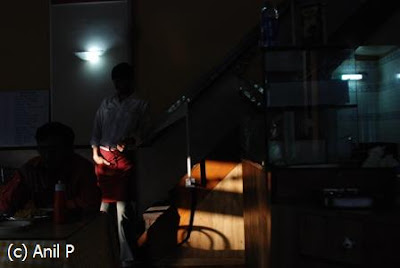 The shaft of sunlight has mellowed somewhat. Faisal walks over to serve a visitor who’s just stepped in before returning to his place at the foot of the stairway to the upper floor. He has an absent look on his face as he stands quietly with his hand in his pocket.
 One day as I rounded a bend in the mohalla a cart hitched to a lone Ox stood in the lane by the house, looking past the bend in the galli. From then on I rarely see an Ox without seeing a blue house on a street corner.
 This was the one.

 The Government of Goa is pushing the State in the direction of Las Vegas, the Casino ‘Capital’ of the world. The fact that some local politicians from the coastal belt, known more for their muscle than intellect, are plumping for Casinos to be floated on the seas off Goa and on inland rivers has queered the pitch further, bringing the Government of Goa in direct conflict with the local fishing community who oppose the Casinos on the river, fearful as much of the culture seeping offshore and laying waste the youth as of the environmental damage that river dredging to accommodate Casino vessels will inflict on their livelihood. There is growing opposition from the local populace to the dredging of the river Sal to accommodate a Casino vessel floated by Hotel Leela to cater to well-heeled tourists and attract more of the same.
 It was last October, on the eve of Diwali, that we rode down the winding roads, past Assolna and Velim along the Sal, stopping by the fishing Jetty at Cutbona to take in the early morning calm off the river and making small talk with fishing hands from Orissa employed on small Goan fishing vessels anchored in the waters. Maria Bai lay in the safety of the jetty, resting easily among the vessels crowding the waterfront, listening to voices floating in from the decks where youth bent over fresh catch of fish while local villagers gathered by the vessels to buy the catch straight off the decks. A warm sunshine had settled in while trees stirred in the gentle breeze.
 At times of such serenity it is difficult to imagine the transitory nature of outward calm, belying the feeling of continuity that nature in its primeval state evokes even while disturbing currents might simmer within inches of the surface, threatening to upset the balance of the very same continuity. It is this state of well-being like the one we experienced on the banks of the Sal that day that I most fear, for it is when one begins to favour a state of permanence that its fragility begins to unravel.


