In late 2009, as I walked down many a Calcutta street, past the ubiquitous image of flowers springing in the grass, it increasingly appeared that there was barely a neighbourhood in Kolkata where the Trinamool Congress did not have a presence. The TMC was everywhere:
On walls of homes along quiet lanes, keeping a young man company on the steps warming to the morning Sun,
Or looking over the shoulder of an elderly lady knitting on the steps of an old dwelling in Kalighat,
Better still, fluttering in the breeze in streets leading to the Esplanade,
Everywhere,
Except at the Writers’ Building.
It was still Red.
Bright, brilliantly Red.
Strikingly Red. Forebodingly Red.
Only until the middle of 2011, that is. The year Kolkata, and West Bengal went to polls.
And Trinamool Congress finally came home to the Writers’ Building. The lease is new, for now.
The grass is still green, and the flowers fresh. Jora Ghas Phul.
From Old Goa the road to Panjim meanders along the Mandovi, often at the same pace as the river, conducting vehicular traffic along its gentle curves to the faint fragrance of the river marching steadily to the Arabian Sea off Panjim, Goa’s capital city located at the confluence of the river and the sea.
This is the stretch I look forward to on my forays into Panjim. On clear days, and the skies are usually clear on either side of the monsoons even if not always blue, the breeze sweeps in on the stretch of road and the rumble of the bus turns into a steady lulling drone, only changing on the driver shifting gears up or down the inclines when it isn’t trying to overtake another.
Occasionally a loud blast of horn will sound from large river barges navigating the Mandovi and ferry goers awaiting river ferries for Chorao and Diwar will turn their face in the direction of the horn. If they’re lucky a second blast of horn will reverberate through them, bouncing off the narrow streets before the quiet lays claim to the streets once again.
The stretch of road past Old Goa offers glimpses of the river in snatches of streetside conversation interrupted by coconut trees, groves, whitewashed chapels set off by gulmohars in spring blaze, shipyards, fisheries, shopfronts, fishing jetty, fishing trawlers, and verandahs along the front of old homes, the cast iron railings lending the street a hint of relief, and on Sundays even more so.
Sundays empty urban and rural landscapes not so much of people as they do of purpose, of urgency, of the necessity of travel, of having to be someplace you’d rather not.
In arriving as Sundays do at the end of the week or at the beginning depending upon how you choose to see it, they seek to serve as a prelude to the moment the body, freed of encumbrances, fleshes out a new beginning, shaking off the sluggishness of the week before, not unlike acquiring a new skin as the old one is lost to the mandatory weekly moulting.
While awaiting a river ferry to take one across the Mandovi, there’s little to distinguish the waiting from any other on a weekday, except maybe there’re fewer vehicles awaiting a ride across the river on a Sunday than on a weekday.
The river itself is a picture of calm, barely a ripple in the sunshine unless fishes try to break surface. Kingfishers continue to perch on overhanging branches before speeding into a dive and returning with equal alacrity, a wriggling fish held firmly in the beak if lucky. Off the road life goes on as usual, and the week is but days that’re no different from any other except maybe Sundays on the Mandovi but not by much.
The spring reveals itself in Goa as flowering trees blossom among the chatter of birds calling on them as much for the succulence on offer as for reveling in the warmth of sunshine on the banks of the river on a Sunday morning.
The Silk Cotton tree in particular is insistent with its blood red blossoms setting off the quiet of the street and the blue skies. Like blood shot eyes lined on bare branches, the flowers seem intent on being seen from afar by birds and meanderers alike.
After the mild Goan winter the first sight of colour breaking out in the trees is an occasion to pause along the way and step out for a closer look. On the banks of the river it’s the time to gaze along its length and steady the morning rush into something more manageable and peaceful.
The Red Silk-cotton tree is among the first to blossom and is the harbinger of spring. If you see a Silk Cotton tree in bloom while most other flowering trees haven’t began blooming yet, it’s likely you’re out in January like I was when I came upon this tree on the banks of the Mandovi on a salubrious Sunday morning on the river.
The tide was out, exposing laterite stones along the sliver of land below the road. In the shade of an overhanging tree, local villagers cast lines out in the river from slim bamboo sticks, watching in silence for signs of fish taking the bait.
Watching them perched on stones and gazing fixedly in the river after the lines that’d gone under, I wondered if necessity had driven them to fish in the Mandovi that morning for, fish are plentiful roadside in the villages that dot the Goan countryside as vendors make their way into village centres early each morning, and while not everyone can afford all the fishes on display there’ll always be a variety or another available in cheap and in plenty.
However, it’s entirely possible that they’d time on hand from their vocations on weekdays and had chosen to go fishing for a bit of quiet and sport on the river, hoping to land some for lunch but not overly disappointed if the Mandovi refused to yield any for their effort that Sunday morning. Moreover, fishing brings a Sunday feel to the activity all by itself as any slowing of pace through the day inevitably will.
Across the road from the three fishermen, a local youth stepped to a roadside Cross bearing white candles. After a brief moment of prayer, he lit the candles at the Cross with a deliberate precision that comes from doing it over time. An act of faith strengthens in belief from enduring time, and tide.
Once the candles he had lit were burning bright at the altar of the Cross, he bowed his head before stepping out onto the road. Whether he had petitioned the Cross or was offering thanks for realizing his prayers is something I would never know. It was equally likely he was paying homage to departed memories as is likely he was infusing his day with piety from offering candles at the Cross.
Later, as we boarded the ferry to Diwar, I leaned against the deck as it pulled away from the landing at Sao Pedro before affecting an about turn in the middle of the river as it headed for the opposite bank.
A fisherman on the river bank we had just left swiveled on his heels as he expertly looped the fishing net into the air, pausing mid swivel to watch it settle in a billowing circle, setting off little ripples where it hit the water.
On the river ferry, framed by an open window a woman in red corduroys lent her gaze to the river in silence. Like a painting of a river hanging from a wall, the open window framed the stretch of river behind her as the ferry neared Diwar.
Soon mangroves and fishing nets replaced the river scene in the open window and the clattering of iron chains sounded as the boatman lowered the landing.
Then there was silence as we stepped past the gangway and made for land and beyond, for the tree from my childhood travels.
Its leafless outline has been a constant from the time I first landed in Chorao on a Sunday bird-watching trip from school, subsequently making my way to Diwar for no better reason than it was there to be explored. It was there I first saw it, and subsequently ever after. It’s home to the great Kites that hover in the skies over Diwar, a place to land for a breather before opening their wings for a foray in the skies.
The stark outlines of the barren tree relieved the empty rice fields of Diwar midway through their stretch against the hills inland where a whitewashed church stands from before, from way, way before.
Here, on the power lines that run along the narrow road that takes the traveler deep into the island off Panjim, Roller Jays launch into the air playing in the same frame as do Black Drongos and Small Green Bee-eaters, each carving their empty space in which to hunt insects, each dancing to their own rhythm bequeathed them by their own kind.
Occasionally a bus will trundle past on its way to the ferry point. On Sundays, even fewer buses will.
Stepping off the road in the direction of a large, shady tree ringed by a platform for travelers to pause and take in the quiet we find company, of locals who’ve ridden to the shade of the tree for a bit of beer and quiet.
Soon another villager joins them bearing snacks (Vada Pao) to complement the crate of beer and soft drinks. It’s likely they’ve stocked up on liquor to go with beer and have taken time off from home to lighten up their Sunday with a bit of beer and talk while the Mandovi courses past them behind the bank of mangroves at the edge of the field.
They’ll have planned the Sunday morning outing over the week, calling up to confirm the time before riding out to the tree by the lonely road, looking forward to doing nothing in particular and reveling in the thought of it. Soon the Sunday on the Mandovi will pass and the week will be upon them.
The anticipation of doing nothing, even if limited to a day, is a salve for having to live with choices made as a matter of course, compulsion or necessity. The anticipation exults not so much in the freedom to do as one pleases as in reverting to a natural state of being, floating freely and away with time, like the birds in the skies over Diwar on the banks of the Mandovi.
When the landscape hurtles to the horizon, flat and deep, for a rendezvous with the heavens where they converge to infinity, it’s never easy to determine if the clouds are coming in or going away, not in an instant anyway.
There’re no trees about for the wind to bend, nor are there leaves in a mood to oblige the nudging breeze. And if you hold your breath in the instant your eyes rove the land before you, it’s likely the expanse will root your feet where they first land for, there’s nothing to approach, nothing to get close to, and nothing that you’ll see better than you already do from where you now stand.
Yet, the landscape holds the gaze as vastness will. Nothing moves or if something indeed does it barely registers. A landscape that stills time assumes a vastness that endures the moment, prolongs it, and freezes it, rooting the eye, and the feet to the eternity of its passing.
The sheep that graze in the fields move less like individuals that they are and more like the clouds in the skies overhead, flowing together into one unyielding mass, changing shape, distending, contracting, but moving all the time, indiscernible but moving all the same, like thoughts seeking space to nest in the mind.
For a moment I wished for Sunflowers in the field, imagining the sheep grazing in a thousand Suns. It was September, and straggling monsoon clouds were playing catching up, travelling great distances over a land they had never visited before nor would they ever visit again. Come next year, other clouds would take their place, passing over farmers gathered on the steps outside their homes, their eyes to the skies, wondering and waiting for rains so they could plant jowar before the last of the clouds disappeared over the horizon.
In the moment that passed me that September day, I caught a glimpse of the land and the horizon locked into a perpetual tango, painting the landscape for travelers like me.
On finding a ‘Cricket Bat’ in a Goan jungle, more precisely in the wildlife sanctuary at Mollem.
If you plan on having a ball in the jungle it’d help to have a cricket bat to play the ball with, or better still, have a ball with. You might yet get a pitch to parade your skills on even if it’s a wet one and the soil is loose beneath the surface, and if you’re lucky you can count on a wild bison for a wicket keeper.
It doesn’t matter if the bison cannot collect the ball cleanly, trust its girth to stop some from passing it to the boundary as did Dhoni in the recently concluded Test series between India and England, and life goes on.
Just watch your step if you do not want to sprain your ankle running in. Where Indian Bisons (Indian Gaur) have stepped through they’ve left ample evidence of their weight on the pitch, deep holes where water collects temporarily before seeping into the earth.
And to clear the field a flat batted shot will not do, get under the ball and attempt a skier to clear the trees if you aim to get the ball anywhere, else it’s likely the nearest tree will field the ball long before you’ve completed your bat swing.
For spectators if you’re happy with a Grey Hornbill busy in a fig tree, chattering Flycatchers, Emerald Doves in tree tops, Warblers in thickets, Kingfishers hovering over jungle streams, and Langurs leaping among branches then you’re set for the game, a bee buzzing in your bonnet.
While there’re bees around, there’re no colourful bonnets about to buzz in, unless the colours sported by Bonnet Macaques on their behinds suffices.
However, speaking of colour, there’s plenty around. Winged wonders who’re as exotic as their names would suggest, flit about the field all day, zig zagging like commuters on Mumbai thoroughfares.
Common Map, Common Crow, Common Sailor, Grey Pansy, Grass Yellows, and even a Count you can count on, the Grey Count, among the lesser Commoners who’re no less cheerful or enthusiastic to see you take guard.
Just take care not to swing your bat when one of them is passing by the edge, for there’s just the chance the Hot Spot might awaken that very moment and show up the spot where the wing singed your bat, sending you on your way to the pavilion, except here you’d have to clamber up the rickety steps of a machan to cool your heels, or to the straw hut the forest curator uses to keep an eye on the grass plot maintained for the Indian Bisons in the wildlife sanctuary, not unlike the pitch curator who keeps a beady eye on the grassy pitch lest an Indian player, enamoured by the nightlife in town, and having partaken of its spoils the night before staggers onto the grassy pitch before play begins.
Don’t forget to watch the ball as you cream it through. There’s every chance Langurs might decide to swing it right back and there’s no guarantee they’ll be aiming at the stumps, and not you.
If you clear the field, chances are the ball would’ve to lucky to make it through the vegetation, and there’s no knowing who’s lurking in there for, over the years I’ve seen slitherers of ever kind when hiking in these very patches, including Kraits, Cobras, Russell’s Vipers, Saw Scaled Vipers, and Whip Snakes here.
But then fortune favours the brave, so you might as well make a dash for the ball before the vegetation devours it and you’re apprehensive in reaching for it in the thicket harbouring the unknown – a motivation as pressing as any in diving for the ball before it crosses over.
Is there a lesson I see here in including this patch in the fielding drills Duncan Fletcher puts the Indian Cricketers through given how they rolled over and lay supine before the ball ‘died’ on the boundary. I’d assume there is one.
Aha, the thoughts that will flit about a perspiring forehead on spotting a cricket bat in the jungle no sooner had Philip and I spotted it by a freshly made dirt track in the sanctuary.
We found our own cricket bat in the jungle the moment we stepped through a rocky path laced with straggling grass and into the thicket before happening upon a newly laid dirt track along the periphery of the sanctuary that runs by the highway conducting vehicular traffic to Belgaum from Panaji, through Mollem before surmounting the Anmod Ghats and back the same way.
Looking around me I spied ‘seats’ of leaves, likely Teak, arranged neatly in a small clearing set back from the newly minted dirt path, indicating where labourers had settled down for a bit of shade and quiet at lunchtime.
The leaves were yet to lose their colour and elasticity, indicating it wasn’t a long time ago that workers laying the walking path were batting the lose topsoil into place with the stodgy cricket bat that looked like it was hewn from the trunk of a Jackfruit tree or maybe a Mango tree. I couldn’t be sure, just that the weight suggested the possibility.
And the fact that they’d left the bat behind where we found it meant they would return to work on the dirt road some more, it looked like it might need some more of batting the soil layer down before the Sun, assuming it would manage to pierce.
I lifted the solid wooden batter shaped like a cricket bat and swung it in the arcs I used to when I was at school and dreamed of making it big as a batsman. But whacks that life dealt me on the hind quarter with cricket bats of another kind nudged me into batting corporate timelines, with teatime restricted to dip wala chai produced in cheap plastic cups stacked in a corner of a makeshift cafeteria, cups you had to learn to hold lightly between your fingers if you didn’t want to turn them into fountains of steaming tea spouting in your face.
I liked the way the workers had arranged the leaves into a temporary seating. Over time the ‘seats’ would turn to mulch and likely nourish the very tree they came from, not unlike the branches that colourful fungi had made their home on.
In the jungle, the temporary is permanent, and temporariness, enduring.
The number of ‘leaf-seats’ suggested there were no more than four workers involved in laying the jungle path. And if you concede the bisons their right of way, and hence the right to leave their footprints deep in the dirt track there were fewer indentations in the entire stretch of freshly turned over red soil of laterite origin that sloped along to a jungle stream some distance away from where we stood than what you’d find in a foot of city roads in Mumbai.
As Philip and I stepped on the surface, bending to trace the outlines of what appeared to be Bison tracks, I felt the surface needed more of the batting down and baking in the Sun to hold firm if it was to survive more of the monsoons on their way West over the Arabian Sea.
And one Cricket Bat in the jungle, worked by one batter at a time, would not suffice if the surface was to be batted down firmer before the soil dried out. More wooden bats were needed, and more batters to wield them and work the surface.
As Philip and I walked down the incline, binoculars dangling from the neck, I wondered if it wouldn’t help to have the ‘feared’ Indian batting lineup donate their cricket bats for the purpose considering they barely made their effort count on the scoreboard in the recently concluded Test series in England, and given how many were found short on technique in facing the English bowlers would it harm the team to have them assigned to batting down the surface of this jungle trail?
I doubt if it would. If anything it’d give them a better feel of tapping the surface of the pitch with the toe-end of their bats to flatten out unevenness before taking guard at the wicket, that’s assuming they’d be picked up to play for India again.
For Drinks Break they can reach into the crook of a nearby tree for water to quench their thirst. That way they could imbibe some jungle wisdom from the Wisdom Tree.
For a shower, they could make do with the jungle stream that courses by not far from the trail.
And if it turns out the Indian batsmen are no good even at batting down the surface of a jungle trail, then there’s the jungle well to hide them from sight lest they get noticed by the selectors again.
In the moment the tide passes Allowing time a temporary reprieve, The shoreline reveals its midriff, As it basks in the rare relief cast its way.
The sentinel’s lights, having fallen silent, pause As eyes scan the horizon for an anchor.
Finding none to steer their course, They chart their run along the shore, Keeping a meandering soul company, and delighting in the colour His umbrella lends a wistful monsoon sky.
In the moment meandering meets serendipity Time anchors my wandering feet to the passing moment.
Behind the dwellings and commercial establishments on Nirmal Chandra Street are more dwellings along narrow lanes that convey residents along to their homes. The lanes are wide enough to let two residents pass each other but not if a two-wheeler were to be parked in the way.
From the road there’s little to indicate the layers that wrap neighbourhoods along tight lines, only relieved by brightly painted doors and windows and lanes sectioning them into blocks while cutting through the neighbourhood.
Into one such neighbourhoood we had sallied forth on a winter morning in Kolkata. When we turned left into a lane branching off the Nirmal Chandra Street the Sun had just about managed to rise above the street-facing homes to light up the houses behind, and it was barely an hour shy of noon.
Around a scooter parked in a lane connecting homes, four school going children had gathered, likely discussing their plan for the day off from school. Sundays are unusually quiet in the older parts of Kolkata.
There’re few people about in the morning, and those who’ve stepped out for an errand or accompanying another for public service exams usually conducted on Sundays will meander about or bask in the winter Sun reading newspapers roadside.
In the winter Kolkata embraces the Sun early in the morning. It’s no use turning to the clock to confirm if it’s still night, not when the winter dawn stirs at a time when it’s still night elsewhere. It was the farthest we had traveled east. And it was the earliest we had seen the Sun rising.
Except for men bathing around a water tank on a footpath along the BSNL – Entally Telephone Exchange building, and later around another water tank in Monilal Saha Lane, there were few people about, among them a barber who had set up an impromptu shop at a street corner. Round the corner behind him the street ran empty.
On Sundays the shutters of most shops along the road were still down with a few exceptions like K. C. Mookerjee & Sons. The Iron & Hardware Merchant probably had a tradition dating back from 1836 to keep alive.
Chatterjee Paul & Co. were probably under no such compulsion and it’s likely they dated back just as far back in time as K.C. Mookerjee & Sons did. Alongside Nirmal Chandra Street, Chatterjee Paul & Co. had also listed Wellington Street, the original street name. If anything, mails addressed by the former name would still find its rightful way.
Chatterjee and Mookerjee are Bengali Brahmin names, a formidable community in the Bengali cultural landscape, admired and respected for its contribution to the Arts, as ubiquitous as the famed yellow Ambassador taxis. And like with most non-Bengalis, those from my generation and from the one before were first introduced to the names Chatterjee and Mukherjee courtesy the classics both filmmakers entranced the Indian audience with, their middle of the road cinema tapping into the goodness of India that Indianness is often associated with, or at least used to be.
While Hrishikesh Mukerjee moved the Indian masses with Anand, Chupke Chupke, Gol Maal, Anupama, Abhimaan, Guddi, Khubsoorat, Aashirwad, and Bawarchi, Basu Chatterjee tapped into the everyday India of his time with the timeless films Rajnigandha, Chitchor, Choti Si Baat, Khatta Meetha, Ek Ruka Hua Faisla, and Baaton Baaton Mein among others. Together they defined a culture and froze it for successive generations to tap into while reminding those of their generation of an India of before, of the 1960s, of the 1970s. Their themes move me still, and the songs even more so.
I first imagined Mumbai local trains from Basu Chatterjee’s 1979 hit, Baaton Baaton Mein, and as a kid I actually believed that romances blossom in Bombay local trains after watching the kindly Uncle Tom introduce the Bandra Boy Tony Braganza to Nancy Perreira to the background score of Suniye Kahiye, Kahtey Suntey Baaton Baaton Mein Pyar Ho Jayega as they travel from Bandra to Churchgate on the Western Line. It was not until much later I learnt that the reality of Bombay of my time was very different from that of Basu Chatterji's time when it was still possible to fall in love Kahtey Suntey Baaton Baaton Mein.
It’s a song I never tire of, an imagination I’ve never abandoned, an era I indulge myself in through films of the time, yes, of a time when Nancy’s mother, Rosie Perreira, initially apprehensive of letting Tony marry Nancy since he was earning only Rs. 300/- per month, finally relents to the match upon learning that his pay would increase to Rs. 1,000/- per month after his probation period.
सुनिए, कहीये कहते सुनते बातो बातों में, प्यार हो जाएगा
ये पहली नजर का, उफ़ क्या असर है तुम्हारी कसम डगमगाए से हम है नहीं जिस पे काबू, ये हैं कैसा जादू मेरे लिए तो, सच भी भरम है
घटा, चाँद, बिजली, बरखा, पवन में शामिल हो तुम मेरी हर कल्पना में तारीफ़ मेरी इतनी करो ना उड़ने लगू मैं, कही आसमां में
तुम्हारी अदा है, वो सब से जुदा है चाहा हैं तुम को इसी वास्ते हम बेखबर है, तुम बेसबर हो उस पे हैं देखो नए रास्ते
It’s perhaps indicative, and maybe even instructive, of the streets and the city of how signboards will sometimes chaltey, chaltey remind the traveller of an entirely different context and baaton baaton mein hee transport the meanderer back in time, to once familiar signposts.
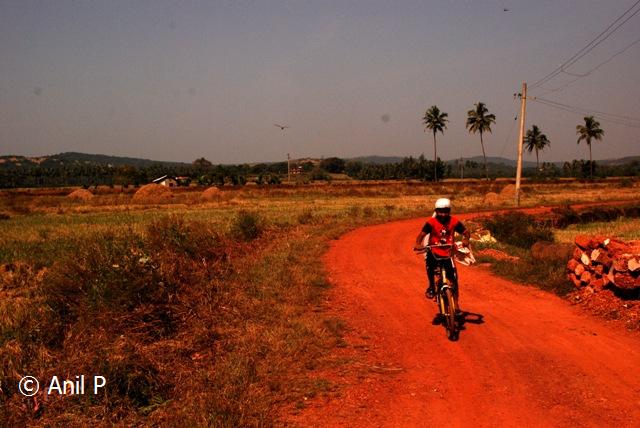
From the house in the shade of trees,
A little boy in red cycled down the winding dirt road.
Past harvested fields and coconut trees he rode
Clasping an empty bag against the handle,
As he flew down the stretch.
With the loose end of his bandana bouncing behind him,
He pedaled furiously and was soon upon us.
But before I could ask him
What it was his mother had sent him out on an errand for,
He curved past me before turning into a blur on the road
We had ridden along on our way to the river Zuari.
When you’re young and raring, any road will do.
And freedom is pedals under your feet,
A set of wheels at your command,
And an excuse to hit the road away from home.
At the turn of the century I returned to Bombay from Goa, not an easy decision to make. A software company let me in, then another, then yet another. Time ran past. This time around I was wise enough not to give chase. So occasionally I take my camera along, searching for corners, finding them where none exist. And some of them are painted blue.