
This time last year the rains had settled down in Mumbai, having traveled up the West Coast early in the season.
So when we left for Bangalore we did so under a sky that had changed from a salubrious mischief monger to one of subdued obedience. The light had turned mellow, and birds were few and far between. Copper Pod and Gulmohar blooms were history, and not a trace remained on the streets of the colour the blooms had lent barely a month before.
I might have enjoyed the subtle nuances to the light if not for the threat the skies held out. If we did not have to travel some distance before boarding the Udyan Express I might have actually preferred to sit by the window and look into the distance and watch the skies open up on the Yeoor hills nudging the Mumbai horizon. It is difficult to delight in the mellow light when rains threaten a wet experience.
The Udayan Express pulled into Kalyan Junction shortly after quarter past nine. We made the platform early in the morning, preferring to wait for the train in the morning din on a busy railway station than run the risk of missing the train. Nobody takes a chance in the Mumbai rains, more so if they’re transferring to a connecting train. I settled down in the hard comfort of the stiff seating the railway junction provides travelers. Milkmen got off suburban locals and balancing the large aluminum vessels on the head made for the exit. It was early morning rush hour, the time of day when the city of Bombay lifts itself up from the slumber of the night before and braces itself for the million embraces the local trains deliver into its weary lap. To stand there and watch the rush hour traffic without being a part of it for once warmed my cockles no end.
 The Udyan Express runs over 1200 kilometres between Mumbai and Bangalore, the journey lasting twenty-four hours as the train passes through Pune, Solapur, Gulbarga, Yadgir, Raichur, and Guntakal before pulling into Bangalore City Junction at nine the next morning. Beyond Raichur it enters Andhra Pradesh, passing Adoni, Guntakal Junction, Gooty, Anantapur, Dharmavaram Junction, Penukonda and Hindupur before entering Karnataka again. From Hindupur, Bangalore lies three hours away.
Along the way scores of stations flash by, small outposts in the hinterland of Maharashtra and Karnataka, and a small stretch of Andhra Pradesh, passing villages and towns, crossing rutted roads at railway crossings and chugging along vast fields of standing crop, and elsewhere freshly plowed fields.
Ploughing deeper into India the terrain would change to a dusty brown, sometimes a rocky grey.
I was looking forward to the run across the country. The window was to be my companion for the length of the long journey.
I looked out the window as the train left Kalyan before walking down the aisle to the door. Wedging myself against it, with camera at the ready, I watched the Western Ghats mountain ranges slide away in slow motion in the far distance.
In the foreground rice fields shimmered in the latent glow of the monsoon morning. Large electricity transmission towers rose from the fields and every once in a while children, walking on mud bunds separating squares of rice fields, reflected in the water, making for a doppelganger effect in the reverse, images that were reminiscent of rural scenes from black and white pictures of years ago.
All along, farmers, ankle deep in the slush of the paddy fields laboured behind pairs of bullocks, ploughing their fields in slow motion. Every once in a while scenes of village folk bent at the waist, planting rice crops, flashed past. Plastic tied around the head they rarely straightened up to watch the train go past. However the children did, waving to passing trains. Watching farmers at work invariably makes me wonder how it must be to be connected so elementally with the earth, smelling its fragrances, and working it for sustenance. India is among the largest consumers of rice in the world.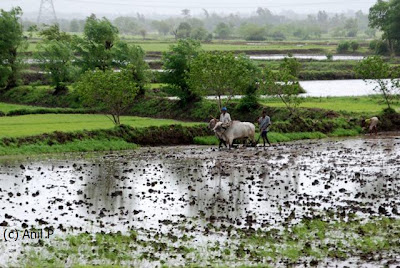
As the train made its way toward Karjat, the earth yielded patch after patch of peaceful scenes of rice fields getting ready for the Kharif crop, also known as the monsoon crop since it is sown in the monsoons. Sugarcane, Maize, Cotton are among the other Kharif crops. Beyond Kalyan it wasn’t until we crossed Badlapur that rice fields made an appearance in significant stretches, the scene repeating itself as we passed Vangani, Shelu, Neral, and Bhivpuri Road. Beyond Bhivpuri Road lies Karjat at the end of the coastal plains of the Konkan. Located on Bhor Ghat, Karjat is known for the largest concentration of farm houses in India, and lately it’s been in the news for the film studios located on its outskirts.
A little over an hour separates Kalyan from Karjat. All along the route the Western Ghats mountain ranges, also known as the Sahyadris, stretched in the far distance, unfolding like a curtain as the train covered ground on its onward run even while hiding from view the terrain on the other side, in the rain shadow of the Sahyadris.
Beyond Karjat the rice fields would make way for the mountain ranges, bringing them much closer than at any other point in the journey. However there was still time before they would rear mightily within view, staying with the train as it made up the incline, helped by the extra engine hooked to the first, before turning south-east in the direction of Pune.
I prepared to photograph rice fields on the run to Karjat and the mountain ranges thereafter. A polythene cover was at hand to wrap the camera with when the wind brought in the rain through the door.
It is difficult to make out faces of Oxen tilling the fields except through the zoom. Usually there isn’t much to separate the two bullocks by size so there’s not much one can deduce in terms of their temperament. It’s a little game I play with myself when I stand at the door as the train slices farmland in the sowing season.
I imagine a little white star on the forehead of an Ox to indicate a blessed soul who wears his blessing with little pomp as if it were his right and he is fine with displaying it to the world. But I was stumped by a pair of bullocks I saw in the field one of which had a white face. It might not have jarred as much if there was some continuity on the rest of its torso. There was not a hint of white elsewhere except for the face; the rest of its torso was a mix of brown and black. There could not have been a greater contrast in colours. This was a first for me. It was as if the head and torso from two different Oxen were joined together. I wondered if it had a split personality.
The cattle were oblivious to the train as it thundered past more rice fields. Between Kalyan and Lonavala the train would make a stop at Karjat. I looked forward to seeing the khaki-shirted Diwadkar Vada Pav wallahs complete with red sashes running across the front of their shirts. They wear the red sash with Diwadkar printed in the Devanagari script on the front, to the back the brand name is printed in English. The Diwadkar Vada Pav vendors are unique to Karjat and are not to be found elsewhere on the Mumbai Suburban Railway Network.
On railways stations elsewhere in Mumbai and adjoining suburbs Vada Pav stalls are run from railway platforms. Typically a tender process identifies the most favourable bids and depending on the number of stalls allocated for each station the eateries commence business,  turning profits quickly as office goers and other travelers make a beeline for the snack. Vada Pav is arguably the most favoured snack on railway stations on the Mumbai Suburban Railway Network. Vada is a potato-based patty savoury made from mashed potato that is rolled into balls before before being dipped into spice-seasoned batter of gram flour and deep fried. Eaten with Pav, a type of bread, it is filling. It is garnished with chutney that can alternate from moderately spicy to very spicy.
 As passing trains pull into Karjat the khaki clad Diwadkar Vada Pav vendors take their positions with practiced ease, two to a bogie. Placing metal stands on the platform they rest their stock of Vada Pav and a packet of chutney, carrying the brand name Diwadkar Foods, in a rectangular metal tray with straps.
At other times they carry the metal stand on their back and dispense Vada Pav from the metal tray that is slung from their necks.
Preparing Vada Pav is a skill that comes with practice. Usually it is the garnishing that distinguishes Vada Pav preparations. Diwadkar’s chutney is red but not as spicy as the red suggests.
It had rained a short while ago, leaving a fresh feel to the trees and the road that runs parallel to the tracks. Vegetable vendors sat by the edge of the road with baskets of fresh looking vegetables. Vegetable vendors bring the streets alive. Baskets of fresh vegetables lend a hint of fertility to what might otherwise be a stretch of dull, unyielding asphalt. Moreover it makes for a reason to walk the roads checking each basket for vegetable varieties sourced from diverse farms, bargaining over prices. In time regular customers develop nodding familiarity with the vendors, exchanging smiles all around. It is an experience actually.
On leaving Karjat, where extra power was added in the form of a second engine, I had little less than two hours to photograph portions of the Western Ghats mountain ranges for, the train after crossing Palasdari makes its way past Thakurwadi, then up Monkey Hill before passing Khandala and then Lonavala. From here it’s not long before it leaves the Western Ghats behind, entering the Deccan Plateau on its way to Pune.
At Thakurwadi a temple dedicated to Lord Hanuman appeared in the middle of nowhere. Painted pink it stood out in the greenery. The paint was running loose in the downpour. An elderly villager clad in a wrap-on and a blouse made her way up an incline that ran parallel to the track. The villagers usually build their homes in clusters, the sloping roofs merging in the backdrop of the mountains. Occasionally homesteads will emerge from isolated patches of farmland, fenced with stems sourced from surrounding vegetation. In the rains it’s not unusual to find fences sprouting life.
A light rain fell outside. I took a deep breath, filling my lungs with mountain air. I was joined by another passenger at the door. He simply stood there and gazed at the mountains that seemed to stretch, and stretch, and stretch all the way. Waterfalls cascaded down the mountains, striking white against the deep green of the foliage, indicating they fell violently.
The western edge of the Deccan plateau ends in the Western Ghats (also known as the Sahyadri mountain ranges) that run north to south along the edge of the plateau, stretching all the way from the Gujarat – Maharashtra border, through Goa, Karnataka, Tamil Nadu, and Kerala, about 1,600 kilometres in all. Sahyadri means benevolent. At 1,200 metres on the average the Western Ghats are not among the tallest but what they lack in height they more than make up with their rich bio-diversity.
But from where I stood at the door of the train, watching the ranges up-close through my lens, tracing waterfalls that fell from great heights down sheer rock faces, and elsewhere emerging from dense foliage covering the near vertical drops, I was reminded of the ferocity of river Mahdei from a trekking camp in Goa years ago. I had only just escaped drowning by the thinnest of whiskers. Nobody had expected me to get out alive.
The train trudged up the incline. It had only a short distance to go before it would veer off into the plateau in the direction of Pune, leaving the core of the mountain ranges behind. I tried counting the streams cascading down the mountains for no particular reason. I could not hear them. They were too far for that. I wished I had carried my field glasses. A 10x50 might've brought them upclose. I wonder if these outcrops have been sufficiently explored, for if my experience trekking the Western Ghats is anything to go by I wouldn't be surprised if explorations were to reveal ancient temples lost to time.
It had stopped raining on the route but in the distance I knew from experience that come monsoon it rarely stops raining in the mountain ranges, swelling rivers that eventually feed peninsular India, among them are the Godavari, the Mandovi, the Krishna, the Cauvery, and the Zuari. At their source the numerous streams descend quickly from the heights before they roil in the violence of the monsoon. Rice fields were now few and far between. As the gradient steepened we left the plains behind. Even as dense vegetation blurred features of mountains in the distance I rewound to images of paddy fields I had seen earlier in the journey. Other images from long ago of children playing in the fields, pausing to wave at the train as it roared past them came to my mind, leaving a warm feel behind.
For some reason each time I’m on a train passing through vast fields in the Indian hinterland I’m reminded of the unforgettable train scene from Satyajit Ray’s classic Pather Panchali when Apu and his sister Durga ‘discover’ a train in a field of Kaash flowers.
Born into an accomplished Brahmin family himself, second to none in their achievements in the Arts, Ray’s Pather Panchali (Song of the Road) is a story of a poor Brahmin family from rural Bengal in the early twentieth century and charts the story of Harihar Ray’s impoverished family struggling to make ends meet. In a backdrop as grim as this the film belies the seeming futility of their existence with its portrayal of Harihar Ray’s children, Durga and Apu, as alive to possibilities of life, and ever ready to imbue meaning into the simplest of things that simply being alive had to offer. Riding on their unaffected childhood innocence that manifests in their discovery of the world beyond their immediate circle of life the film unravels time to the pace of Durga and Apu’s life, and nowhere more so when Durga and Apu find themselves in a field of Kaash flowers, possibly drawn to the humming of high tension electricity wires, only to hear an unfamiliar sound carried their way on the breeze. Never having heard a train before Durga stills herself, her eyes having averted to a non existent visual frame before her, only the occasional jerk of her face in the direction of the sound indicating she was seized of the unfamiliar, and Apu having gone quiet, looking for cues in Durga’s absent gaze presses his face to the high tension electric metal pole even as the Kaash flowers sway gently to the breeze now bringing the mystery to the fore.
 Seconds turn to minutes and as Durga breaks into a run to meet the mystery, Appu follows her. There among the head high flowers they pause unsure of the direction the sound was coming from, their heads still, the sound grows louder, and in the split passage of a moment on the threshold of unfolding the unknown, realization dawns, and their heads jerk to their right just in time to catch sight of thick black smoke in the distance gusting back above the heads of Kaash flowers, the engine and coaches hidden from view. Pushed back by the force of air yielding to the train’s momentum as it hurtles across the plains, the swirling black smoke might as well have been a demon snorting rage. Appu breaks into a run to meet his defining moment as he comes face to face with a steam locomotive for the first time in his life.
In that one moment of sprinting innocence I understood the Indian hinterland from a different perspective and my travels by Indian Railways were never to be the same again.
July 20, 2008
Through Karjat by the Udyan Express

July 10, 2008
Red Shirts of a Different Kind

Each time I catch sight of sprightly railway porters (also known as coolies) in bright red shirts and shiny brass armbands sporting license numbers on bustling railway platforms as they take their positions, usually one to a bogie when the train rolls into the station, I’ve mixed feelings.
 On the one hand I’m reminded of Coolie, the role Amitabh Bacchan essayed in the film by the same name, barely surviving an accident on the sets. In a dialogue from the film he famously declared “Bachpan se hai sar par Allah ka haath, aur Allahrakha hai mere saath; Baazu par hai saat sau chhiyaasi ka billa, bees number ka beedi peetha hoon, kaam karta hoon coolie ka aur naam hai Iqbal.”
 For years the film instilled a sense of pride in railway porters otherwise accustomed to a life devoid of meaningful dignity, and occasionally respect, the lack of which is often glimpsed in heated arguments with harried customers over fees for transporting luggage from the train to the taxi stand and vice versa, and the butt of the occasional derisive comment.
The flip side can be a nasty experience with aggressive porters upping the price after transporting the luggage to the train, a situation rendered delicate if the train has sounded its horn to indicate imminent departure. The more enterprising among them will launch themselves into moving trains to be the first ones into unreserved compartments before quickly spreading their towels on unreserved seats, to be “sold” to passengers with valid tickets. I’ve had my share of confrontations on the occasions I had to travel by the General Compartment. One journey I remember traveling for six hours sitting on the footboard because there was nowhere else to sit.
At Victoria Terminus, and as with other railway stations, it is not uncommon to catch sight of porters (or coolies) demanding money from clueless foreign tourists for ‘helping’ them locate their train and the compartment.
Nevertheless it can be hard work for, the very nature of Indian Railways and the people who travel by it ensures that the railway porter’s job remains a demanding one. Even with light luggage, scurrying up the stairs and through crowds to the waiting train can be quite a task for a seasoned traveler, let alone a porter with heavy luggage stacked on his head while zigzagging through crowds. It gets trickier if the client arrives late and has only a few minutes to board the train.
Those of us who saw Coolie will remember the song
Sari Duniya Ka Bojh Hum Uthate Hain
Log Aate Hain Log Jaate Hain
Hum Yahin Pe Khade Reh Jaate Hain
Chaar Ka Kaam Hai, Ek Ka Daam Hai
Khoon Mat Pijiye Aur Kuchh Dijiye
Ek Rupaiya Hai Kam,
Hum Khuda Ki Kasam
Badi Mehnat Se Roti Kamaate Hain
Sari Duniya Ka Bojh ...
(We carry the burden of the world
People come, people go
We’re left standing here
We do the work of four for the price of one
Don’t drink our blood, give us a little more,
One rupee is less, I swear on God,
Earning our bread is mighty hard work
We carry the burden of the world ...)

On train stops along the journey I often get off and saunter on railway platforms for the joy of the hustle and bustle that is characteristic of Indian railway journeys. There’s so much to see that at times it is as if I’m at a play where I visit different theatres by turn to catch the entire story. It can be surreal.
A year ago on one such train stop at Pune on our way to Bangalore I got off the Udayan Express (6530/6531) that runs between Bombay and Bangalore to take a few pictures of railway porters napping on hand carts in the afternoon. There I met Nandu and Vilas, two Marathi speaking porters. Within moments we were surrounded by the rest.
Vilas, the elder of the two said though the job has become demanding in terms of competition it is possible to make a living on it for, more of India now travels by trains. A few of them were at the ‘drinking water’ taps. From the look of it they’d just finished eating their lunch. On finding none of the porters approach any of the passengers disembarking at Pune I became curious.
“Passengers from Mumbai getting off at Pune will rarely hire porters to carry their luggage,” Vilas explained. Pune is pre-dominantly Maharashtrian.
Nandu, the younger porter listened on, as Vilas continued.
“It is possible to eke out a living for a couple and two kids in this job, but not if you’ve habits (an Indian euphemism for addiction to vices like alcohol, cigarettes, gambling, ladies bars, and women on the side among other things).”
As the train sounded the whistle I made an offhand comment as I prepared to leave, “Too many trains now as compared to before.”
Vilas smiled before saying, “Lots of trains yes, but only if folks use our services will money pass hands else not.”
I smiled in turn before sprinting to the door just as the train pulled out of Pune.
June 30, 2008
Hard Lessons

The art gallery, with its four exhibition halls, is helped by its location. No one who visits the heritage precinct of Kala Ghoda can miss seeing it. So, tourists visit the gallery in droves. Some get curious after seeing others walk in, and hence follow suit. Yet others hesitate, wondering if they’ll be allowed past the entrance before mustering courage and making their way up the steps.

After visiting an exhibition one late afternoon I stepped out of the gallery and was about to run down the steps and across the road in the direction of the David Sassoon library but stopped short on seeing a lady posing for the camera against the backdrop of the art gallery. Her little daughter stood on the road with a point-and-shoot while she posed patiently, waiting for the shutter release, to be indicated by a flash, though there wasn’t a need for one in the late afternoon light. Seconds passed, no flash, more seconds passed, still no flash. A touch edgy, she walked up to her daughter and after a few quick instructions she returned to her spot and struck a pose. Her husband stood to the side watching on.

The little girl brought the camera to her face. Behind her, cars motored past. More seconds passed, still no flash. I watched from the steps, willing the little girl to get it right, for I knew it must mean a lot to her to be able to point to the picture later and tell whoever would listen that she’d taken the picture of her mother in front of the art gallery. Yet more seconds passed, still no flash. By now the mother was getting visibly irritated, and after walking up to her daughter for the third time she returned to her spot and struck a pose. Nothing happened. The little girl tried, but the camera would not yield.
The lady strode up to her little daughter in a huff and snatched the camera from her reluctant hands before turning it over to her husband. The little girl dropped her gaze to the road as her mother led her to the side, by a parked car. Her father took her place. Her hands by her side, she watched her mother strike a pose for her dad.

Seconds later, the camera flashed.
I wonder if later that night the little girl wished she would grow up quicker.
June 14, 2008
Forever

Every once in a while
Wandering souls will pause,
In a timeless moment of togetherness.
There, floating on the wind,
Moments from centuries ago
Whisper in willing ears
The story of a king mourning his love.
June 10, 2008
The Long Road

At times it is not so much the milestones but the length of the journey that brings meaning to traveling.
June 04, 2008
River Crossings

Each time I take the ferry across the Mandovi to Piedade on the island of Diwar I return refreshed.
From the time the passenger ferry glides across the Mandovi to where I wait under the shade of coconut palms in a light breeze wafting across the river, stirring the placid waters into shy ripples glinting gold as they catch the Sun, I delight in the languid pace of life before making my way down the sloping ferry ramp to the gangplank the ferry’s crew lowers to discharge passengers from Diwar for passengers to Diwar.
Eyes squinting in the harsh noon light, waiting passengers quickly make for the ferry after having waited in the heat of the afternoon Sun at St. Pedro in Ribandar, off the Panjim – Old Goa road. The Goa Institute of Management (GIM) that was formerly known as Santa Casa da Misericordia (The Holy House of Charity) or The Royal Portuguese Hospital lies nearby. It was also known as the Ribandar Hospital. Until 1993 it was the campus of the Goa Dental College before making way for the management institute.
Each time I pass the heritage structure by bus I wonder why it was not set back further from the road so people could admire its façade. The banks of the Mandovi lie only a few metres away. Occasionally a few boats can be found anchored to a small jetty that abuts the road as it passes by the former hospital. In the night it is not uncommon to find lanterns in the cabins of these boats. For years I would lookout for the lanterns as the bus made the corner by the former hospital on its way to Old Goa and beyond. Sometimes as I wait in the Sun, watching the ferry leave the shores of Diwar in the distance, Redvented Bulbuls in nearby trees catch my attention, so do Kingfishers that perch on overhanging branches scouring the waters for sign of fish. Other times I watch large barges ferrying iron ore from Goa’s open cast mines that account for over 60% of India’s iron ore export, their massive flanks the colour of rust, an occasional burst of horn shattering the peace of noon as they keep to the middle of the river, sometimes going upstream, other times downstream of the Mandovi estuary.
 Usually only a few people are about as the ferry sweeps an arc on the river after leaving Diwar before straightening up in the direction of Ribandar. On weekdays office goers returning to their homes in Divar ready their scooters, motorcycles and cars as the ferry glides to a stop on the gangplank making noisy contact with the sloping ferry ramp, occasionally jarred by the impact as it slides up the ramp to the sound of the engine winding down.
Once the ferry empties of passengers and their vehicles it is boarding time. The crew is at hand to direct the passenger traffic onto the flat-bottomed ferry. Then the levers snap into action as cables reel in, lifting the gangplank as the ferry pulls away in slow motion. Soon land recedes in the distance as the engine throbs to life, cutting through the water swiftly. Every once in a while I lean on the side of the ferry and rest my chin in my palms and watch absently at the wake the ferry churns up as it glides to its destination across the river. The island of Diwar that was to my back as the ferry pulled away from St. Pedro now swivels to the front as the ferry makes an about turn mid river. A swathe of mangroves hides the island in the distance. Upstream of the Mandovi, tributaries that feed it now run steady after the heady monsoon months when runoffs coursing down the slopes of the Western Ghats mountain ranges into its tributaries swell the Mandovi, raising her water level upstream. It is late January now and the South-West monsoon is still a good five months away.

As the ferry approached the island of Diwar mangroves loomed large. Travelers heading to Piedade, a village in Diwar, got off the ferry.
 Strung around bamboo sticks the fishing nets attract Egrets and Herons and they can be found perched on the nets hunting fishes trapped in the nets as the tide goes out. Within minutes the ferry was empty of travelers. A fifteen-twenty minute wait for passengers headed in the opposite direction, to Panjim and elsewhere, and the ferry would embark on its return journey, criss-crossing the river route before calling it a day at ten in the night.
Given a choice I would chose a ferry crossing over that by bridge any day even if it means sitting on the riverbank late in the night for the tide to come in and bring the ferry over like the night at Surla-Maina years ago. Returning home with my parents I spent the time squatting on the approach road with dozens of travelers watching for signs of the incoming tide while identifying the stars and constellations overhead in-between even as we made new friends that day. When the tide came in three hours later, bringing with it the ferry that would take us to Volvoi I was disappointed at having to leave behind what had been a perfectly delightful wait on the quiet riverbank where water lapped the landing rhythmically. Away from the highways Goa goes quiet in the night. Streetlights along narrow roads keep travelers company at intervals, welcoming them with their shadows that shorten to a point as they pass underneath the tube light, lengthening behind them as they move away.
Another time returning with my friend late one night we made for the Amona – Khandola ferry only to find the ferry anchored for the night, having made its last run for the day. Fortunately for us the crew was still around. A request and a sympathetic nod later we rode over the gangplank as the engine came to life. I don’t remember it sounding sweeter than it did that night under the stars. In the distance lights flickered beyond the banks, growing brighter as the ferry glided over the still waters to Khandola. It must have appeared like a hulking apparition to anyone out on the banks that night. A bridge now spans the ferry route.
Ferries between Panjim jetty and Betim used to run full in the days following the collapse of the bridge over the Mandovi in the mid-eighties, just two months after I expressed fears over its stability to a fellow athlete as we ran over it on our morning run from Campal to the incline beyond the bridge that leads to Maphusa. “This bridge will fall someday soon,” I had remarked to him as we willed our weary legs over it. Two months later it went down. Ferries were then pressed into service to take travelers over the Mandovi. Watching passengers and vehicles at Panjim jetty crowd the flat bottom carrier headed for Betim across the river I would say a quick prayer and will the ferry over the Mandovi safely.
 The only ferry route I swore off was the one connecting Dona Paula to Mormugao. Actually I do not remember it to be a flat-bottom ferry; it was more of a boat that could hold about 25 passengers. One monsoon day the ferry nearly tipped over in the rough seas. We were thrown off our seats as it began to see saw in the tumultuous waves. As we scrambled to right ourselves, reaching for support to steady our footing, the waves deposited sea water in the boat. Someone passed a bucket and the seawater went right back, arms scooping the water furiously. Overhead the clouds darkened as the rain pelted us. Looking back now I’m inclined to believe that ample screaming and vomiting by passengers eventually convinced the wind gods into letting us survive the journey. It took me the threat of impending exams at school to eventually cast those memories away to the back of my mind.
Among the ferries I’ve ridden over the years the one over the Terekhol in Pernem is among the more memorable experiences I’ve had. The Kiranpani – Aronda ferry over the Terekhol bridges Goa and Maharashtra respectively.
Kiranpani perches on the very edge of Goa’s northern boundary with Maharashtra so, it was only natural that folks crossed over to Maharashtra by night, smuggling in essential commodities from across the border into Goa during the blockade by the Indian Army of the Portuguese ruled Goa. To get to the Terekhol fort we boarded the ferry at Kiranpani for Aronda across the Terekhol river, passing through a sliver of Maharashtra at Redi where Usha Ispat has located its Pig Iron plant. Then we crossed back into Goan territory as we neared the Terekhol fort. From here the Arabian sea swirls around a near 360 degrees. The fort is now a luxury hotel.
 When we reached Kiranpani early in the afternoon we saw migrant labour busy in extracting sand from the river, depositing large quantities of it along the banks for trucking it out to construction sites. Demand for sand is high in the booming construction industry; more often than not the sand is extracted illegally. On our way back from the Terekhol fort through the portion of Maharashtra that separates the mainland of Goa from its other portion, a small one, we stopped at what was a small village shop for directions to an eating place that might be open for lunch. An elderly man stood behind a row of bottles that held confectionery among other things. He spoke Konkani well and was running his shop from a room to the back of his house.
“If you want we can make food for you here,” he said. Surprised to hear the shopkeeper offer us the option, but glad nonetheless, we nodded and went in and made ourselves comfortable on two planks of wood hewn into rudimentary benches. His wife, an elderly lady, got to work preparing lunch. Few places I’ve eaten since can beat the authenticity of that meal I had that day. Then we crossed back into Goa and hit the road.
From Kiranpani, Vengurla and Sawantwadi in Maharashtra are twenty-odd kilometers away. Pernem is the last stop for trains out of Goa, heading up the West Coast. Each time I take a train out of Goa or enter the state I make for the door as the engine hurtles over the huge spans bridging the Terekhol. The tone changes to a distinct metallic as I peer down at the river and wonder if the river is indeed so green as to have a golf course at the bottom or is it that my eyes are playing tricks on me. Coconut palms fringe the waterways, and in the distance every once in a while I spot ferries making river crossings.

For sheer visual drama few ferry ramps can beat the one at Narwe (Naroa) in Bicholim where the rail bridge over the Mandovi reverberates as trains hit the Konkan trail. The ferry ramp is fairly close to the bridge and passing trains make for a heady spectacle as if floating in the sky. As May gives in to June, and June to July clouds come in from the West in great numbers, spurred on by the South-West monsoon winds. In the backdrop of white puffs sailing in the sky, the sight of trains speeding over the metal spans high up in the sky stir imagination, and waiting at the Naroa (Narwe) ferry point for a ferry to take me to Diwar I’ve often willed trains into passing that way just so I can look up and marvel at the unfolding scene.

Looking up to watch a train pass over a bridge up-close is different from watching a train pass over a bridge in the distance where it becomes part of the landscape, an element that is as much a part of the bridge as the bridge is part of the earth that holds it up. But up-close against the backdrop of a summer sky, the pillars are transformed into fingers of an open palm nudging the train into taking wings and sailing away to a faraway land. In the silences to be found in the far corners of Goa, the real very often seems unreal. Out there landscapes make you their own.
The few times that I’ve taken the ferry out of Narwe to Diwar I’ve had only a traveler or two for company waiting for the ferry. The sparse numbers may have to do with the time of my journey as ferries usually run full in the morning and evening hours when the traffic is largely made up of office-goers.
As the train emerges from the tunnel at Old Goa on its way up North it first clatters over the bridge spanning the Mandovi at Old Goa before crossing over into Diwar. After a short run through Diwar among paddy fields it passes over the second rail bridge on the Mandovi, entering Bicholim at the Narwe – Diwar ferry point, where if let your imagination fall in step with the rhythm of the train chugging over the bridge you can see it sail away with the clouds.

On its run through Diwar the locomotive cuts through paddy fields and open landscapes where birds of prey circle in the sky and water birds emerge from mangroves along the Mandovi.
 A large Egret will flap its wings and ascend before gliding to a stop in the thick of mangroves or a Red-wattled Lapwing will give away its location with its sharp cries. It’s not uncommon to find Serpent Eagles and Brahminy Kites glide overhead in the blue skies nor an occasional Shikra as it breaks cover and whistles past in a blur.
On electricity wires along the narrow road that splits a paddy field into two, Drongos, and Small Green Bee-eaters abound, and so do Swallows and Roller Jays.
In the late afternoon light the grass are a burnished gold.

On our way back home from Diwar we headed for the other ferry that connects Diwar to Old Goa across the Mandovi. We drove past pretty houses to the center of the village of Piedade, then turned right. I kept my eyes peeled out for a roadside inn I used to stop for a plate of pao-bhaji once in a while. Ganesh Naik ran a small eatery in his house from a room that fronted the Dumo Shet road. Soon enough after we passed a group of boys busy at cricket in an empty paddy field the inn emerged in the shade of a leafy tree by the road. A radio was playing film songs. We made for the other table to the back of the room. The one by the door was occupied by a villager in shorts sipping tea. There were only two tables in the small room.
“What bhaji do you have on the menu?” I asked Ganesh.
“I’ll need to check if there’s any left,” he replied before disappearing into the adjoining room.
Emerging from the room he said, “Patal Bhaji, sufficient quantity.”
“Ok, we’ll have three plates, with pao (a type of bread). Is the bhaji hot?” I asked. He nodded and went back in. We sat listening to the radio, occasional crackles bringing alive the silence on the road outside.

We asked for a second round of helpings and listened to a few more songs on the radio. Sated we made for the door, bending to avoid the sloping roof before stepping out. Then we made for the ferry, this time further upstream from the one we took out of St. Pedro for Diwar earlier in the day.
As the road slipped under the wheels, the rail bridge at Old Goa that trains on the Konkan Railway heading out of Goa take appeared to our left, its metal girders glinting silver in the evening light that cast grassy stretches in pale gold. Water bodies acquired a rich hue, tones that might have quickened the pulse of landscape artists. We stopped on the way to count a large flock of water birds that had settled on a bund that ran across a stretch of water in the backdrop of the bridge. There were one hundred and thirteen of them. We could not land a positive identification. We got back on the road and made for the ferry ramp. The ferry was mid-river and heading our way. It would now take us to Old Goa, in the backdrop of the railway bridge over the Mandovi.
Across the river churches and cathedrals of Old Goa peep out from among the mass of coconut palms fronting the Mandovi. On this very river, probably on this very stretch events that made history etched Goa with blood, irrevocably changing it.
On the surface there’re no knowing how deep rivers run or what stories they hold.

The setting Sun nudges our ferry on its journey across the river, and we are away.
Note: Goa operates ferries on twenty-two routes. Typically two ferries operate on a given route, crossing one another mid river. Routes with less traffic are serviced by a single ferry. Among the routes operated by ferries are: Calvim – Carona, Keri – Tiracol, Pomburpa – Chorao, Aronda – Kiranpani, Panaji – Betim, Siolim – Chopdem, Ribandar – Chorao, Kamurlim – Tuem, Ribandar – Piedade, Aldona – Corjuem, Old Goa – Piedade, Amona – Khandola, Vanxim – Amboi, Volvoi – Surla-Maina, Naroa – Diwar, Cortalim – Marcaim, Cumbarjua – Gaundaulim, Durbhat – Rassaim, Sarmanas – Tonca, Raia – Shiroda, Dona Paula – Mormugao, and Assolna – Cavelossim.




